
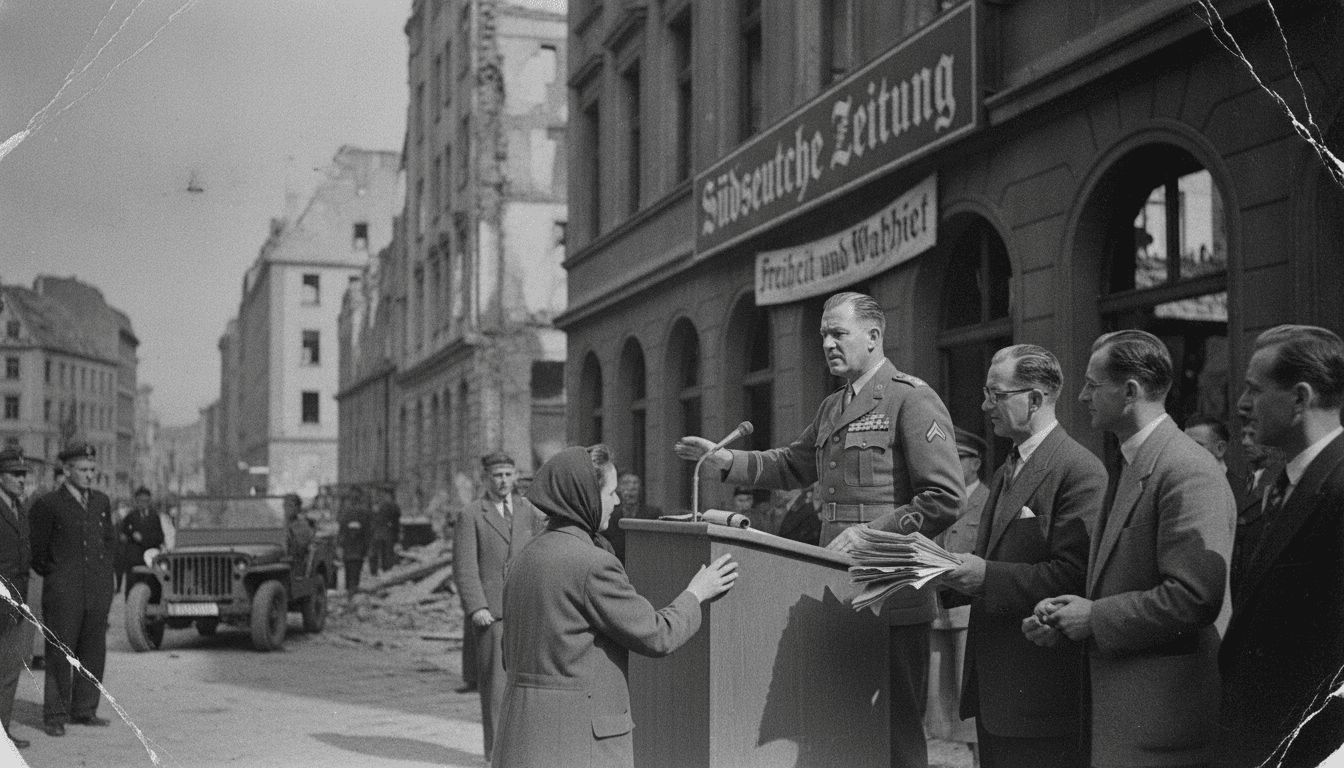
Süddeutsche Zeitung founding: How US License No.1 and McMahon’s Order Shaped Bavaria’s First Postwar Daily
Süddeutsche Zeitung founding in 1945 began under US License No.1 after a directive to eradicate Nazi influence from German public life, launching the paper five months after the Third Reich collapsed. The new Bavarian daily was established under the supervision of U.S. occupation authorities who sought to foster democratic journalism through freshly licensed publishers and editors. Those early ambitions, however, met practical and political obstacles that delayed the broader cultural and institutional transformation the license intended to trigger. The paper’s origin remains a defining moment in the reconstruction of German media after World War II.
Occupation Policy and the Licensing System
The Allied occupation authorities instituted a strict licensing regime to control who could publish newspapers in the immediate postwar period. Licenses were issued selectively to journalists and publishers who were deemed not to have been compromised by Nazi ties, and the goal was to cultivate a press that would support democratic values. In Bavaria the United States took direct responsibility, setting the terms and tone for reconstruction and public re-education. In practice, the licensing process mixed idealistic aims with pragmatic choices born of scarcity, local power dynamics, and the urgency of providing reliable news.
Colonel McMahon’s Instruction to Founders
On October 6, 1945, Colonel Bernard B. McMahon delivered a stark mandate to the founders and editors of the new paper: to excise “the Nazi spirit, the spirit of militarism” from the hearts and minds of Germans. That instruction framed the United States’ immediate expectation of the press as an instrument of denazification and democratization. McMahon’s words were not merely rhetorical; they signaled an active policy role for occupation officers in shaping editorial direction and personnel decisions. For the newly licensed editors, the statement made clear that rebuilding a free press was inseparable from confronting the recent past.
License No.1 and the Launch in Bavaria
The Süddeutsche Zeitung appeared as the first licensed newspaper in Bavaria under License No.1, making its debut only five months after Nazi Germany’s defeat. Its emergence filled an urgent information vacuum and offered a platform for public debate in a region still reeling from military defeat, displacement, and institutional collapse. The license’s numerical primacy carried symbolic weight: it represented a formal break with the old regime and a tangible exercise of Allied control over who would speak to the German public. Yet the immediate circumstances of paper shortages, staffing limitations, and political uncertainty complicated the simple narrative of a clean break.
Editorial Reality Versus Democratic Ideals
Despite the ideal of “unburdened” journalists and publishers, the early Süddeutsche Zeitung faced constraints that limited its capacity to transform public attitudes quickly. Staffing the newsroom required experienced practitioners, and in many cases those available had complex professional histories. Supply limitations, censorship mechanisms, and the need to navigate local power structures also shaped editorial choices. As a result, the paper—and West German society more broadly—initially struggled to realize the full ambitions of denazification and democratic renewal set out by occupation authorities.
Long-Term Influence on German Press Culture
Over time, the Süddeutsche Zeitung developed into one of Germany’s prominent regional and later national voices, but its origin under occupation left an indelible imprint on postwar press culture. The licensing system established precedents for external intervention in media as a transitional mechanism, and the debates sparked by that intervention informed later conversations about journalistic independence. The paper’s evolution from an occupation-licensed organ to an established daily illustrates how institutions adapted to changing political conditions while wrestling with questions of continuity and rupture.
Historical Reflection and Public Memory
The founding moment of the Süddeutsche Zeitung continues to be a touchstone in discussions of media responsibility and democratic rebuilding in Germany. McMahon’s charge to remove militaristic and Nazi influences captures the moral urgency of the immediate postwar period, while the subsequent difficulties of implementation highlight the complexity of social transformation. As historians and journalists revisit these origins, the episode is treated both as an example of Allied efforts to shape postwar society and as a reminder of the limits of top-down cultural change.
Five decades after its founding, the Süddeutsche Zeitung stands as a product of both occupation policy and the incremental work of German journalists who navigated the fraught transition from dictatorship to democracy. The paper’s beginning under License No.1 and the clear, uncompromising directive handed down by Colonel McMahon mark a consequential chapter in the reconstruction of Germany’s public sphere—one where aspiration, constraint, and historical contingency intersected.
