
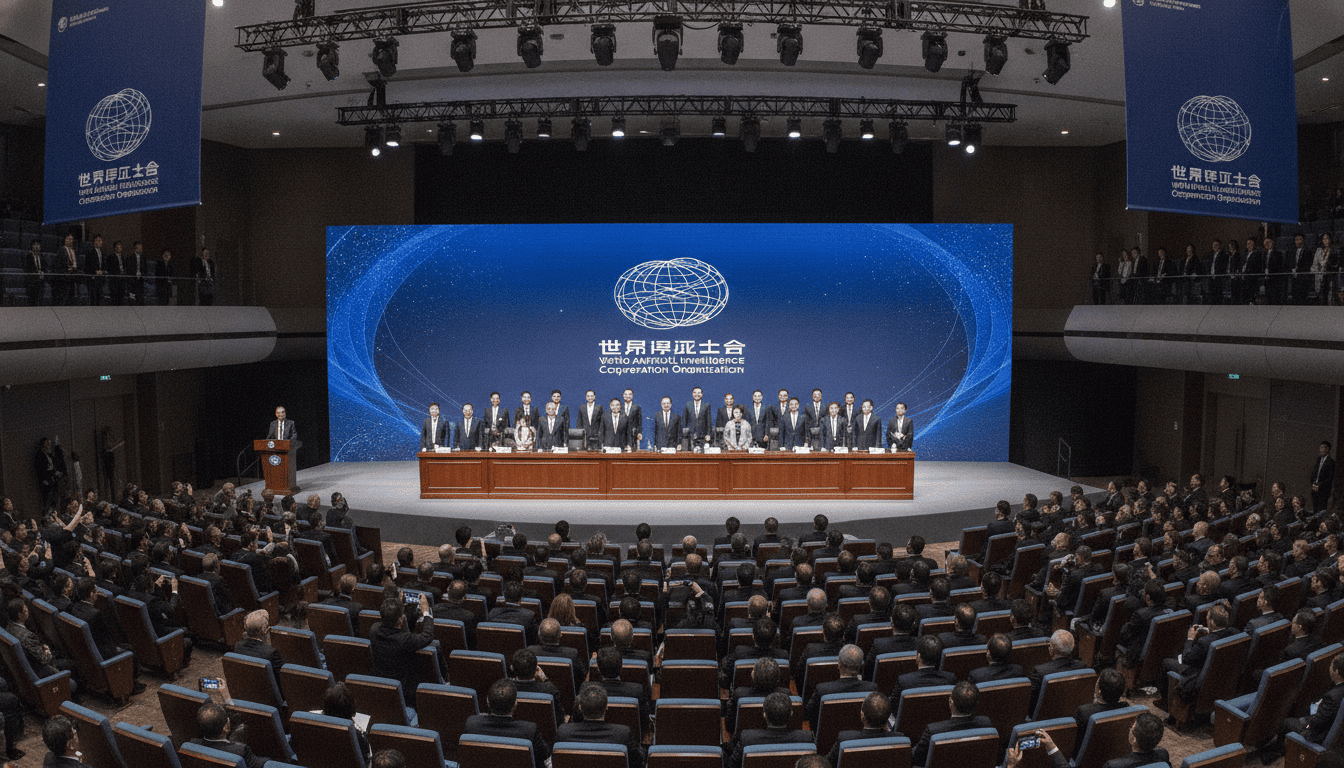
Xi announces World Artificial Intelligence Cooperation Organization as geopolitical tensions surface
Xi Jinping unveils the World Artificial Intelligence Cooperation Organization (WAICO) in Shanghai, aiming to set global AI rules while U.S. leaders voice warnings and markets react.
Chinese President Xi Jinping used his first personal opening of the World Artificial Intelligence Conference to announce the creation of the World Artificial Intelligence Cooperation Organization (WAICO), positioning Shanghai as its headquarters and placing AI at the top of Beijing’s strategic agenda. The announcement came almost simultaneously with comments in Washington in which U.S. President Donald Trump accused China of stealing voter data and attempting interference in the 2020 U.S. election, underscoring the geopolitical dimensions of AI competition. WAICO was presented as a vehicle for international cooperation on artificial intelligence, but the move immediately prompted scrutiny from diplomats, industry observers and financial markets.
Xi opens the World Artificial Intelligence Conference in person
Xi’s appearance marked the first time China’s leader has personally inaugurated the conference, signaling elevated political priority for AI development in Beijing. He framed WAICO as a mechanism to encourage rules and shared standards for AI deployment, arguing that development should proceed through international cooperation rather than unilateral action. In his remarks Xi cautioned against overusing the concept of national security to block AI collaboration, a line that observers read as a rebuke to Western export controls.
WAICO’s mandate and Shanghai headquarters
Officials presented the World Artificial Intelligence Cooperation Organization as an international body intended to promote cooperation, shared norms and the cross-border sale of Chinese AI technologies. The organization’s headquarters will be in Shanghai, and its founding participants were said to number 29 countries representing a mix of long-standing partners and larger developing economies. Beijing cast WAICO as an open-source-friendly platform intended to broaden access to Chinese AI models and tools.
Diplomatic skepticism and limited participation
Diplomats in Shanghai described the WAICO launch as opaque and hastily arranged, with several potential partners declining to join during initial planning. According to attendees, only Russia played an active role alongside China in shaping the organization’s early structure, and at least one African country joined only after the formal signing sequence. The United States publicly warned partner nations about the initiative, and several Western interlocutors expressed concern that WAICO could become a conduit for exporting China’s strategic AI assets under thin multilateral cover.
Industry reactions and immediate market signals
The conference coincided with the unveiling of a new model by the Chinese start-up Moonshot AI, which the company said narrowed the performance gap with leading U.S. players while stopping short of parity. The model announcement triggered sharp market moves: shares in public Chinese AI developers such as Zhipu AI and Minimax fell by double-digit percentages on investor reassessment of competitive prospects. At the same time, a Beijing-linked chipmaker, CXMT, prepared an initial public offering expected to raise roughly €7.5–8.5 billion, a planned deal that would be one of the region’s largest this year.
Regulatory posture inside China and export controls
Beijing’s domestic posture toward high-end AI development appears ambivalent: while presenting WAICO as outward-facing and open-source friendly, Chinese authorities have increasingly tightened controls on certain technologies. Regulators recently intervened in the attempted relocation of a domestic AI company and blocked a transaction that would have transferred assets to a foreign firm, actions that industry watchers interpret as steps to retain advanced capabilities at home. State discussions reportedly include potential limits on exceptionally powerful models and possible restrictions on foreign access to certain systems.
United Nations response and the global south alignment
United Nations Secretary-General António Guterres spoke positively about China’s open-source emphasis at the Shanghai gathering, describing it as a potentially constructive contribution to wider access. Several developing countries with large populations and growing digital sectors — including Indonesia and Brazil — were listed among WAICO participants, reflecting Beijing’s outreach to the global south. Still, some diplomats warned that alignment with WAICO could carry political and economic trade-offs given the organization’s close ties to Chinese state institutions.
The launch of the World Artificial Intelligence Cooperation Organization crystallizes competing narratives about the future governance of AI: Beijing pitches cooperation and broader access, while critics worry about strategic leverage, transparency and standards. How WAICO evolves — whether as a genuine multilateral forum, a vehicle for exporting Chinese technology, or a hybrid institution shaped primarily by Beijing and close partners — will depend on which governments and companies decide to engage and on the regulatory choices both at home and abroad.
Global markets and policymakers will be watching WAICO’s membership, governance rules and first initiatives for standard-setting, as those details will determine whether the organization mitigates fragmentation or deepens bloc-by-bloc divides in advanced AI development.
