
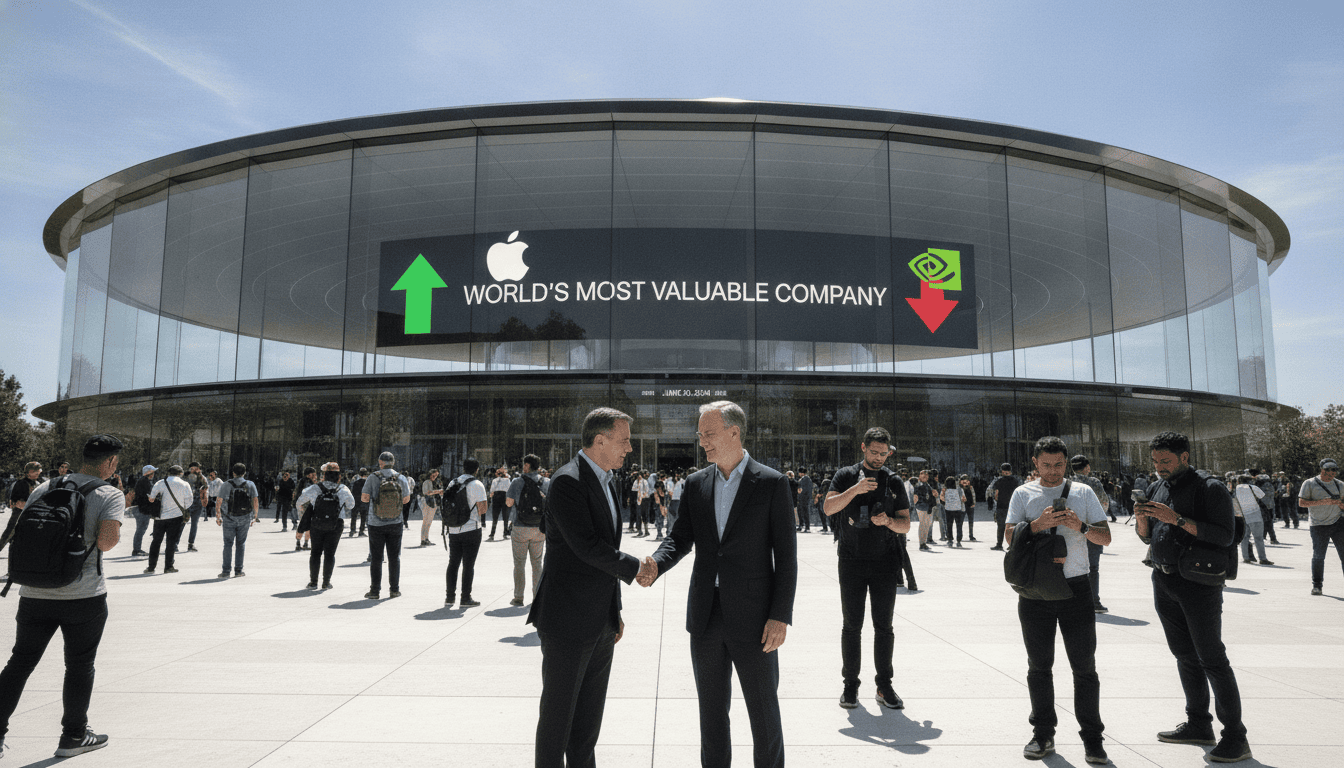
Apple briefly reclaims top spot in global market valuation as Nvidia falters
Apple briefly reclaimed the world’s top market valuation on July 17, 2026, overtaking Nvidia amid a mid‑day swing in share prices and investor concerns about AI‑chip valuations. The Apple market valuation surged past Nvidia’s for a short window, driven by a rally in Apple stock and a pullback in chipmaker shares at the U.S. open. Markets later trimmed the gap as Nvidia recovered some losses, leaving the two companies trading neck and neck.
Apple briefly tops global market valuation on July 17, 2026
On July 17, 2026, intraday pricing showed Apple’s market capitalization reach about $4.9 trillion while Nvidia’s valuation dipped to roughly $4.8 trillion, figures that briefly placed Apple back at the top of the world’s most valuable companies. The shift was short‑lived: as U.S. trading progressed, Nvidia regained some ground and the lead tightened. The episode highlighted how volatile headline rankings can be when valuations for mega‑cap tech stocks swing on sentiment and news flow.
Nvidia share slide at U.S. market open triggers the change
Nvidia shares opened lower in the United States, falling more than four percent at the start of trading and removing billions from the company’s market cap. Traders cited profit‑taking after a prolonged run and fresh skepticism about demand for the company’s high‑end AI chips. The decline in Nvidia’s price, coupled with gains in Apple stock, produced the momentary flip in the rankings.
Wall Street concern over an overheating tech rally
Analysts on Wall Street have warned that valuations for semiconductors and other technology firms have become stretched, prompting expectations of sector rotation. Investment strategists argue that the “bar” is set high for chipmakers that have benefited from the AI boom, increasing the risk of downward adjustments if revenue growth or margins disappoint. Some research firms expect mutual funds and institutional investors to rebalance toward other sectors if sentiment weakens further.
AI supply dynamics and Chinese developments exert pressure on Nvidia
Recent advances in Chinese AI models contributed to the market unease by suggesting developers may be able to progress with less dependence on the latest Nvidia hardware. Investors reacted to reports that Chinese firms currently rely largely on older, lower‑performance Nvidia systems, and to the prospect that software advances could reduce the premium for top‑tier accelerators. That combination of hardware access limits and rapid software innovation has injected uncertainty into Nvidia’s near‑term growth outlook.
Apple rally aided by new Siri AI announcement and product optimism
Apple’s shares have risen in recent weeks after the company unveiled an upgraded Siri with integrated generative AI in early June, a feature Apple says will ship to users this fall. Early testers reportedly responded positively to the enhancements, supporting expectations for improved engagement across iPhones and iPads. That optimism, paired with broader investor appetite for resilient consumer tech franchises, underpinned part of Apple’s market value gain.
European rollout of Apple’s AI features faces regulatory and privacy hurdles
Apple has signaled that the new Siri experience will not initially be available on iPhone and iPad devices in the European Union, citing privacy concerns tied to regulatory demands to open operating systems to third‑party AI providers. The dispute underscores how differing regional rules on data protection and platform openness can affect product launches and revenue timing for global technology firms. Regulators in Europe have introduced measures aimed at increasing competition among AI service providers, and those rules are reshaping product road maps for major vendors.
Markets have reacted to a mix of factors that go beyond single‑day share moves, including product cycles, regulatory developments, and the pace of AI adoption. Apple’s brief return to the top of the market‑cap rankings reflects both the resilience of its consumer business and the fragility of investor confidence in AI‑led growth stories.
The episode is a reminder that headline rankings among the largest public companies can change quickly as traders reassess risk and opportunity, and that sustained leadership in market valuation depends on durable earnings and execution rather than short‑term sentiment swings.
