
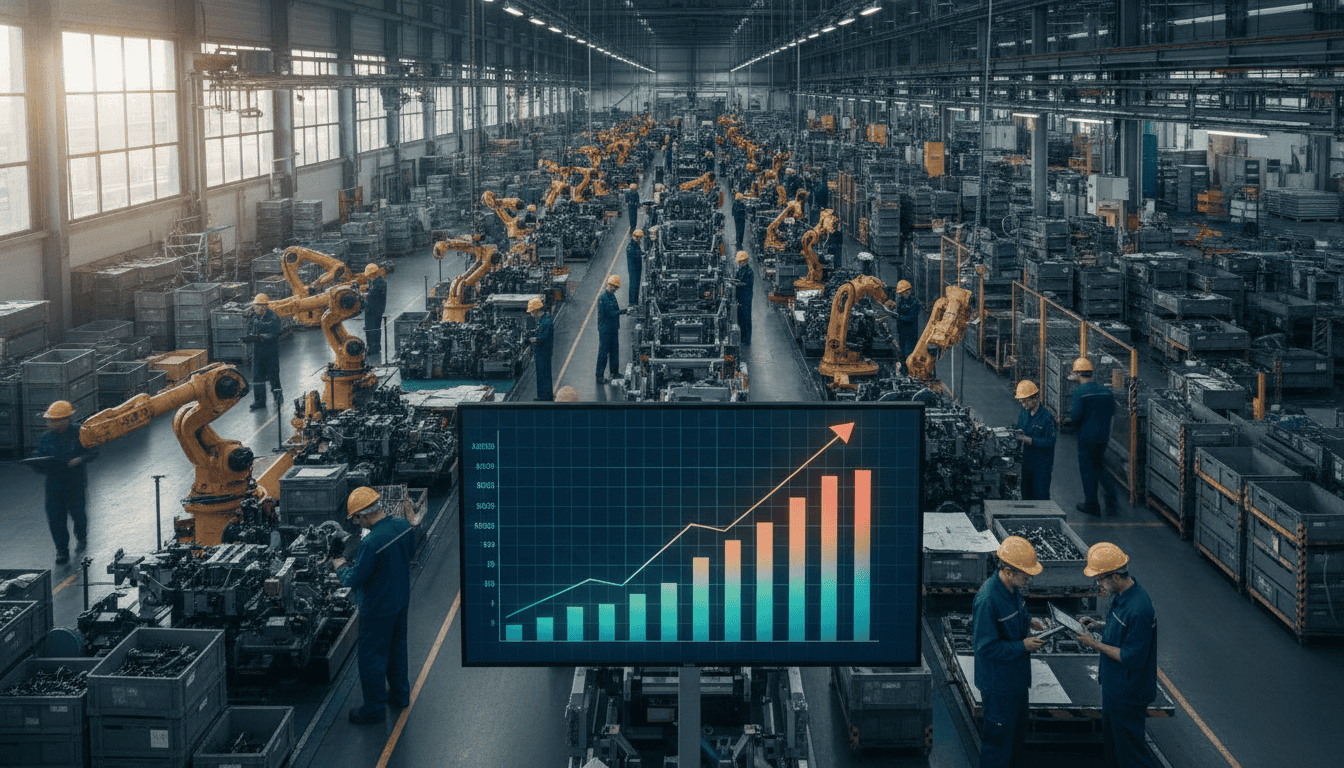
German manufacturing order backlog hits record high in May 2026
Germany’s manufacturing order backlog reached a record in May 2026, rising 1.7% month-on-month and 9.5% year-on-year, led by machinery and data-processing gains.
The German manufacturing order backlog surged to its highest level since records began in 2015, the Federal Statistical Office reported for May 2026. Seasonally and calendar-adjusted orders in the manufacturing sector grew 1.7% from April, marking the strongest monthly rise since September 2021. The bureau said orders were 9.5% above their level in May 2025, reflecting broad strength in capital goods and electronics.
Record backlog since 2015
The Federal Statistical Office said the total volume of outstanding orders now implies the longest run of work on record, with firms theoretically needing nearly nine months to clear current bookings at unchanged output. That 8.9-month implied production horizon is the highest the statistics have shown since the series began in 2015. Officials described the outcome as a clear sign that demand pressures are concentrated in certain industrial subsectors.
Month-on-month and year-on-year movements
On a monthly basis the 1.7% rise followed volatile readings earlier in 2026 and represented the sharpest single-month gain in nearly five years. Year-on-year the 9.5% increase was the strongest annual expansion since August 2022. Analysts noted the simultaneous momentum on both horizons suggests a genuine pickup in order intake rather than a short-lived correction or pure calendar effects.
Machinery and data-processing lead the gains
The machinery sector was a principal contributor to the improvement, posting a notable rise in orders from April to May. Manufacturers of data-processing equipment, electronics and optical products also reported roughly a 3% increase, supporting the overall advance in the order backlog. These capital- and technology-intensive segments have benefited from renewed investment demand in certain export markets and from firms updating production lines.
Automotive sector shows a dip
By contrast, the automotive industry bucked the broader trend with a modest decline in outstanding orders. The Federal Statistical Office recorded a 0.8% drop in auto industry backlogs for May, reflecting ongoing adjustment after the rapid shifts of recent years. Industry participants said structural factors, such as the shift to electric vehicles and longer project cycles, continue to reshape order patterns in the sector.
Production bottlenecks and geopolitical pressures
Economists cautioned that a large backlog is not the same as higher output, noting several constraints that could slow conversion of orders into produced goods. Alexander Krüger, chief economist at Bank Bethmann HAL, warned that elevated energy costs, manufacturing relocations abroad and lingering supply-chain bottlenecks could limit how quickly firms translate bookings into shipments. Krüger also highlighted how renewed geopolitical tensions, including recent flare-ups in the Middle East, are prompting firms to delay deliveries and stockpile orders as a precaution.
Companies reported rising use of foreign production sites in order to safeguard margins and access different supply chains, a trend that may mute the domestic economic impact of the order surge. At the same time, persistent shortages of key components and logistical constraints remain acute in parts of the electronics and machinery supply chains, according to the industry accounts compiled by the statistics office.
Implications for production, employment and policy
A backlog at record levels raises hopes for stronger manufacturing output in the months ahead, which could support industrial employment if orders are converted into sustained production. However, analysts said the conversion depends on firms’ willingness to invest in capacity and on an easing of cost pressures, notably energy prices and financing costs. Policymakers face a balancing act: measures that improve site competitiveness could accelerate domestic production, but incentives may be muted while uncertainty around trade, energy and geopolitical risks persists.
The statistics office’s report provides fresh evidence that demand for German industrial goods remains robust in selected niches, even as the overall manufacturing cycle shows mixed signals. Investment-intensive sectors such as machinery and data-processing appear best positioned to expand output if supply constraints and cost headwinds are managed.
The record backlog underscores both an opportunity and a risk for Germany’s industrial recovery: strong incoming orders could fuel a rebound in production and exports, but only if businesses can resolve bottlenecks, control costs and translate bookings into finished goods at home.
