
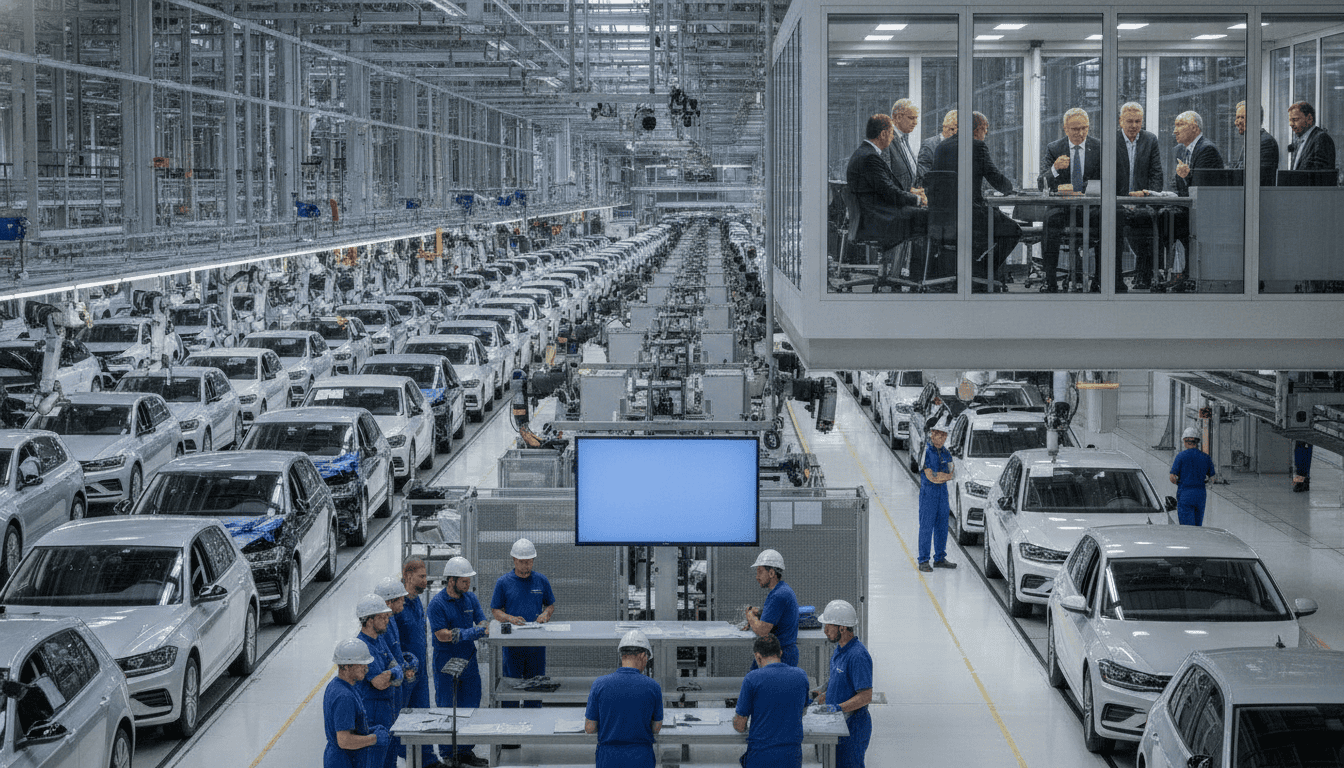
VW job cuts prompt mass plant meetings as works council demands clear figures
Volkswagen faces a storm of factory meetings in late August as the works council warns that proposed VW job cuts and site reviews could put as many as 140,000 positions at risk ahead of a September supervisory board session.
The works council has scheduled a series of staff assemblies at major Volkswagen plants to press management for detailed information on cost-saving plans and possible closures. Senior executives including Chief Executive Oliver Blume and brand head Thomas Schäfer are expected to speak at some of the meetings to answer employee questions.
Management to speak at large factory assemblies
Volkswagen management has been asked to present its plans directly to employees across multiple sites, the works council said. Executives set to appear include Oliver Blume, Thomas Schäfer, Chief Financial Officer Arno Antlitz and technical board member Thomas Schmall‑von Westerholt, with Schmall slated for components and engine plants.
The works council framed the gatherings as an opportunity for the board to “speak plainly” about the scale and timing of savings measures. It has warned that the information provided so far is insufficient for staff to assess the impact on jobs and locations.
Works council aggregates risk at 140,000 positions
Employee representatives have produced a new calculation that aggregates multiple measures into a single risk estimate, saying the total number of roles potentially affected could reach 140,000. Their tally combines a previous decision to cut 50,000 positions in Germany, a possible additional 50,000 global reductions mentioned by the CEO, and roughly 40,000 jobs at four German sites under review.
Volkswagen has not confirmed the works council’s combined figure and emphasized that no final decisions have been taken. Still, the scale of the estimate has heightened anxiety among staff and intensified calls for clarity from the board.
Timeline and locations for the August meetings
The works council’s schedule begins with the Wolfsburg main plant on Tuesday morning, August 25, 2026, followed by a session in Braunschweig that afternoon. Additional assemblies are planned at Emden, Zwickau, Chemnitz, Dresden, Kassel, Salzgitter and Hannover through Monday, August 31, 2026.
The Wolfsburg plan does not include Neckarsulm, which belongs to Audi and is being treated separately despite similar reports of risk there. The concentrated week of meetings is intended to give workers at key production and components sites a forum to press management before the next supervisory board meeting.
Supervisory board meeting set for September 4, 2026
After the round of plant assemblies, Volkswagen’s supervisory board is due to meet on Friday, September 4, 2026, according to reporting around the schedule. The works council and unions are preparing to bring the questions and reactions from the factory assemblies directly into that boardroom debate.
Pressure on the supervisory board has increased as employee representatives have signaled they may escalate scrutiny if the management team does not provide a more detailed roadmap for savings and site decisions. Company spokespeople have stressed that deliberations are ongoing and that formal resolutions have yet to be adopted.
HR leadership vacancy and Erika Rasch’s candidacy
The vacancy in Volkswagen’s personnel portfolio, left after Gunnar Kilian’s departure about a year ago, remains politically sensitive as the company plans deep structural changes. Reports have named Erika Rasch, the head of human resources at supplier Bosch, as a leading candidate to take on the role.
According to media accounts, Rasch’s prospective appointment stalled at the latest supervisory board meeting amid broader disagreement over the design of management responsibilities and a proposed new technology portfolio. Both Volkswagen and Bosch declined to comment on the nomination or the board’s internal discussions.
Cost targets and the math behind the cuts
Company leadership has linked any additional job reductions to an ambition to cut overhead costs by about 20 percent, focusing on administration, infrastructure and internal services that support core manufacturing. Management has indicated that achieving those savings could result in further global reductions beyond previously announced measures.
Works council members say that combining overhead reductions with potential site closures produces the higher aggregated threat figure to employment. The dispute over the arithmetic, and the absence of fully detailed plans, is central to the unrest between the workforce and the board.
As Volkswagen prepares to brief thousands of employees and face its supervisory board in early September, the debate over figures, sites and leadership appointments remains unresolved. Workers and unions will be watching the August assemblies closely for concrete commitments or timelines, while management must balance the need for fiscal restraint with the political and social consequences of plant reviews and staff reductions.
