
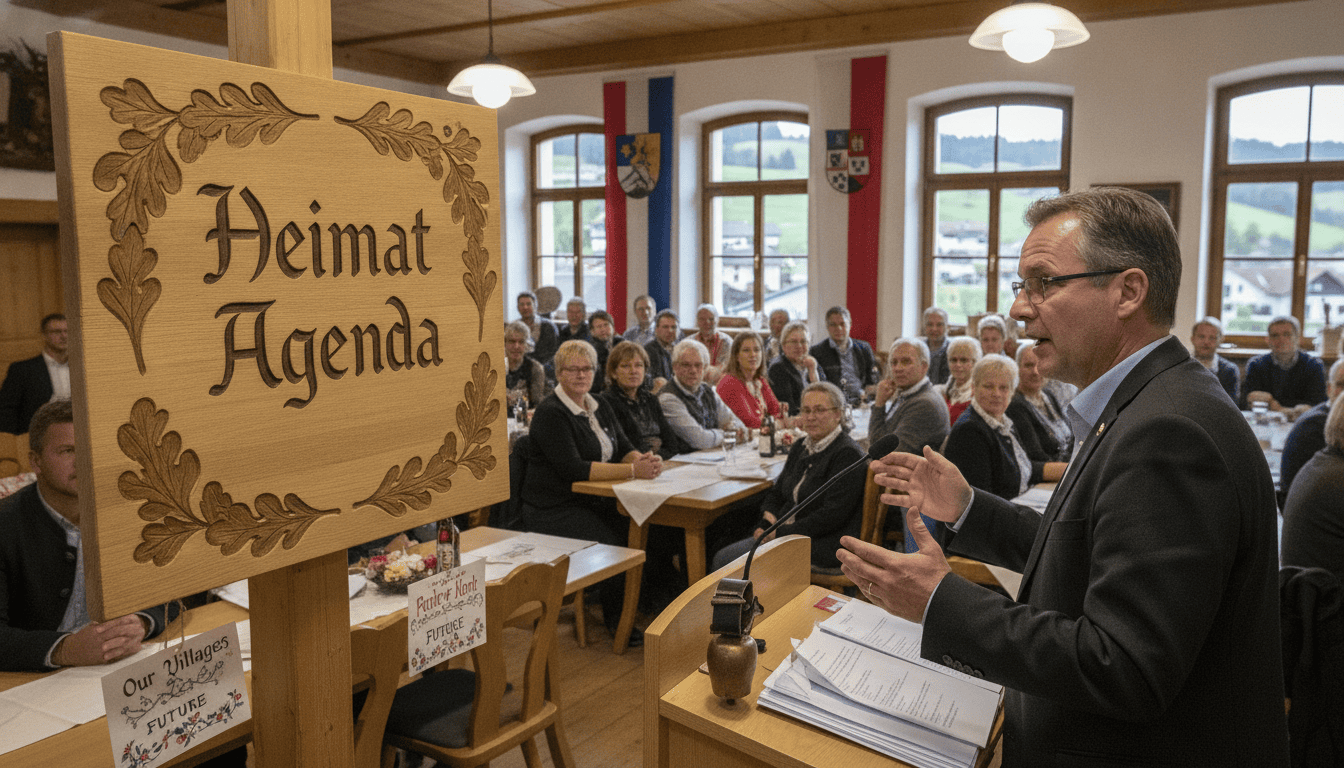
Heimat-Agenda: Minister Alois Rainer tours rural Germany to sell cohesion plan amid €54m funding cut and rising AfD influence
Heimat-Agenda: Federal minister Alois Rainer tours rural Germany to boost cohesion and business despite a €54 million cut to rural funding and AfD gains.
Alois Rainer, Germany’s federal minister now responsible for homeland affairs, spent a week touring structurally weak rural regions to promote his newly unveiled Heimat-Agenda. The minister’s summer tour focused on small villages and local projects, using community visits and personal anecdotes to underline goals of cohesion, economic resilience and support for volunteers. Rainer presented concrete spending decisions here and acknowledged sharp constraints elsewhere, framing the agenda as a mix of targeted grants, deregulation and outreach to local stakeholders.
Village visits underline local connection
Rainer’s itinerary brought him to tiny communities such as Serwest in Brandenburg, where residents turned out to meet the minister outside their village hall. The contrast between his home village of Haibach in the Bavarian Forest and the 300-odd residents of Serwest was a deliberate touchstone in his messaging about comparable living conditions. On the ground, Rainer emphasized familiarity and personal ties, drawing on his long service as a mayor and his rural background to bridge the gap between federal policymaking and local concerns.
€150,000 granted to renovate community house
One of the most visible outcomes of the tour was a €150,000 grant for the restoration of a historic brick community house that once served as the village school. The building has been repurposed for table tennis, arts classes, yoga and other local activities, and the funding aims to secure those uses for the future. Rainer used the handover to highlight the symbolic value of local meeting places as engines of social cohesion and civic engagement. He also traded lighthearted personal stories with residents to underscore his connection to everyday village life.
Heimat-Agenda emphasizes cohesion and support for volunteers
At a village pond in Golzow, Rainer set out the core pillars of his Heimat-Agenda, which prioritize social cohesion, equal living conditions across regions and bolstering economic strength. The ministry describes itself as a “Möglichmacher” for the many volunteers and local actors who run community life, seeking to reduce red tape and enable grassroots initiatives. The agenda places people and local associations at the center, framing government action as facilitation rather than top-down redistribution. That emphasis on local agency is intended to appeal to communities that feel overlooked by national policy.
Budget cuts shrink room for new programmes
Despite the new agenda, Rainer’s ministry faces acute fiscal constraints that limit fresh spending commitments. Officials confirmed that the largest national fund for rural development will be reduced by €54 million next year, a cut that narrows the resources available for local projects. To compensate, the ministry is pushing deregulation and administrative relief as cost-neutral measures that could free capacity for volunteers and small businesses. Rainer framed the strategy pragmatically: when cash is tight, simplifying procedures and removing obstacles becomes a primary lever to sustain local jobs and services.
Industry seeks support and supply-security arguments
During the tour, visits to industrial sites, including a major fertilizer plant in Wittenberg, highlighted the economic arguments woven into the Heimat-Agenda. Company executives urged the minister to improve competitiveness for energy-intensive industries, warning that costs such as the European emissions trading system weigh on domestic production and jobs. The minister echoed calls for resilience and reduced dependency in strategic supply chains, arguing that a strong industrial base is central to homeland security. He also signalled that his ministry aims to link support for local communities with broader agricultural export strategies to help small and medium-sized firms access foreign markets.
Political backdrop sharpens stakes ahead of regional votes
Rainer’s tour comes as regional elections loom in several eastern states where the AfD polls strongly and has made “homeland” a central campaign theme. The minister was careful not to make funding decisions based on party strength, insisting that eligibility for support is assessed on objective criteria. Yet his public remarks repeatedly warned against division, implicitly addressing the political tug-of-war over cultural and economic anxieties in these regions. Observers said the Heimat-Agenda is as much a policy initiative as it is a political effort to reclaim the terrain of local identity from populist rivals.
The outcome of Rainer’s summer roadshow will be judged on whether modest grants, regulatory relief and targeted industry support can produce visible improvements in small communities while withstanding a tighter federal budget. For now, the Heimat-Agenda frames a practical response to long-standing rural challenges, but its success will depend on implementation, intergovernmental cooperation and whether it can blunt political shifts in the coming regional elections.
