
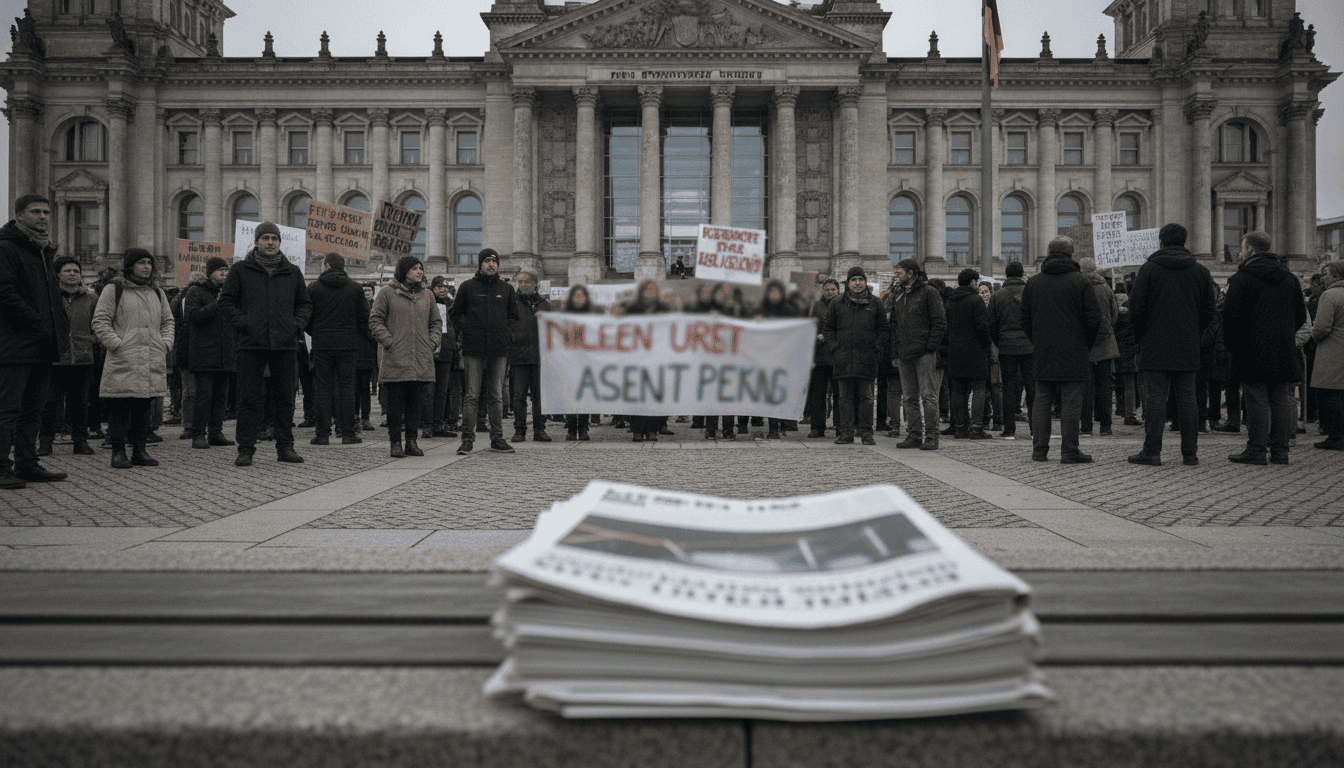
German government reforms face broad public skepticism, ZDF-Politbarometer shows
ZDF-Politbarometer: German government reforms face broad public skepticism in July 2026—only 30% approve while 81% say the burdens are unfair, survey finds.
The latest ZDF-Politbarometer finds strong public resistance to the German government reforms, with only 30 percent of respondents saying the measures are heading in the right direction. The survey also reports that 63 percent view the reforms negatively and 81 percent consider the distribution of burdens unfair, underscoring widespread concern about the plan’s equity. The results arrive as the government prepares to press ahead with a package described as a “Programme for Recovery and Employment,” placing public acceptance at the center of the political debate.
Public opinion snapshot from the ZDF-Politbarometer
The ZDF-Politbarometer poll gives a clear numerical picture: 30 percent of those surveyed back the government reforms, while 63 percent do not, and the remainder remain undecided. These figures reflect sentiment across a representative sample of 1,284 eligible voters surveyed between July 14 and July 16, 2026. The large gap between approval and disapproval signals a major communications and legitimacy challenge for leaders advocating the reforms.
Contents of the ‘Programme for Recovery and Employment’
The government’s reform package comprises more than 30 individual measures designed to boost growth and employment. Key elements include a proposed tax reform, loosening of certain labor regulations, targeted bureaucracy reduction, and a federal prohibition on state-level expropriation or nationalization of private rental housing stocks. Officials have framed the measures as a comprehensive effort to spur investment and job creation, while critics warn of unintended consequences for households and tenants.
Widespread concerns about fairness and burden-sharing
Survey respondents were particularly vocal about fairness: 81 percent said the planned burdens are unevenly distributed across society. That perception cuts across income and regional lines, according to the poll, and is likely a central reason for the low overall approval. Analysts say perceptions of unfairness can erode public trust even when some technical indicators point to economic gains, making compensation or targeted relief politically important.
Party supporters’ responses diverge markedly
Responses broken down by party affiliation show divergent views among supporters. Backers of the Union (CDU/CSU) were most positive, with 66 percent saying the reforms go in the right direction, while 51 percent of SPD supporters expressed approval. By contrast, supporters of AfD, the Greens and Die Linke registered majority skepticism, and FDP supporters were split. These differences underscore the political fault lines over economic policy and suggest the governing coalition still faces internal challenges in building a unified public narrative.
Methodology and timing of the survey
The poll was conducted for the ZDF-Politbarometer by Forschungsgruppe Wahlen, with interviews carried out by phone and online from July 14 to July 16, 2026. The sample comprised 1,284 randomly selected eligible voters and is presented as representative of the voting-age population in Germany. Survey timing is relevant: conducted shortly after the reforms were introduced, the results capture initial public reaction rather than longer-term opinion shifts that can follow implementation or clarifying messaging.
Potential political and policy consequences
The pronounced public skepticism documented by the ZDF-Politbarometer could complicate the government’s legislative agenda and public-relations strategy. High perceptions of unfair burden-sharing may prompt policymakers to revise measures or introduce compensatory policies aimed at affected groups. Opposition parties are likely to use the poll’s findings to pressure the coalition and to shape debates in parliament and the media ahead of key legislative votes.
The ZDF-Politbarometer results highlight a central challenge for the government: translating a complex package of reforms into perceived benefits for a majority of citizens. With only three in ten approving the reforms as presented and widespread concerns about fairness, the political margin for error is narrow and public acceptance will be a critical factor in whether the measures achieve their intended economic effects.
