
Tour de France 2026 route, stages and early winners: Barcelona start to Champs-Élysées finale
Tour de France 2026 preview: route, stages, key climbs and early winners from Barcelona to Paris. Teams, favorites, German riders, live TV and streaming.
The Tour de France 2026 began on July 4 in Barcelona and will conclude on July 26 on the Champs-Élysées, with 21 stages across 3,321 kilometers and 54,450 meters of climbing. The race field comprises 184 riders distributed among 23 teams, and the early stages have already produced a mix of team strength and individual victories. This report summarizes the route, the decisive climbs ahead, key stage winners so far and the riders to watch as the race moves into the high mountains.
Start in Barcelona and finish on the Champs-Élysées
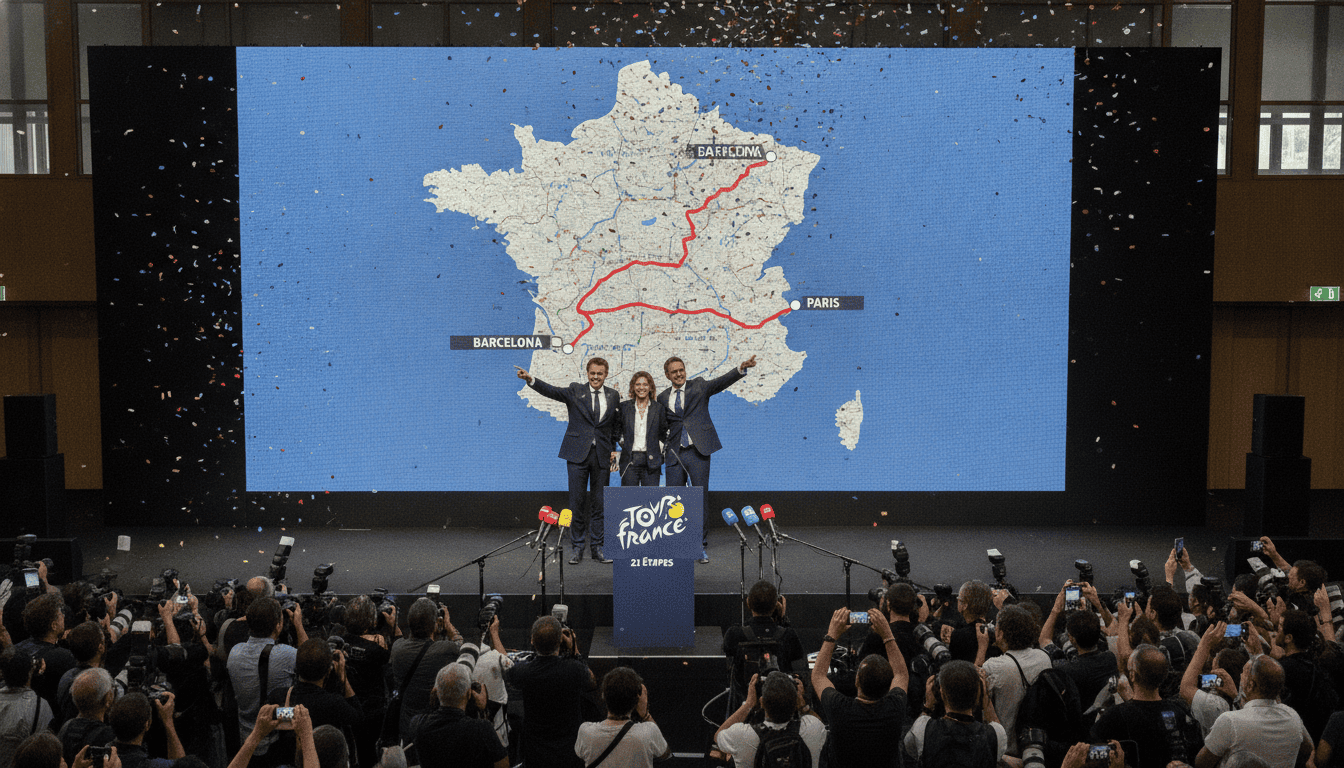
The Grand Départ in Barcelona opened with a 19.6 km team time trial that immediately tested collective pacing and equipment choices. The race itinerary then moves northeast through the Pyrenees before crossing central France and rising into the Alps for two consecutive summit finishes. The peloton is scheduled to arrive in Paris on July 26 for the traditional flat finale along the Champs-Élysées.
The full route features seven flat stages, four hilly stages and eight mountain stages, with two individual time trials including a 26.1 km test between Évian-les-Bains and Thonon-les-Bains. Two rest days are built into the program, on July 13 and July 20, giving teams recovery windows before the decisive Alpine phases. Organizers have emphasized a balance of sprint opportunities and high-mountain challenges to keep general classification contenders separated.
Early winners set the tone after the Barcelona opener
The opening team time trial rewarded coordinated power and aerodynamic discipline when Team Visma-Lease a Bike took the stage victory and the first yellow-leader advantage. Individual stage winners through the first nine days included Isaac del Toro, Tadej Pogacar, Mads Pedersen, Olav Kooij, Tim Merlier (twice) and Mathieu van der Poel, reflecting a mix of sprinters, classics specialists and GC attackers. Pogacar’s stage successes underline his dual threat as both a climber and opportunist earlier in the race.
These early results have already rearranged team tactics, with sprint squads protecting position for bunch finishes while the top general classification teams conserve riders for mountain duties. Time gaps remain modest in many segments, but the upcoming high-altitude tests promise larger differentials. Teams that controlled the first week will now shift focus to mountain domestiques and equipment choices for steep ascents.
King stage on July 25 includes Col du Galibier and Alpe d’Huez
The designated “king stage” on July 25 runs about 171 kilometers and packs roughly 5,450 meters of climbing, including the Col du Galibier at 2,624 meters. That stage combines the Col de la Croix de Fer and Col du Télégraphe earlier in the route, followed by the Galibier and a final ascent to Alpe d’Huez. Race planners describe this sequence as the most arduous single day, with sustained gradients and altitude that will expose any weaknesses in the contenders’ legs.
Mountain specialists and GC teams have already mapped energy expenditure and feeding plans for that day, knowing it may be decisive for the overall podium. The finish at Alpe d’Huez, reached twice in the final weekend, offers a classic summit showdown that can produce dramatic shifts in the general classification. Riders will also face variable weather and steep descents, adding tactical complexity beyond raw climbing ability.
Pogacar, Vingegaard and the list of overall favorites
The main narrative for the overall title centers on a rivalry between Tadej Pogacar and Jonas Vingegaard, with Pogacar aiming to defend the 2025 victory and Vingegaard seeking to reverse recent time losses. Pogacar has shown strong form in one-day classics and shorter stage races this season, while Vingegaard arrives with victories including a Giro d’Italia and Paris–Nice. Both have deep team support and will rely on mountain domestiques and time-trial form as the race progresses.
Other GC contenders include Remco Evenepoel alongside Florian Lipowitz at Red Bull – Bora-hansgrohe, and younger challengers such as Paul Seixas, the 19-year-old French prospect who has drawn attention with wins earlier in the year. Seixas’ emergence offers host-nation interest, but his mid-June crash introduced questions over his form and durability. Teams like UAE Team Emirates-XRG and Team Visma-Lease a Bike remain favorites to contest the yellow jersey into the Alps.
German focus: Mulhouse, the Vogesen stage and national riders
Stage 14 on July 18 runs from Mulhouse to Le Markstein Fellering, traversing the Vosges with three first-category climbs and about 3,800 meters of elevation. The proximity to the German border—Mulhouse lies roughly 20 kilometers from Germany—means a strong local presence, and German supporters are expected in force for segments of that stage. Climbs such as the Grand Ballon and Ballon d’Alsace present chances for domestic riders to animate the race.
Several German riders figure on start lists with roles ranging from sprinter to GC helper: Florian Lipowitz headlines as a classified general classification rider, while Nils Politt and John Degenkolb provide experience and sprint capability for their squads. Debutants Georg Steinhauser, Max Kanter and Michel Hessmann have also made the Tour roster and may target breakaways or stage opportunities. National interest has been amplified by previous strong results from German teams and the presence of domestiques capable of shaping race tempo.
Live TV and streaming schedule for viewers
Broadcasters have scheduled widespread coverage, with the public broadcaster ARD carrying daily live broadcasts, typically starting at 14:00 local time, and earlier action available via the ARD livestream. Eurosport provides additional free-to-air coverage, while pay services including Discovery’s platforms, HBOMax and DAZN offer comprehensive multi-angle streams and extended pre- and post-stage analysis. International streaming packages will vary by territory, so viewers should check local platform availability.
Race-day coverage emphasizes stage previews, climb maps and live gap graphics to help explain tactical moves in real time. Commentary teams are focusing on the mountain stages as pivotal moments for the general classification, while sprint stages retain interest for their tactical lead-outs and bunch finishes. Broadcasters will also highlight the dual arrivals at Alpe d’Huez and the Galibier profile during the final weekend.
As the Tour de France 2026 moves into its second half the race is set to pivot from tactical positioning to decisive mountain warfare, with several stages likely to determine the final podium. Teams and riders will now prepare for two consecutive Alpine days that could make or break ambitions as Paris approaches.
