
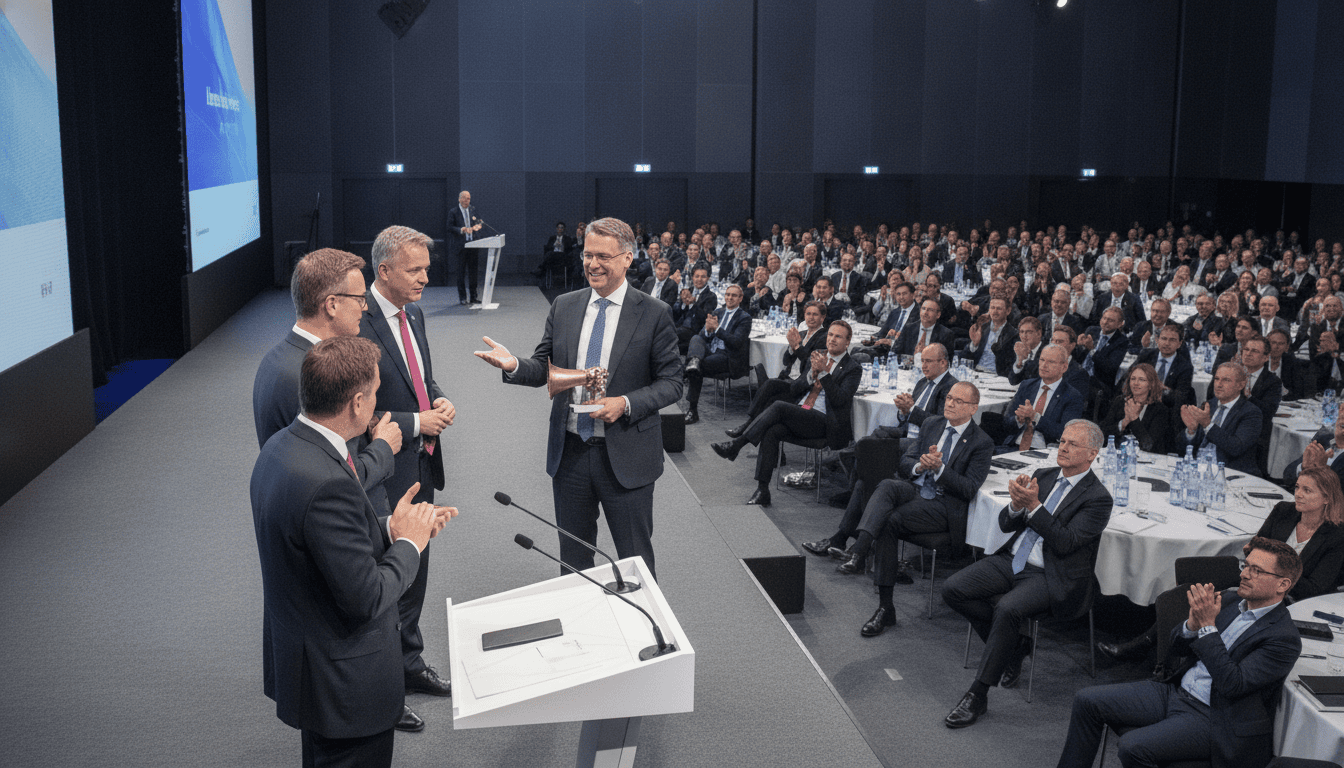
DAX CEO speeches sharpen as live AGMs return; VRdS honors Hanebeck, Bruch and Jungsthöfel
VRdS analysis finds DAX CEO speeches more vivid after a return to live AGMs; Infineon’s Jochen Hanebeck won best rhetorician, with awards stressing the human factor.
The annual review by the Association of Speechwriters of the German Language (VRdS) finds DAX CEO speeches markedly improved after companies returned to in-person shareholder meetings. The group evaluated this year’s addresses across the DAX-40 and awarded prizes for rhetorical quality, stage presence and a themed category, highlighting a renewed focus on clarity and the “human factor.” Winners included Infineon’s Jochen Hanebeck, Siemens‑Energy’s Christian Bruch and Hannover Re’s Clemens Jungsthöfel, while the association cautioned against alarmist reactions to the use of artificial intelligence in speech preparation.
VRdS: Live audiences revive stagecraft
The VRdS report notes that 22 of the 40 DAX shareholder meetings this year were held in person, a shift the association links to more dynamic delivery. Executives were observed moving more confidently on stage, using visual aids and direct exchanges with employees to make technical topics tangible. The return to live audiences appears to have encouraged CEOs to trade sterile monologues for more engaging, human-centered presentations.
Award categories and judging standards
Since 2023 the VRdS has split its annual prize into three categories: best rhetoric, best appearance and a rotating thematic award; the 2026 theme was the “human factor.” Judges evaluated speeches on structure, language clarity, use of imagery, pacing and the effective employment of pauses. The jury also factored in whether multimedia elements served comprehension rather than spectacle, favoring substance over mere showmanship.
Jochen Hanebeck picked as best rhetorician
Infineon CEO Jochen Hanebeck was named best rhetorician for 2026 after impressing a six-member jury with a tightly organized address and accessible language. Evaluators highlighted his use of vivid images and a measured tempo, noting that his pauses reinforced key messages and conveyed steadiness during uncertain times. The award recognized a speech that balanced realism about challenges with a credible tone of reassurance.
Christian Bruch defends best appearance title
Siemens‑Energy’s Christian Bruch retained the prize for best appearance, repeating last year’s success with a theatrical yet purposeful entrance. Bruch’s meeting, held in February before an audience for the first time since the pandemic, opened with a short film that concluded with him leaving an office after a phone call and immediately stepping onto the live stage. The jury praised the cinematic transition and the way subsequent video inserts supported understanding rather than overshadowing the live delivery.
Clemens Jungsthöfel wins themed prize for ‘human factor’
In the special “human factor” category, Hannover Re CEO Clemens Jungsthöfel — in office for roughly a year — was singled out for a restrained, credible style that carried a touch of wry charm. Speechwriters judged his address precise and calm, and said he successfully reframed anxieties about technological change into a message of cautious confidence. His handling of the topic of artificial intelligence was flagged as a model for how executives can acknowledge change without inflaming fear.
Speechwriters push back on AI alarmism
The VRdS used its report to temper public concern about the role of AI in speechwriting, arguing that headline fears are often undifferentiated. Association president Peter Sprong stressed that AI assistance is not inherently problematic and that it requires substantial human input to produce meaningful text. The group reiterated a long-standing rule of thumb — roughly one hour of preparation per minute of speech — to underscore the labor behind polished addresses and to remind audiences that drafts undergo multiple iterations and human oversight.
Jury chair Christoph Schlegel framed a related dilemma for professional speechwriters: AI tends to replicate familiar rhetorical devices, which can make traditional figures of speech appear mechanistic or suspect. That dynamic has prompted some practitioners to rethink the unselfconscious use of certain stylistic tools, because audience familiarity with AI output may change how those devices are perceived.
The VRdS report suggests a broader recalibration in corporate communication: stagecraft and multimedia are welcome when they clarify complex subjects, but they must be subordinated to clear arguments and credible delivery. For DAX executives, the shareholder meeting remains one of the year’s most important public platforms, and this year’s awards underline a preference for speeches that combine technical competence with human connection.
As shareholder meetings continue to oscillate between virtual and live formats, the VRdS findings indicate that executives who prioritize audience engagement, narrative clarity and responsible use of technology are likely to set the standard for future DAX CEO speeches.
