
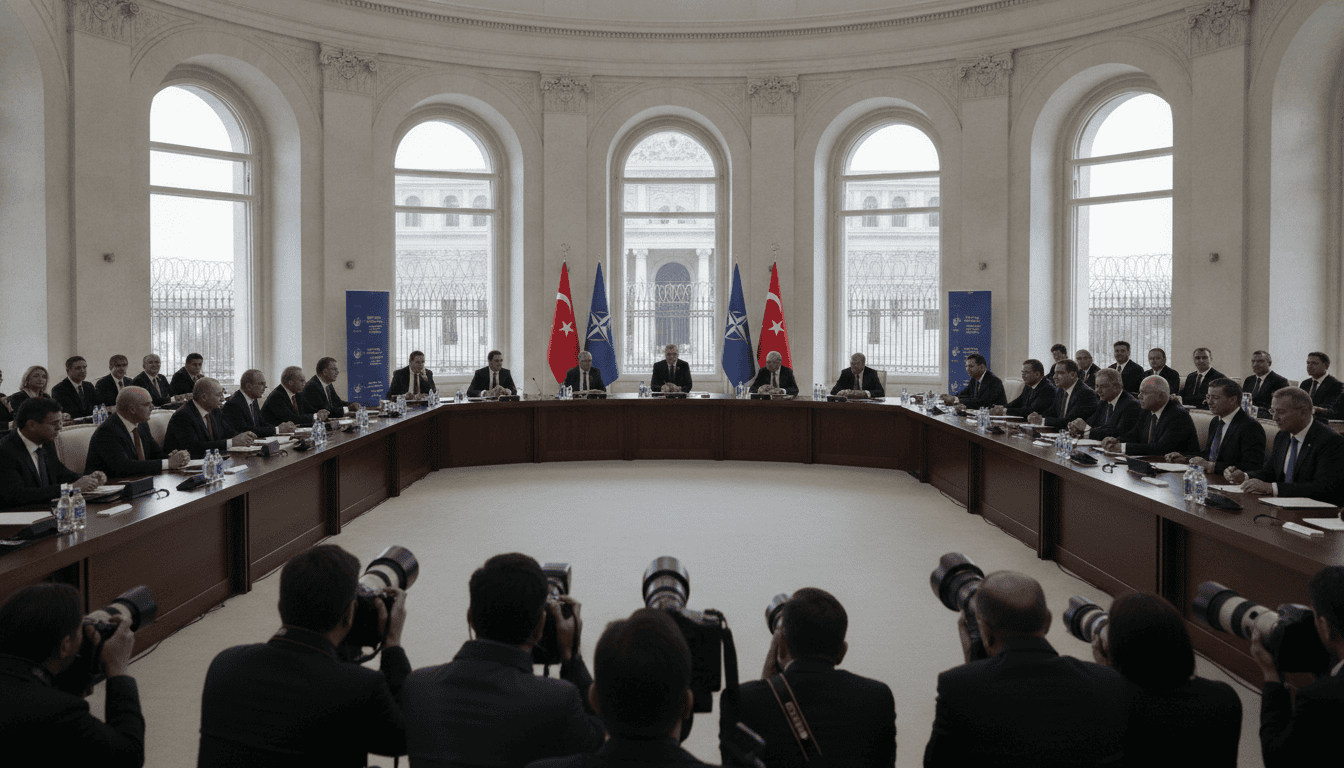
Ankara NATO summit draws leaders amid criticism over Turkey’s democratic backslide
Leaders gather at the Ankara NATO summit as critics say Turkey’s recent raids and court removals signal democratic backsliding amid security talks and unity.
In Ankara this week, heads of state and government convened for the Ankara NATO summit while domestic critics and opposition figures warned that political repression at home was being sidelined. The meeting brings the alliance’s most senior leaders together to discuss collective defense even as allegations of police raids, court-ordered removals and high-profile imprisonments stir controversy. Organizers say the summit will concentrate on strengthening deterrence and military cooperation, but observers argue those security priorities are colliding with questions about Turkey’s adherence to democratic norms.
Western leaders affirm attendance despite rights concerns
Several Western leaders publicly confirmed their presence at the summit and framed participation as essential to alliance unity and regional stability. U.S. and European officials emphasized the strategic value of sustained cooperation with Ankara on deterrence, counterterrorism and the eastern Mediterranean. Political statements ahead of the meeting concentrated on defense commitments rather than public rebukes of Ankara’s domestic measures.
At the same time, the tone from some delegations underlined diplomatic sensitivity toward President Recep Tayyip Erdoğan. High-level messages ranged from praise for Turkey’s growing defense industry to expressions of personal respect for the Turkish president, a signal that bilateral and strategic ties factored heavily into leaders’ calculus. That posture has heightened frustration among opposition activists who had hoped the summit would amplify concerns about civil liberties.
Recent police raids and court actions against the CHP
In recent weeks police operations targeted the headquarters of the Republican People’s Party, the country’s largest opposition formation, drawing condemnation from party officials and rights advocates. Party figures say the raids followed a series of legal challenges and court decisions that have reshaped opposition leadership and operations in short order. The moves have deepened a sense among critics that the legal system is being used to weaken institutional checks on executive power.
Those judicial actions followed an extended period of pressure on opposition journalists, civil society groups and local officials, according to opposition statements and independent monitors. Elected municipal leaders have faced investigations and in some cases detention, raising alarms about the independence of local governance. For voters and party activists, the visible erosion of political space at home stands in stark contrast to the international stage where Ankara hosts allied capitals.
Istanbul mayor’s detention and political fallout
The detention of high-profile local officials has become a potent symbol for critics who argue Turkey’s democratic institutions are under strain. The detention of the elected mayor of Istanbul has been repeatedly cited by opposition leaders as evidence of selective enforcement and politicized prosecutions. The mayor’s supporters view the case as part of a broader pattern that includes legal actions against other municipal and party figures.
Government spokespeople have defended those measures as lawful responses to security and administrative concerns and have rejected accusations of politically motivated prosecutions. Erdoğan’s administration insists that rule-of-law processes are being followed and that national security considerations sometimes necessitate decisive action. The competing narratives underscore the polarized domestic environment that now intersects with Ankara’s role as a summit host.
Security agenda and rhetoric at the summit
Summit discussions have been dominated by proposals to strengthen NATO’s deterrence posture and to accelerate cooperation on defense procurement and industry. Delegates are due to address force posture in Eastern Europe, maritime security, and the development of joint logistics and surveillance capabilities. Several leaders highlighted the importance of an integrated industrial base and welcomed Turkey’s advances in domestic arms production as a potential contribution to alliance capabilities.
That practical focus on military cohesion has frequently displaced more direct debate about governance and human rights from formal summit sessions. While some delegations raised concerns in private meetings and side discussions, public statements emphasized the urgency of collective defense in a volatile geopolitical environment. For many attending capitals, immediate security threats and operational cooperation appear to have outweighed the imperative of foregrounding democratic standards in summit deliberations.
Questions over NATO’s credibility and alliance values
The presence of Western leaders in Ankara has prompted analysts and rights groups to question whether NATO risks undermining its rhetorical defense of liberal democracy by convening in a country facing serious democratic concerns. Critics argue that the alliance’s legitimacy depends in part on its ability to reconcile security cooperation with clear expectations about governance and human rights. Hosting a summit in a capital where political space is perceived to be narrowing complicates that balancing act.
Supporters of continued engagement counter that isolating Ankara would produce strategic costs and weaken NATO’s operational coherence at a time of heightened tensions. They maintain that dialogue and partnership are more effective than punitive gestures for influencing behavior and preserving alliance unity. The debate highlights a persistent tension within NATO over how to integrate normative commitments with stark security imperatives.
The Ankara NATO summit has thus become a lens through which broader dilemmas about alliance priorities, democratic standards and realpolitik are being refracted. As leaders return to their capitals, questions will linger about whether the summit’s security gains can be sustained without clearer public engagement on the rule of law and political freedoms in the host country.
