
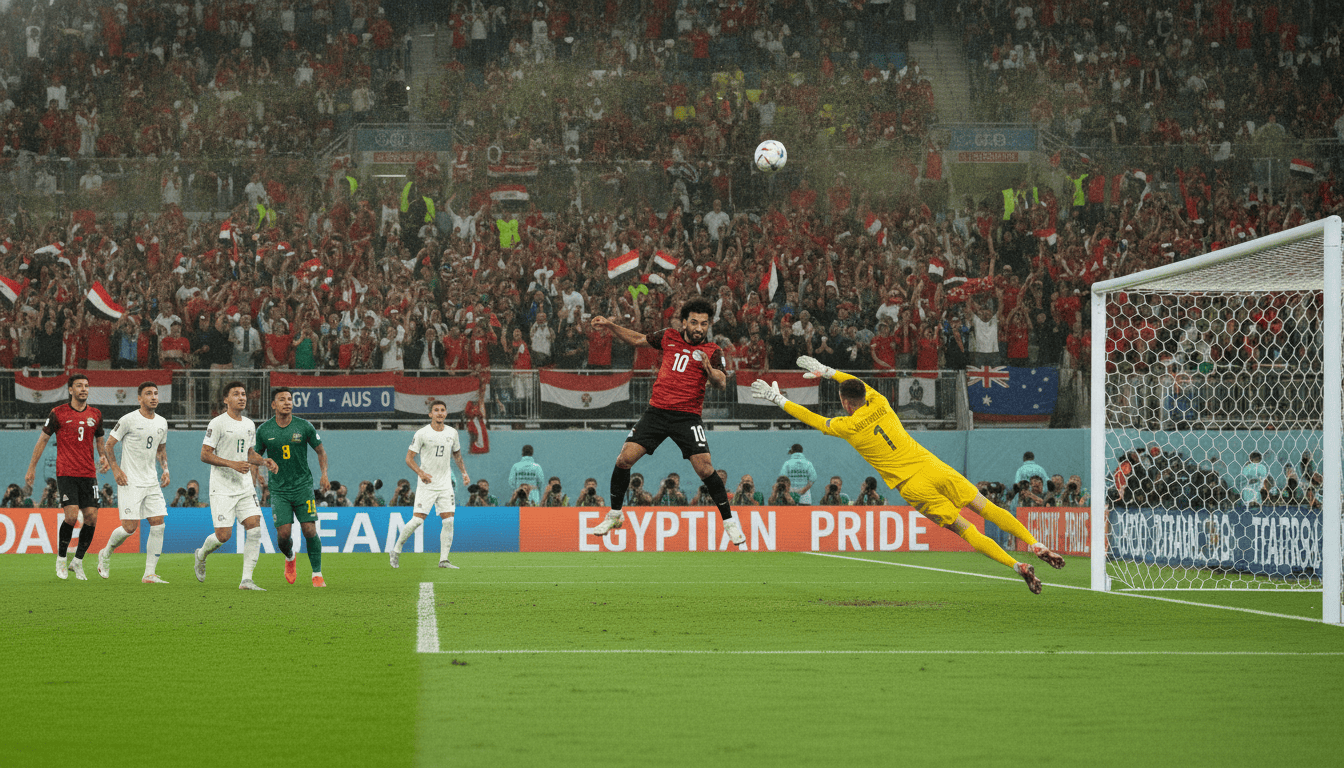
Mohamed Salah Wears Nemes Headdress After Shootout Heroics as Egypt Advance
Mohamed Salah donned a Nemes headdress in Dallas and scored the decisive penalty as Egypt beat Australia on penalties to reach the World Cup last 16.
Egypt’s captain Mohamed Salah strode through the Dallas arena wearing a Nemes-style headpiece and later converted a calm, chipped penalty in the shootout to send his nation into the knockout round. The shirt-and-headdress moment and his emotional reaction after the match underlined Salah’s status as Egypt’s leading figure at the tournament. Fans across Cairo and other cities flooded streets in celebration as videos of jubilant scenes spread online.
Salah’s Nemes Headpiece and Stadium Moment
The image of Mohamed Salah in a Nemes — the striped headdress associated with ancient Egyptian pharaohs — became an instant visual emblem after the game. He wore the traditional head covering briefly during his walk through the arena, a theatrical gesture that many supporters embraced as a symbol of national pride.
Photographers captured Salah with clenched fists and bent arms, an unmistakable assertion of leadership on the field. The act reinforced long-standing nicknames for him, including “Pharaoh” and “Egyptian King,” and fed a wave of celebratory commentary in social and broadcast media.
Penalty Chip Secures Egypt’s Progress
In the decisive moment of the shootout, Salah executed a composed chip down the center that left the goalkeeper stranded. He later described the kick as a spontaneous decision and was visibly moved when reflecting on what the victory meant for himself and the country.
The match had been tightly contested, and Salah’s penalty proved the difference in a nerve-wracking finish. Teammates and staff embraced on the pitch as the result confirmed Egypt’s place in the tournament’s knockout phase.
Street Celebrations and National Reaction
Across Egypt, the result sparked jubilant scenes: people danced in the streets, vehicles joined impromptu processions, and celebratory pyrotechnics lit the night sky. Clips circulated online showing families and groups watching the shootout on big screens, their elation erupting as Salah’s kick found its mark.
Public reaction also included a mix of pride and high expectation, with many fans projecting hopes for deeper progress in the competition. The emotional atmosphere in the homeland underscored how closely national identity and international football success remain intertwined for Egyptian supporters.
Salah’s Tournament Role and Playing Pattern
On the pitch, Mohamed Salah’s approach throughout the tournament reflected careful energy management and tactical focus rather than constant high-intensity bursts. He spent parts of matches conserving effort, linking play when needed and producing crucial moments in decisive phases.
Statistically he has been influential, creating more goal-scoring chances than any other player in this tournament at the time of the Australia match. That ability to manufacture opportunities while pacing himself has been central to his captaincy and overall influence on Egypt’s attacking structure.
Club Context and Career Trajectory
Salah’s international performances come amid a notable transition in his club career: he is no longer a Liverpool player as of this summer, and the previous club season contained visible fluctuations in form. Despite those variations, he has retained an elite level of accomplishment across English and European competitions over recent years.
At 34, Salah blends experience with situational intelligence, using his positioning and passing to affect games beyond pure goal scoring. Observers have compared aspects of his late-career game to other veteran greats, though he remains distinct in style and contribution.
Upcoming Round-of-16 Challenge Against Argentina
Egypt’s next opponent in the last 16 is Argentina, with the match scheduled to take place in Atlanta and broadcast domestically on public television. The upcoming fixture will pair Salah against Lionel Messi, setting up a high-profile confrontation between two veteran leaders who have shouldered national expectations for years.
Salah had previously named Messi as his preferred opponent for a final dance at the tournament, a remark that now frames the clash as a marquee encounter. The tactical decisions and fitness management by Egypt’s coaching staff will be central to their chances against a side that has proven resilient and dangerous in transition.
Mohamed Salah’s walk with the Nemes and his composed penalty combined spectacle with substance, encapsulating a night when individual poise delivered a collective reward for Egypt.
