
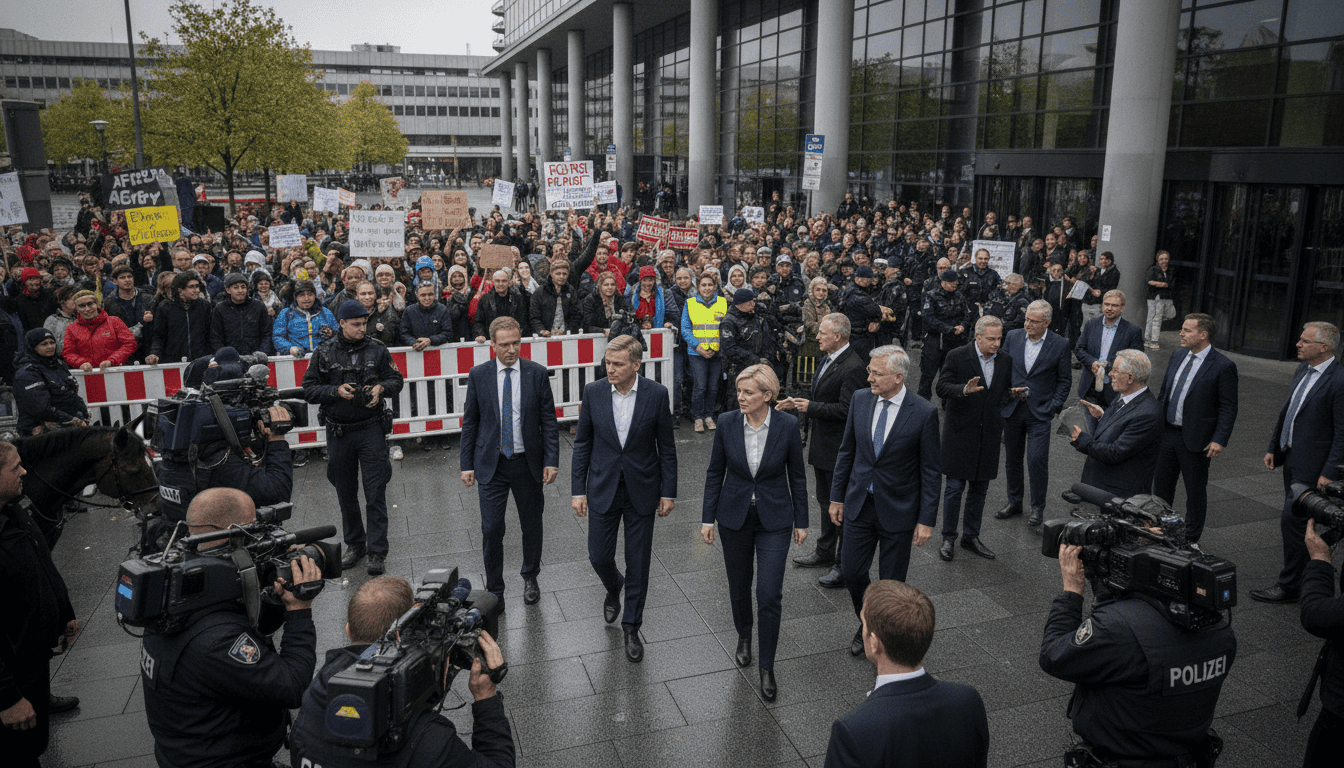
AfD party congress draws sharp criticism and legal debate as blockade plans surface
Tension rises ahead of the AfD party congress as opponents vow mass blockades while party critics point to nationalist rhetoric and past controversies. The AfD party congress has become a flashpoint in the debate over how democracies should confront extremist politics without undermining constitutional order.
Concerns cited by critics of the AfD
Critics point to the AfD’s nationalist rhetoric and statements by prominent figures that many regard as minimizing the crimes of National Socialism. Observers say those remarks and a tendency toward ethnic nationalist ideas create legitimate grounds for political opposition to the party.
Political actors and commentators also highlight episodes where AfD members exercised public office in ways seen as undermining democratic norms, citing past incidents that intensified mistrust. These examples are frequently invoked by groups arguing the party poses an exceptional challenge to mainstream politics.
Organized plans to block the congress
Groups on the left and self-described antifascist organizations have announced plans to physically block the AfD congress, sometimes promising mass mobilizations. Organizers have described their actions as a direct confrontation with what they call a fascist movement, framing blockades as a moral imperative.
Those plans raise the prospect of large-scale street demonstrations and confrontations around the venue, with organizers and participants publicly debating tactics and the limits of civil disobedience. Supporters of the blockades stress symbolic resistance, while critics of the tactic warn of legal and safety risks.
Legal boundaries and the role of the state
German legal doctrine places the authority to prohibit assemblies or ban political parties squarely with courts and state institutions rather than private citizens. Legal experts emphasize that decisions to restrict a political gathering or pursue a party ban must follow established judicial procedures and evidence-based criteria.
That rule-of-law principle means that even deeply felt political opposition does not justify unilateral action to prevent an event from taking place. Authorities and courts, not protest groups, are the constitutionally sanctioned arbiters of whether a party’s activities cross the threshold for prohibition.
Left party chair Schwerdtner’s stance draws scrutiny
Left party chair Schwerdtner said she wished for “non-violent” protest yet also urged efforts to prevent the congress from taking place “normally,” a stance that prompted debate over political responsibility. Critics argue such language blurs the line between lawful dissent and advocacy for extra-legal disruption.
Supporters of Schwerdtner contend her remarks were aimed at denying the AfD a normal platform, not at endorsing violence, and that political leaders must mobilize opposition within democratic bounds. Nonetheless, the comments have intensified scrutiny of how mainstream parties balance forceful condemnation with adherence to legal processes.
Security implications and public order considerations
Event planners and security officials face the challenge of enabling lawful protest while ensuring public safety and the right to hold a political assembly. The presence of thousands of demonstrators intent on blockade raises logistical hurdles for police and municipal authorities responsible for maintaining order.
A failure to manage the situation could fuel accusations that the state either overreached in limiting protest or failed to protect lawful political activity. That delicate equilibrium often becomes a focal point for broader debates about policing, civil liberties, and political polarization.
Broader democratic stakes for public debate
The standoff over the AfD party congress highlights a deeper tension in democratic societies: how to confront parties accused of extremist tendencies while preserving fundamental freedoms. Legal scholars and civic organizations warn that shortcuts in defending democracy risk eroding the very institutions defenders seek to protect.
Many voices argue the most sustainable response combines robust public criticism, civic education, and legal accountability pursued through the courts, rather than reliance on physical obstruction. At stake is not only the outcome of a single congress but the precedent set for how political conflicts are conducted in public life.
The coming days will test political leaders, courts and security services as they navigate protests, protect assemblies and determine whether legal channels can address the grievances that have made the AfD party congress such a contested event.
