
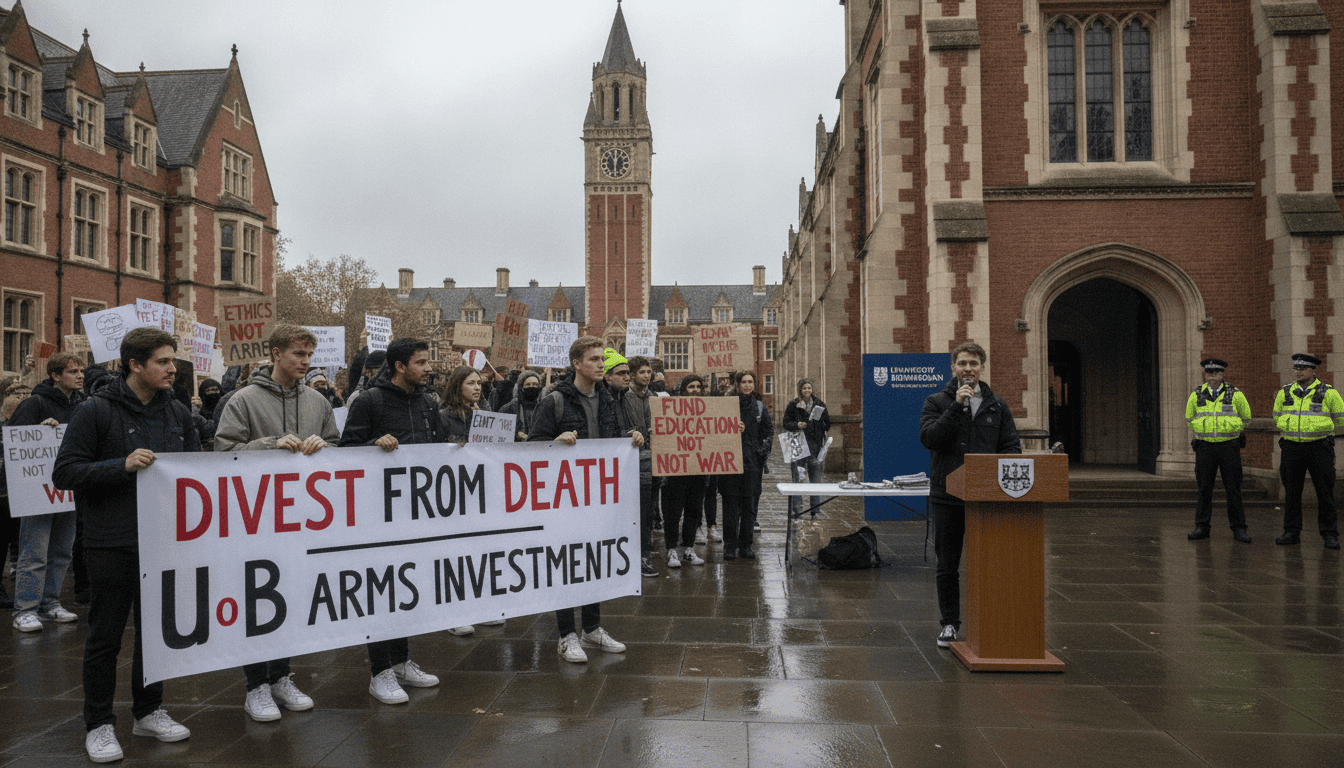
University of Birmingham criticised for loosening investment restrictions on weapons companies
University of Birmingham faces accusations of diluting its responsible investment rules by replacing explicit arms exclusions with a principles-based ESG approach, prompting concern from campaigners.
The University of Birmingham has been accused of significantly weakening its restrictions on investing in weapons companies after moving from a policy that sought to “minimise” such holdings to a new framework that emphasizes consideration of “financially material” environmental, social and governance factors. The change, which affects how investment managers identify and act on exclusion criteria, has drawn criticism from student groups, campaigners and some faculty who say it reduces safeguards against university funds supporting arms manufacturers. The dispute raises questions about how the university balances financial stewardship with ethical obligations and reputational risk.
University alters investment framework
The university has replaced a 2022 responsible investment policy that explicitly committed to incorporating ESG issues with a set of investment principles that require investment managers to account for “financially material” ESG factors. Under the new framework, investment decisions are to be guided by whether ESG considerations materially affect financial returns rather than by categorical exclusions. Critics say this shift narrows the circumstances in which companies connected to weapons systems or related activities would be avoided by the university’s endowment and other funds.
From “minimise” exclusions to materiality test
Previously, the policy directed managers to “minimise” exposure to sectors such as arms, tobacco and alcohol and to “give consideration” to specific exclusion criteria tied to weapons revenues. That approach included language aimed at companies deriving more than 10 percent of revenues from activities linked to weapon systems, as well as whole weapon system manufacturers and producers of cluster munitions and anti-personnel landmines. The new text replaces explicit exclusion guidance with a materiality test, meaning investment teams must decide whether ESG risks are financially relevant before acting to exclude or divest.
Details of the 2022 responsible investment commitment
The earlier responsible investment policy adopted in 2022 spelled out a process to integrate ESG issues into investment analysis and decision-making, giving investment managers a duty to consider predefined exclusion thresholds. Those thresholds were intended to provide clear boundaries and to limit the likelihood that university funds would be placed in companies with significant involvement in weapons production. Supporters of the 2022 policy argued that specific criteria offered transparency for stakeholders and accounted for reputational and ethical concerns associated with university holdings.
Campaigners and student groups raise concerns
Student organizations and external campaign groups have publicly accused the university of softening its stance and creating loopholes that could permit continued investment in arms suppliers. They say the removal of explicit exclusion language reduces accountability and makes it harder for the university community to scrutinize holdings. Campaigners are pressing for the university to publish more detailed guidance, disclose current holdings that may be affected, and recommit to clear exclusion criteria to align investments with institutional values.
University financial rationale and governance issues
University officials argue that adopting a materiality-driven investment framework allows professional managers to focus on risks that affect returns and to meet fiduciary duties to beneficiaries of university funds. Proponents contend that a principles-based approach can be more flexible and responsive to changing market conditions, while still enabling ethical considerations where they materially impact performance. Governance experts note, however, that without transparent thresholds or binding exclusions, interpretation rests heavily on managers’ judgments, increasing the importance of public reporting and oversight mechanisms.
Potential reputational and stakeholder impacts
Observers warn that perceived backtracking on arms-related exclusions could produce reputational damage and strain relationships with donors, students and partner institutions that view ethical investment policies as central to university identity. The debate is likely to intensify pressure on the University of Birmingham to clarify how it assesses ESG materiality and to disclose whether any holdings meet prior exclusion definitions. Legal and policy analysts say institutions adopting similar shifts often face heightened calls for transparency to reassure stakeholders that ethical risks are not being deprioritised for short-term financial gains.
The controversy now centers on whether the university will provide detailed disclosure and firm guidance to reconcile its stated commitment to ESG integration with stakeholders’ expectations for clear limits on investments in weapons-related activities.
