
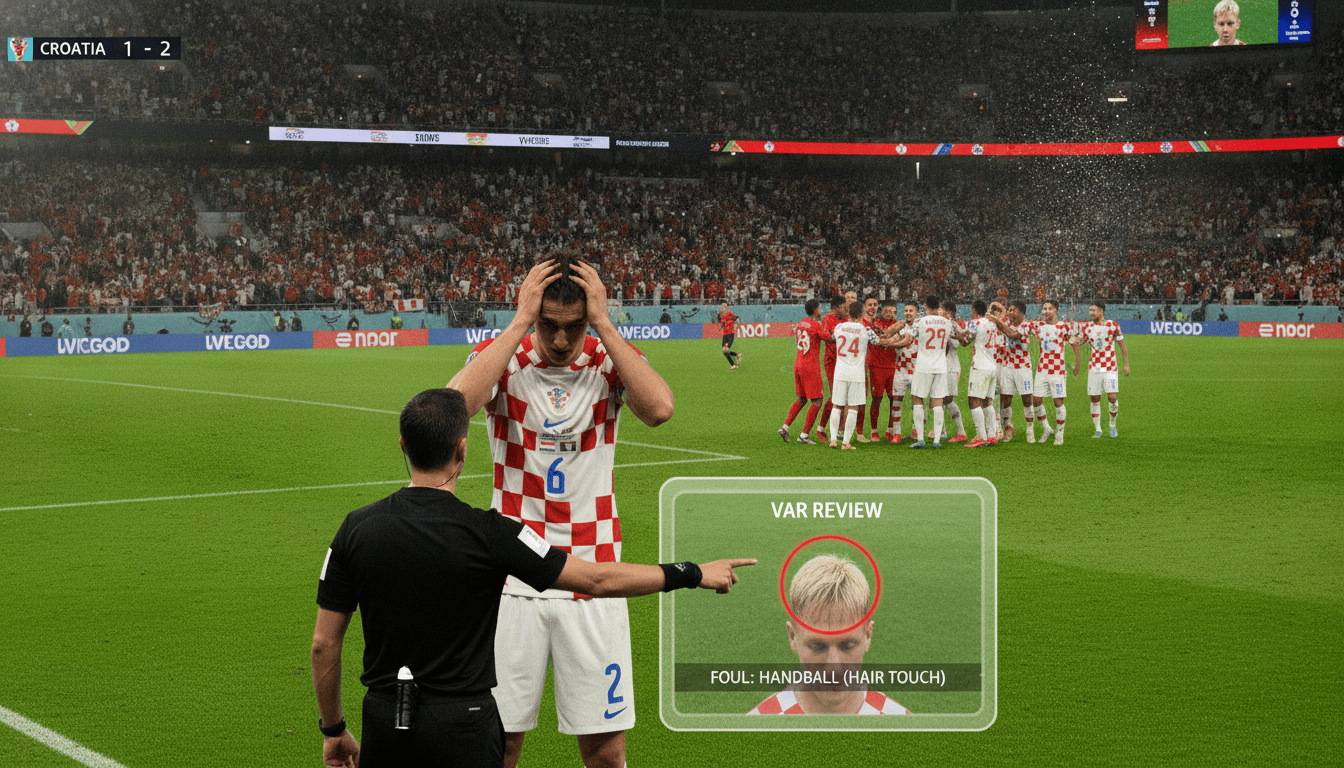
Croatia World Cup exit sealed by VAR hair-touch ruling as late Gvardiol equaliser is overturned
Croatia World Cup exit came after a dramatic VAR intervention that voided Josko Gvardiol’s late equaliser, with Igor Matanovic’s hair touch on the ball deciding the 2-1 defeat to Portugal.
Late VAR ruling overturns Gvardiol equaliser
Josko Gvardiol thought he had rescued Croatia deep into stoppage time when he headed home from a Perisic cross in the 13th minute of added time. The pitch-side celebration was cut short when the Video Assistant Referee reviewed the build-up and flagged a touch by Igor Matanovic on the way to the goal.
FIFA officials said the decision rested on data from a sensor in the match ball that recorded a minuscule contact; that evidence was used to determine that Mario Pasalic had been in an offside position when the ball reached the scorer. The disallowed goal ended Croatia’s late rally and confirmed a 2-1 victory for Portugal.
Matanovic hair touch decides tie
Igor Matanovic, who was a substitute in the sequence, said afterward that he had only felt the ball “very lightly” in his hair and that he had asked the referee for clarification immediately. The touch — measured in the nanoseconds by ball-tracking technology, according to officials — proved decisive in a tie that swung multiple times in the closing stages.
The manner of the decision has already prompted debate about the thresholds and technology used by VAR in major tournaments. For Croatia, the smallest of contacts turned into the match-defining moment and brought an emotional end to their run in the knockout stage.
Perisic and Modric drive second-half revival
Ivan Perisic put Croatia ahead in the 63rd minute with a powerful finish, becoming one of only a handful of players to score at four different World Cups. Luka Modric, again crucial in midfield, helped steer a reinvigorated Croatian performance after a subdued first half that had drawn criticism for a hesitant opening.
Mateo Kovacic regained control of the central areas in the second half, and the team adopted a more aggressive posture that nearly overturned Portugal’s advantage. Despite the comeback spirit, Portugal’s late resilience and clinical moments ultimately proved the difference.
Dalic signals end of an era for Croatian national team
At his post-match press conference, coach Zlatko Dalic said bluntly that Croatia had “reached the end of a long era,” acknowledging the likely close of a cycle that produced the nation’s most successful generation. Dalic, who has managed the team since 2017, defended his selection in previous tournaments but conceded that this squad’s core had probably played its last World Cup together.
He also praised veteran contributors and singled out Perisic and Modric for their leadership and performances, while stressing that discussions on his own future and broader team decisions would be held back home. The defeat left players and staff to contemplate transitions for the squad’s younger members.
Controversy over technology and match governance
The incident has renewed scrutiny of high-precision match technology and the balance between accuracy and the spirit of the game. Officials pointed to the ball’s internal chip as the source of the evidence used by VAR, a method that surfaces questions about how tiny, instantaneous contacts should influence match outcomes.
Broadcast images, player reactions and social media quickly amplified the debate, as observers weighed the fairness of overturning a goal for a hair-line touch against the principle of enforcing the letter of the law. Football governing bodies may face renewed pressure to clarify standards and thresholds ahead of future competitions.
Luka Modric, Matteo Kovacic and a younger crop of players were seen consoling each other on the Toronto turf as supporters and teammates processed the abrupt end to Croatia’s World Cup campaign. The emotional scenes included tears from some squad members and calm composure from veterans who have been through similar exits before.
The defeat leaves Croatia to plan for a post-Dalic, post-generation transition while younger players such as Petar Sucic and Igor Matanovic carry the immediate burden of expectation and scrutiny. For a nation that has punched above its weight at recent World Cups, the questions now center on how quickly a new competitive core can be assembled and how the sport will manage technological interventions that can hinge on the smallest of touches.
