
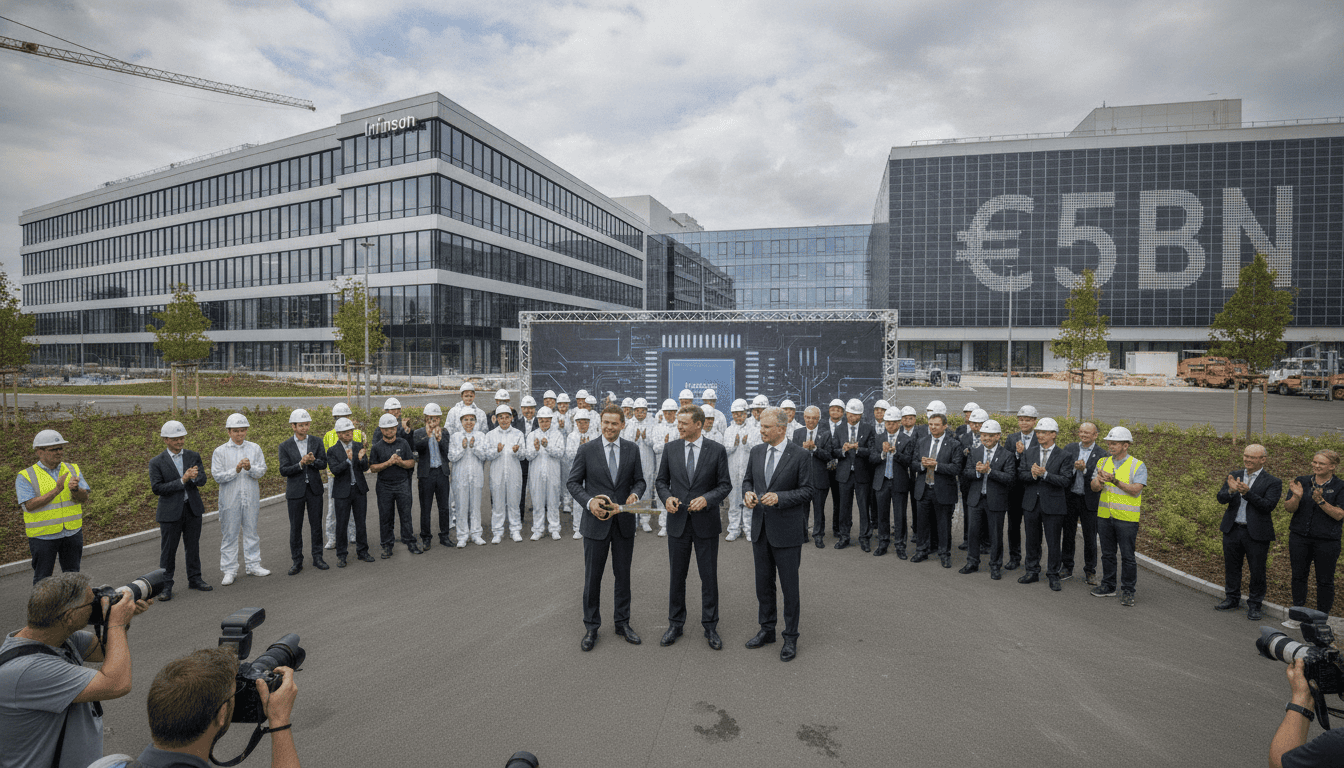
Infineon Dresden chip factory opens Smart Power Fab in Dresden, three months early
Infineon Dresden chip factory Smart Power Fab opens after a three-year build; €5 billion investment, €920 million EU support, doubled capacity and roughly 1,000 new jobs.
Infineon Technologies has inaugurated its new Smart Power Fab in Dresden, completing the facility three months ahead of its original schedule and marking the company’s largest single investment. The Infineon Dresden chip factory will more than double the site’s production capacity and is designed to supply power semiconductors for electric vehicles, renewable energy systems, data centers and industrial applications. Company executives described the plant as a strategic step toward European technological sovereignty backed by public and EU funding.
Infineon opens Smart Power Fab in Dresden three months ahead of schedule
The new Smart Power Fab began operations after a construction period that started in May 2023 and concluded in mid‑2026, shaving roughly three months off the planned timetable. Infineon executives said the facility ranks among the most advanced semiconductor production sites globally. The company emphasized the significance of delivering the plant early amid intense global competition for microchip capacity.
Construction was accelerated through concerted planning and project management, according to company statements. Management framed the early completion as evidence that European manufacturing can scale rapidly when regulatory processes and approvals are aligned with industrial timelines.
€5 billion investment and capacity doubling at Dresden site
Infineon invested approximately €5 billion in the Smart Power Fab, the largest amount the company has ever deployed on a single project. The investment is expected to double the production capacity at Infineon’s Dresden campus, which the company says already accounts for a significant share of Europe’s chip output. Infineon plans to use the expanded capacity to meet rising demand across several high‑growth sectors.
The company highlighted that the new fab will produce so‑called power semiconductors—components that help manage and convert electrical energy more efficiently. Management projects that the additional output will be critical for applications requiring high reliability and energy efficiency.
European Chips Act funding and public partners
The project received €920 million in support under the European Chips Act, with the EU Commission approving the aid in February 2025. National and state authorities also participated in the funding package, underscoring a joint public‑private effort to bolster semiconductor capacity in Europe. Infineon and officials framed the financing as an example of targeted industrial policy to secure supply chains for strategic technologies.
Company leaders pointed to the funding as a validation of Europe’s push to reduce dependency on foreign chip producers. Officials involved in the approvals said the aid was intended to accelerate domestic production of critical components for electrification and digital infrastructure.
Production focus: power semiconductors for EVs, renewables and AI data centers
The Smart Power Fab will specialize in power semiconductors designed for electric vehicles, renewable energy installations, industrial equipment, the Internet of Things and AI data centers. Infineon noted that these components can help reduce the electricity consumption of large processor farms, a growing concern as demand for AI compute rises. The company aims to position its output as a lower‑energy alternative that enables more efficient systems across multiple industries.
Industry analysts say expanding local production of such chips could ease bottlenecks in the supply of parts critical to the energy transition and vehicle electrification. Infineon’s focus on energy efficiency aligns with customers seeking to lower operating costs and emissions.
Construction scale and engineering details of the new plant
The new building comprises six levels centered on a large cleanroom for chip fabrication, spanned by a 5,000‑ton steel structure. During construction, the project used approximately 50,000 cubic meters of concrete and some 25,000 tonnes of steel. Infineon described the scale and technical complexity of the facility as comparable to the most advanced fabs in the world.
Project managers credited tight scheduling and prefabrication where possible for enabling the rapid construction pace. The engineering layout prioritizes both production throughput and maintainability, the company said, to support long‑term competitiveness.
Employment, regional impact and cluster growth in Saxony
Infineon expects the Dresden expansion to create around 1,000 new jobs directly at the site, complementing the firm’s existing workforce. According to its latest semiannual financial report released at the end of March 2026, Infineon employed about 56,500 people globally. Local officials and company leaders said the factory will strengthen Dresden’s role as a European semiconductor hub that already hosts other major players.
The arrival of global foundries and further expansions by established manufacturers have led planners to forecast sizable growth in regional chip employment; projections cited by industry participants estimate the chip workforce in the Dresden region could rise toward 100,000 by 2040. Supporters say the cluster will generate opportunities across vocational training, engineering and advanced manufacturing.
Environmental measures and resource efficiency for operations
Infineon said the Smart Power Fab was built with environmental safeguards and resource‑saving systems. The plant will source electricity from renewable sources, use industrial water supplies rather than drinking water for processing needs, and deploy internal recycling systems to reuse production water multiple times. The company described these measures as integral to lowering the environmental footprint of chip manufacturing.
Operations teams added that ongoing monitoring and offset measures were part of contractual obligations tied to the factory permits. Infineon framed sustainability as both a regulatory requirement and a competitive advantage given customer interest in lower‑impact supply chains.
The new Smart Power Fab in Dresden combines a major private investment with public support and promises a boost to Europe’s semiconductor capacity, particularly for power components used in electrification and energy‑intensive computing. As the plant moves into production, attention will turn to how quickly output scales to meet industry demand and how the expanded campus integrates with regional supply chains and workforce development efforts.
