
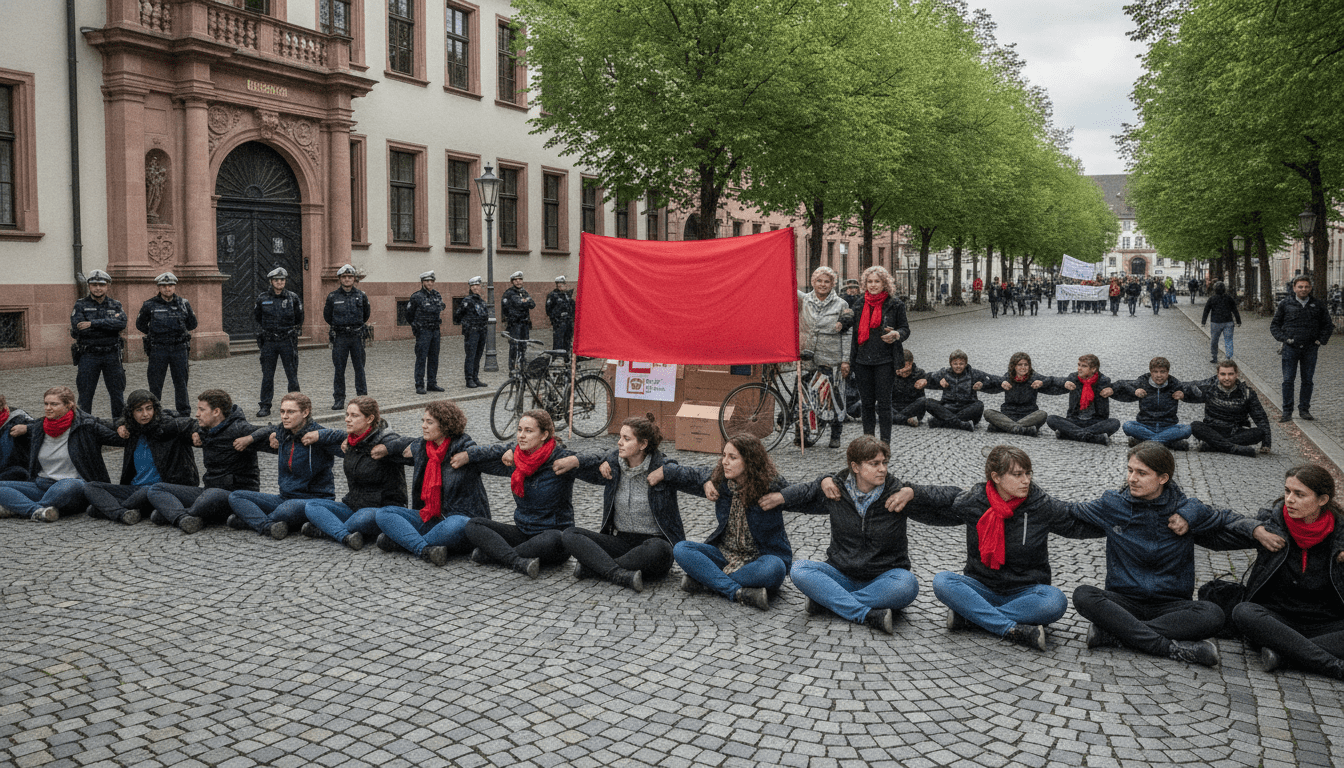
AfD party congress in Erfurt draws plans for large nonviolent blockades and police readiness
Left party backs nonviolent blockades ahead of AfD party congress in Erfurt on July 4–5, 2026, as authorities prepare for tens of thousands of counterdemonstrators.
Germany’s Left party on Monday publicly endorsed nonviolent blockade actions aimed at disrupting the AfD party congress in Erfurt, scheduled for July 4–5, 2026, setting the stage for a major confrontation of protest tactics and law enforcement response. The announcement, joined by trade unions, the Green Party and other groups, escalates mobilization plans even as Thuringian authorities warn that preventive “shut-down” blockades could exceed legal protections. Police sources cited by Welt am Sonntag estimate 35,000 to 50,000 counterdemonstrators, a figure that local officials say will require detailed operational planning and firm enforcement of assembly law.
Left party signals support for disruptive, nonviolent protest
The Left’s leadership framed the action as a legitimate expression of political opposition while stressing a commitment to nonviolence. Party chair Ines Schwerdtner said the Left would support protests capable of preventing the AfD’s event from proceeding in its usual form, and described public, nonviolent blockade as an appropriate tactic against what the party labels as anti-democratic forces. Other progressive groups have echoed the call, planning a range of street demonstrations and sit-ins in Erfurt during the two-day congress.
Organizers emphasize civil disobedience rather than confrontation, and have sought to set clear boundaries aimed at avoiding physical clashes. The message to participants has focused on disciplined, peaceful obstruction designed to maximize disruption of the AfD’s ability to convene. Protest coordinators are also planning legal briefings and marshals to reduce the risk of escalation and to help demonstrators understand their rights and limits under German assembly law.
AfD leadership escalates rhetoric ahead of congress
Senior AfD figures have responded to the protest calls with sharp rhetoric that frames the planned resistance as an existential threat. State AfD chairman Björn Höcke described the prospect of mass demonstrations in alarmist terms, while other party voices portrayed the opposition as violent and dishonest. The party’s vice parliamentary leader cast the mobilization as an attempt to silence a growing political force, asserting that rising support for the AfD would not be deterred by street protests.
The AfD has sought to use those warnings to rally its own supporters to the Erfurt event and to portray the gathering as a necessary defense of democratic expression. Party communications in recent days have mixed bellicose language with calls for a strong turnout on July 4–5, 2026, aiming to pre-empt the planned counterdemonstrations and to delegitimize the blockade strategy.
Interior minister says preventive blockades fall outside assembly rights
Thuringia’s interior minister, Georg Maier, has publicly rejected the legal basis for preventive shutdown blockades, telling regional media that attempts to preclude a lawful assembly are not protected by the right to demonstrate. Maier urged anyone exercising protest rights to do so peacefully and warned that authorities would intervene should demonstrations aim to make the party congress impossible to hold. He emphasized that the police would apply assembly law consistently to both protect lawful protest and to prevent illegal disruption.
Maier’s office made clear that security planning will prioritize the enforcement of court orders and the protection of public safety, while still accommodating peaceful dissent. The minister’s comments signal that authorities are preparing legal and operational tools to differentiate permitted demonstrations from actions that courts and police could deem unlawful.
Police prepare for mass counterdemonstrations and enforcement
Internal police assessments reported by Welt am Sonntag anticipate between 35,000 and 50,000 counterdemonstrators converging on Erfurt for the congress, a scale that would push local law enforcement to deploy significant personnel and logistical resources. Police briefings reportedly include plans for cordons, controlled access routes, and designated protest zones, alongside contingency measures to break up blockades that cross into illegal territory. Officials said resources from other states could be requested to bolster capacity if required.
Authorities also plan to issue public guidance on permitted routes and assembly points in the days before the congress, aiming to channel large crowds into areas where maintenance of order is more feasible. Organizers on all sides have been notified that any form of violence will prompt immediate police action and potential legal consequences, a stance meant to deter escalation while preserving the ability of different groups to demonstrate within legal limits.
Local logistics and civic impact as Erfurt braces for disruption
City officials in Erfurt are preparing for transport disruptions, road closures and the likely temporary closure of some public facilities during the July 4–5 timeline. Businesses, schools and municipal services have been alerted to expect interruptions and to plan accordingly, while emergency services have revised deployment schedules to maintain coverage amid large public gatherings. The economic and civic impacts of a high-profile protest weekend are a concern for local administrators balancing order and the right to protest.
Residents have received information on alternative routes and advised on safety precautions, and municipal coordination meetings are ongoing to synchronize police, transport and health services. The aim is to minimize harm to bystanders and local commerce while enabling lawful demonstrations to proceed in designated areas where possible.
Tensions ahead of the AfD party congress in Erfurt highlight a broader national debate over the boundaries of protest and the responsibilities of authorities to protect both lawful assembly and public order. As July 4 and 5 approach, organizers, political leaders and security services face the task of preventing violence while respecting citizens’ rights to march, assemble and voice dissent.
