
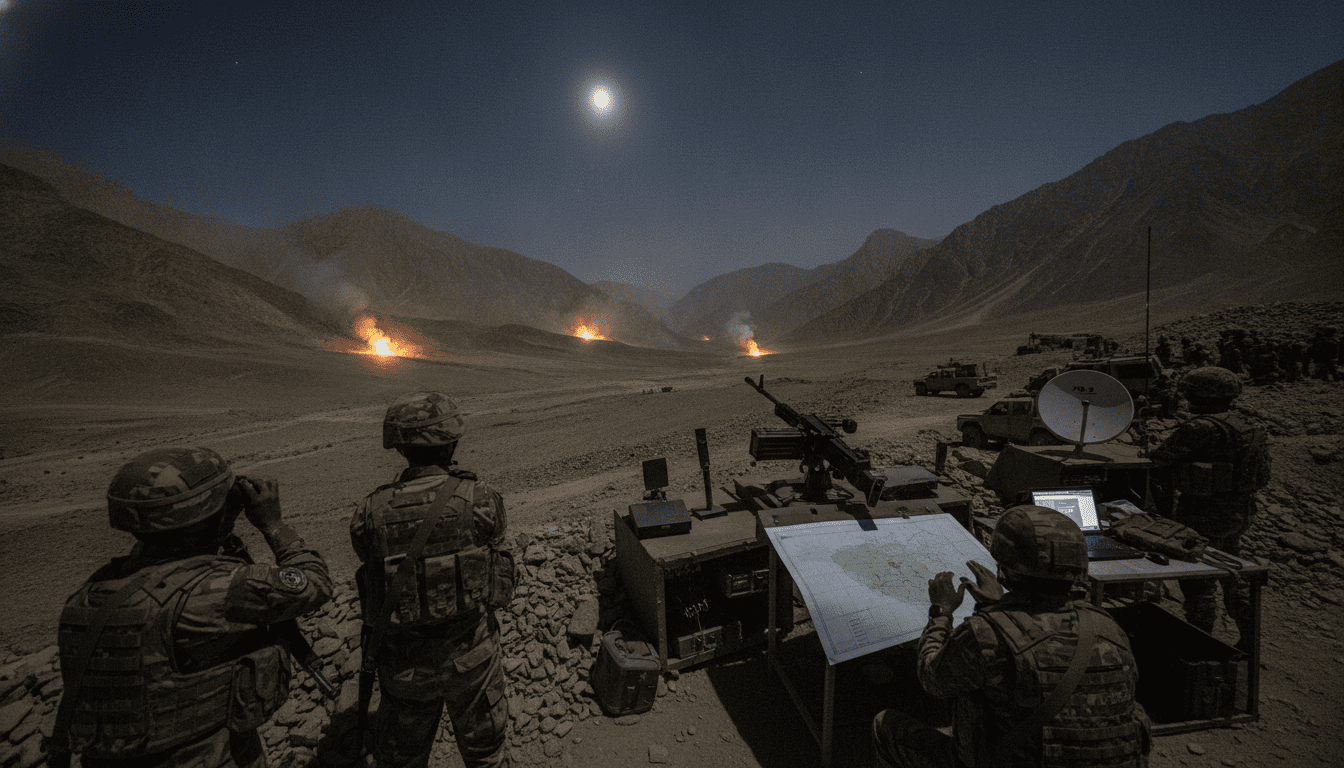
Pakistan attacks Afghanistan: Cross‑border ground operation and airstrikes hit TTP hideouts, Islamabad reports
Pakistan attacks Afghanistan with cross‑border ground operation followed by airstrikes in Paktia, Paktika and Kunar, Islamabad says 29 militants were killed.
Pakistan launched a coordinated ground operation along the Afghan border and followed it with airstrikes that targeted hideouts and fallback positions used by militant groups, Islamabad said. Information Minister Ataullah Tarar said the strikes struck three sites in the provinces of Paktia, Paktika and Kunar and that 29 extremists were killed. The government framed the action as a direct response to recent attacks inside Pakistan, including a deadly incident in Karachi claimed by Jamaat‑ul‑Ahrar.
Details of the operation and reported toll
Ataullah Tarar wrote on social media that Pakistani security forces carried out the ground incursion along the Pakistan‑Afghanistan frontier before conducting precision airstrikes on militant encampments. According to the statement, three separate targets were destroyed in eastern Afghan provinces that border Pakistan. Islamabad’s tally of 29 militants killed comes from military sources; independent verification from on‑the‑ground teams in the targeted areas was not available at the time of the report.
Targets named: Paktia, Paktika and Kunar
The strikes were concentrated in Paktia, Paktika and Kunar provinces, areas long associated with cross‑border militant activity and complex tribal terrain. Officials in Islamabad said the destroyed locations included logistical hubs and safe houses used by Tehrik‑e‑Taliban Pakistan (TTP) and affiliated groups. Afghan local officials and independent monitors have previously documented militant movement through these mountainous border zones, complicating verification of individual strike claims.
Karachi attack cited as immediate trigger
Pakistani authorities framed the operation as retaliation for a string of attacks on security personnel, highlighting an incident in Karachi in which three security officers were killed. Pakistani officials say three attackers were also killed and one was wounded; the wounded assailant was identified by the military as an Afghan national. The Karachi attack was claimed by Jamaat‑ul‑Ahrar (JuA), a splinter group of the Pakistani Taliban, which Islamabad and its security agencies have repeatedly blamed for urban and cross‑border violence.
Afghan Taliban government condemns strikes, cites civilian casualties
A spokesman for the de facto Taliban administration in Kabul, Sabiullah Mujahid, denounced the Pakistani strikes and said they resulted in civilian deaths and injuries, including women and children. Mujahid called the operation a crime and “a cowardly act of aggression,” urging the international community to take notice. Kabul’s account marks a sharp contrast with Islamabad’s framing and raises immediate concerns about civilian harm amid densely populated and hard‑to‑monitor border districts.
History of reciprocal attacks and fragile ceasefires
Cross‑border violence between Pakistan and Afghanistan has surged intermittently since autumn of the previous year, driven largely by Islamabad’s accusations that Afghan territory shelters militants who carry out attacks inside Pakistan. The TTP, while organizationally distinct from the Afghan Taliban, has maintained an alliance that has complicated bilateral trust. After a period of tentative de‑escalation and a localized truce, Pakistan declared an “open war” at the end of February, signaling a return to more aggressive operations targeting alleged insurgent sanctuaries.
Risks of escalation and regional implications
The strikes underscore how quickly tit‑for‑tat dynamics can escalate into wider confrontations along the porous border, raising risks for civilians and for diplomatic relations between Islamabad and Kabul. Pakistan is a nuclear‑armed state, and any broadening military confrontation in the region would prompt international concern about stability in South Asia. Analysts warn that continued cross‑border operations, retaliatory attacks and the involvement of multiple militant factions could further destabilize border districts already coping with displacement and limited humanitarian access.
Pakistan attacks Afghanistan have become part of a broader, recurring pattern of security operations and insurgent reprisals that regional governments and international observers say require a political as well as a military response. Military pushbacks may disrupt militant networks temporarily, but officials on both sides acknowledge that long‑term solutions depend on sustained dialogue, border management and counter‑radicalization efforts.
The immediate aftermath of the latest strikes is likely to feature competing narratives from Islamabad and Kabul, hasty damage assessments in affected Afghan provinces, and renewed calls from local and international actors for restraint. As details remain contested, residents along the border face an uncertain security environment and mounting humanitarian pressure.
