
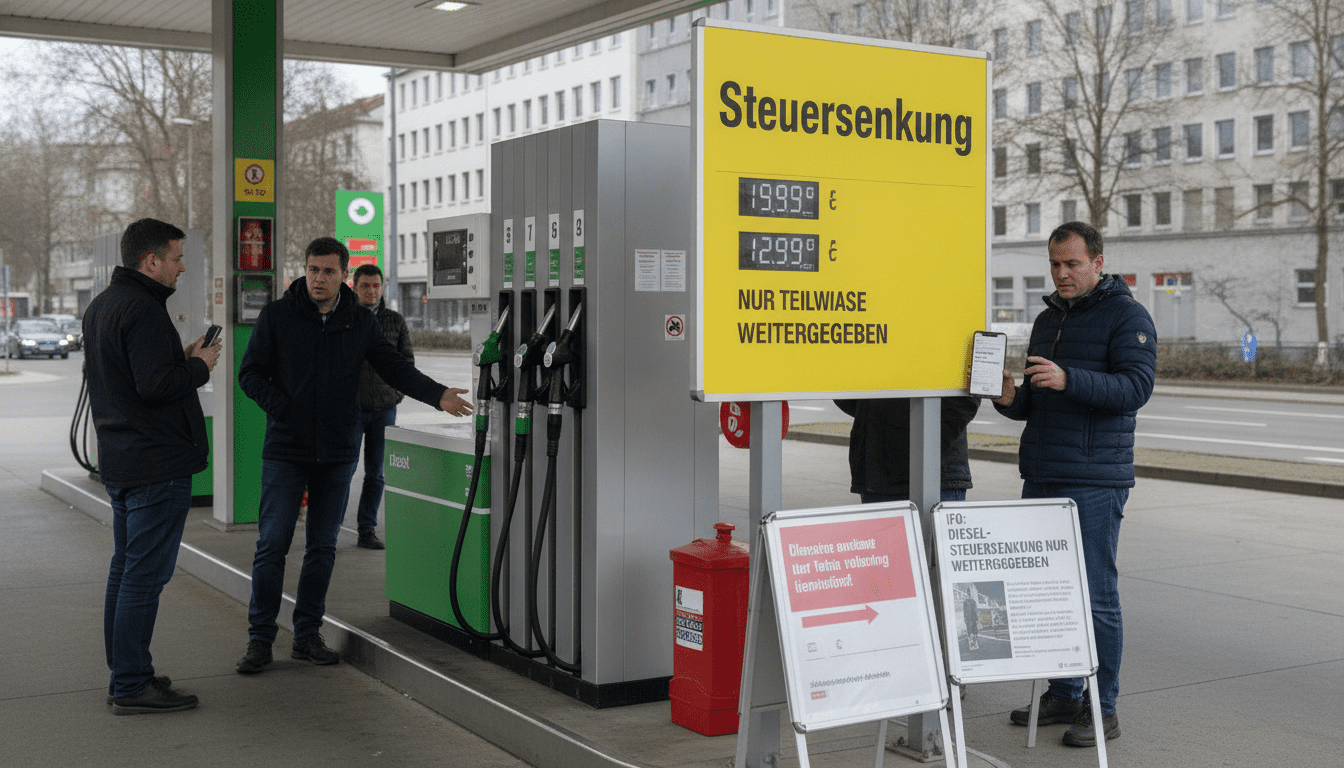
Ifo: Tank rebate passed almost fully to petrol drivers but only partly to diesel users
Ifo: Germany’s tank rebate was passed nearly fully to petrol drivers but only partly to diesel users; prices could rise after the rebate ends in July 2026.
Germany’s temporary tank rebate has been transmitted unevenly to motorists, with petrol drivers receiving most of the relief while diesel users have seen only a fraction of the tax cut at the pump. The Munich-based Ifo Institute calculated pass-through rates using prices up to June 25, 2026 and found diesel stations averaged a 12-cent-per-litre reduction compared with a 16.7-cent tax cut. The discrepancy has reignited debate about market behaviour, pricing mechanisms and the short-term impact of fiscal measures on households.
Ifo finds diesel pass-through at 12 cents per litre
The Ifo Institute’s analysis shows diesel retailers passed on an average of 12 cents per litre to consumers through June 25, 2026, short of the 16.7-cent reduction in fuel tax. That gap suggests diesel buyers captured roughly three-quarters of the intended relief, leaving residual margin or costs absorbed upstream. The institute emphasized the figures cover the period to June 25 and represent national averages rather than uniform outcomes across all stations.
Petrol motorists received near-full benefit
By contrast, Super E5 and Super E10 motorists saw pass-throughs close to the full value of the tax cut, with calculated reductions of 17 and 16 cents per litre respectively. Florian Neumeier, deputy head of Ifo’s public finance unit, said the findings indicate the tank rebate for super petrol was passed on “almost completely” to drivers. The near-complete transmission to petrol users means the fiscal relief reached many consumers more directly than diesel-focused measures did.
Ifo methodology and data window
Ifo economists based their calculations on pump price movements and the government’s announced tax reduction, comparing observed retail price changes with the 16.7-cent statutory cut. The institute’s estimates reflect price data collected through June 25, 2026 and exclude subsequent days when supply adjustments or local promotions may have altered pass-through dynamics. The researchers noted that short-term volatility in wholesale oil markets and station-level pricing strategies can affect measured pass-through in the weeks after a policy change.
Price outlook as the rebate expires in early July 2026
Ifo warned that fuel prices are likely to rise again when the tank rebate ends in early July 2026, with the magnitude of any rebound depending heavily on the oil price. The institute pointed to recent declines in crude that had helped moderate pump prices even as the rebate was in place. If crude returns to higher levels or stations adjust margins upward after the expiry, consumers should expect higher retail prices at the start of July.
Possible reasons diesel lagged behind petrol
Economists and industry observers offer several explanations for why diesel did not see full pass-through. Diesel markets have different demand elasticities and a smaller retail footprint in some regions, which can reduce competitive pressure to pass tax cuts through immediately. Logistics and inventory timing also matter: stations selling diesel purchased at earlier, higher wholesale prices may be slower to reflect tax changes. Additionally, commercial diesel demand from freight and agricultural users can alter station pricing strategies compared with petrol, where retail competition is often stiffer.
Implications for policy and households
The uneven transmission of the tank rebate raises questions about the design and effectiveness of short-term tax cuts as a tool for consumer relief. Policymakers seeking fast-acting benefits may need to consider complementary measures or monitoring mechanisms to ensure intended savings reach end users. For households, the differing pass-through rates mean petrol drivers may have felt more immediate relief than diesel-dependent commuters and businesses, affecting household budgets and transport costs in the short term.
Ifo said it will continue to monitor price developments after the rebate expires and assess how wholesale oil movements and station-level behaviour influence final retail prices. The institute’s findings offer an early snapshot of the policy’s impact but underline that pass-through can change quickly as markets and margins adjust in the weeks following a tax change.
