
German Greens Seek Centrist Rebound in Sassnitz Ahead of Two Crucial State Elections
German Greens present a centrist alternative in Sassnitz, attacking the federal coalition and proposing regional electricity pricing ahead of key state elections.
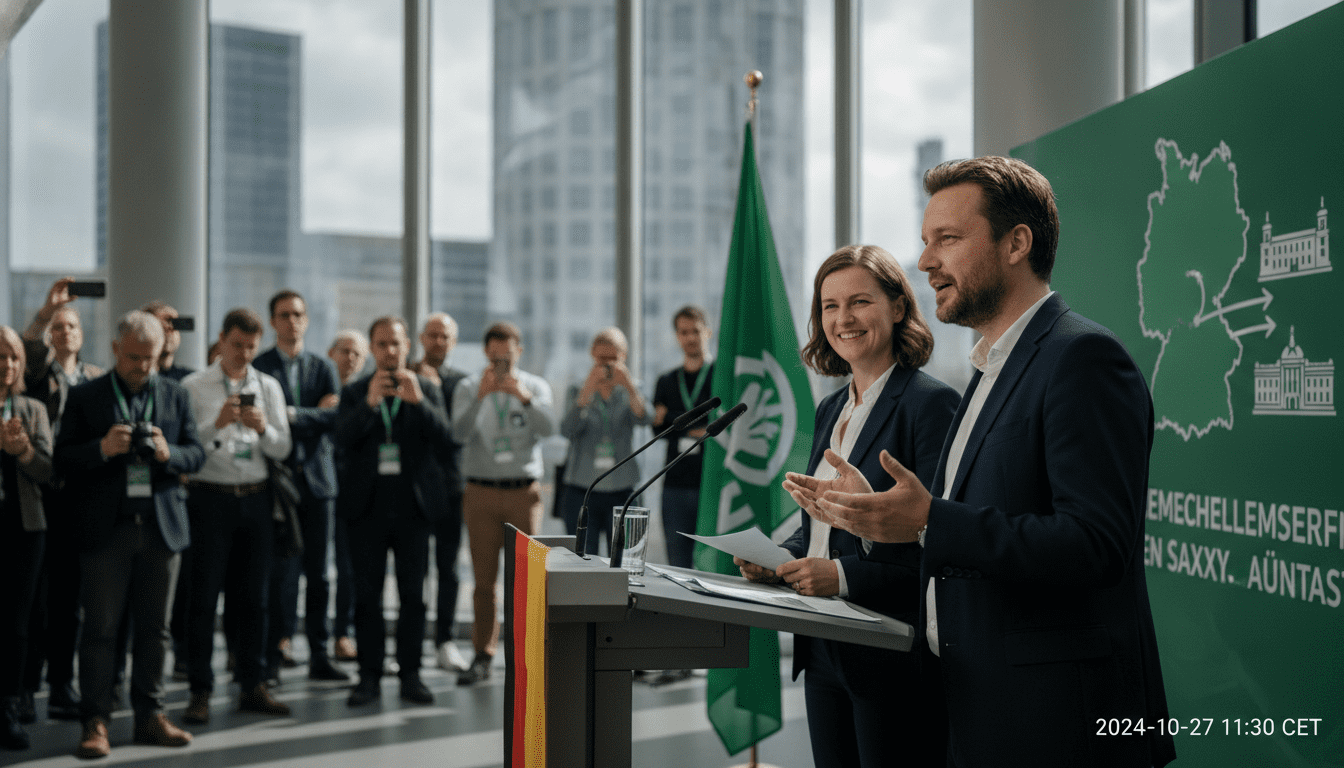
The German Greens used a compact party meeting in Sassnitz to position themselves as a democratic-centre alternative to the federal coalition and to sharpen a campaign focus ahead of the Mecklenburg-Vorpommern and Saxony-Anhalt state elections. Party leaders Felix Banaszak and Franziska Brantner sharply criticized the federal government’s rhetoric and spending choices, while senior MPs highlighted recent heat-related events as evidence of policy failure. The gathering combined political critique with a concrete policy push on regional electricity pricing and a strategic pitch that entering both state parliaments would curb the AfD’s influence.
Leadership Criticizes Federal Coalition
Felix Banaszak accused the governing coalition of contributing to a toxic public mood by lecturing citizens and stressing austerity themes that, he said, ignored people’s daily realities. Franziska Brantner targeted the narrative that either spending cuts or tax reductions alone will solve public-service shortfalls, arguing the Greens will pursue a balanced agenda. The leadership framed the party’s role as defending strong public services—schools, health care and pensions—while also insisting on fairer taxation for the very wealthy.
Electoral Stakes in Mecklenburg-Vorpommern and Saxony-Anhalt
Polls in both Mecklenburg-Vorpommern and Saxony-Anhalt currently place the Greens near or below the threshold for parliamentary representation, a reality the party acknowledged at the meeting. Delegates described the upcoming contests as make-or-break tests for the Greens’ ability to claim relevance outside municipal and federal arenas.
The party argued that securing seats in both state parliaments would not only advance their policies locally but would also fragment the vote landscape in a way that makes it harder for the AfD to assemble majorities. Claudia Müller, the Greens’ lead candidate in Mecklenburg-Vorpommern, reiterated that a Green presence in the regional assembly would be a practical bulwark against far-right dominance.
Climate Response and Heatwave Criticism
Several speakers used recent weekend heat spikes to underscore what they called governmental inaction on climate adaptation and mitigation. Britta Haßelmann and other MPs described official responses as inadequate and argued that visible climate impacts underscore the need for faster, more ambitious policy measures. The criticism blended urgency on immediate protections with calls for long-term investment in resilience and emissions reductions.
Policy Proposal: Regional Electricity Pricing
The party unveiled a prominent policy plank aimed at lowering electricity costs in the regions where renewable power is produced, arguing this would align prices with local generation and social fairness. Under the proposal titled “Nah am Menschen, stark im Wandel,” the Greens seek mechanisms to make electricity cheaper at the point of production in wind and solar-rich areas, while maintaining affordability for consumers overall.
Advocates said the move responds to structural mismatches in Germany’s current system, where a single nationwide spot price governs transactions even though generation concentrates in the north and east and industrial load centers are mainly in the south and west. They also pointed to grid bottlenecks that sometimes force renewable producers to curtail output; regional pricing, the Greens argue, would reduce such waste and better reflect local value.
Strategy to Limit AfD Influence
Party strategists framed the campaign as not only advancing Green priorities but also as pragmatic politics intended to reduce the AfD’s parliamentary leverage. They contend that a more plural assembly complicates the arithmetic required for the AfD to convert voter leads into governing power. At the Sassnitz meeting, speakers repeatedly linked the goal of re-entering state parliaments to the broader task of defending democratic norms and pluralism.
The strategy blends policy detail with electoral arithmetic: by making the case for centrist, socially balanced climate and economic proposals, the Greens aim to attract voters who might otherwise drift to established parties or to protest options.
Final paragraph
As the campaign season intensifies, the German Greens face the twin challenges of translating national critiques into local votes and convincing regional electorates that their proposals will yield tangible benefits. The Sassnitz meeting set a clear course: sharpen criticism of the federal coalition, foreground climate and social-policy proposals, and run explicitly to prevent far-right consolidation in two closely watched states.
