
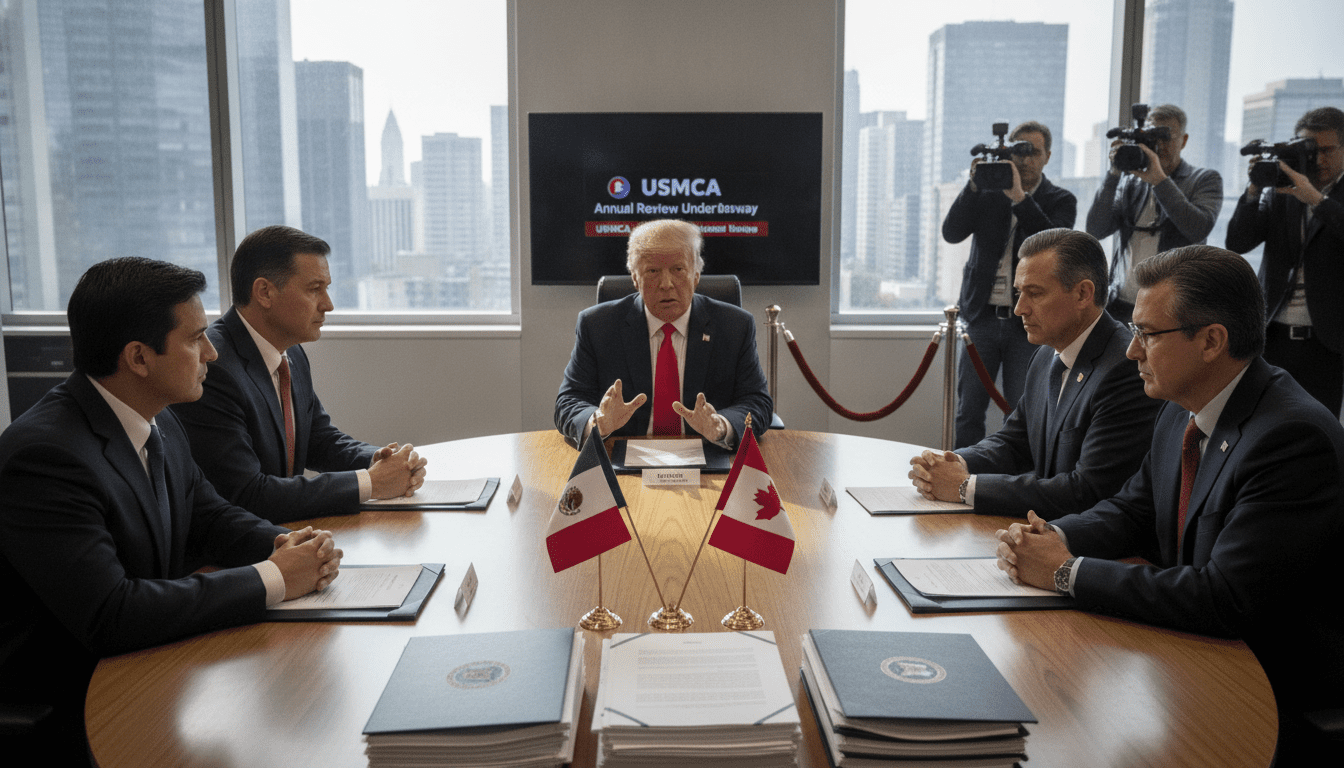
USMCA review set to test North American trade as July 1 deadline looms
As the USMCA review begins July 1, 2026, uncertainty over U.S. commitment threatens tariffs, supply chains and investment, hurting businesses across the region.
The sixth anniversary review of the United States–Mexico–Canada Agreement (USMCA) opens a window for the three partners to decide whether the pact will extend for another 16 years or shift to an annual renewal process. Analysts say ambiguity from Washington, and particularly statements by President Donald Trump, have lowered the odds of a straightforward renewal and raised stakes for cross-border trade and investment.
July 1 deadline puts USMCA up for renewal
The USMCA entered into force on July 1, 2020, with a built‑in joint mandatory review scheduled for its sixth anniversary. If the three governments do not agree to extend the deal, the pact moves to an automatic annual review until 2036, a structural change that would keep the agreement under periodic debate.
Officials from Canada and Mexico have publicly urged continuation, citing legal certainty for businesses and the shield the agreement provides against ad hoc tariffs. Yet Washington’s posture remains unsettled, making July’s meetings pivotal for exporters and supply‑chain planners across the continent.
Trump signals mixed position on renewal
President Trump has given mixed signals in recent weeks, at times questioning the need to renew the USMCA and at others indicating a willingness to negotiate terms with Canada and Mexico. His comments have injected fresh political risk into an otherwise technical review process.
Observers caution that presidential ambiguity can translate quickly into market and policy uncertainty, especially when the U.S. administration retains legal tools to impose or lift tariffs independent of trade‑agreement status.
Annual reviews would increase business uncertainty
Economists warn that moving to annual renewals would be a major headwind for commercial decision‑making. Tony Stillo, director of Canada Economics at Oxford Economics, said that perpetual annual reviews would keep uncertainty alive and complicate investment and hiring choices for firms operating across borders.
Vina Nadjibulla of the Asia Pacific Foundation of Canada has described the negotiating dynamic as unclear, asking whether incremental changes will be accepted or whether no agreement will stand until all parties sign off. That ambiguity is already prompting some businesses to reassess procurement and contingency plans.
Tariff tools and legal manoeuvres under scrutiny
Beyond the procedural question of renewal, the review highlights how U.S. trade policy tools have been used in recent years. The Trump administration has turned to measures such as Section 232 of the Trade Expansion Act and other statutory authorities to impose tariffs on steel, aluminum and other products, sometimes affecting even goods that meet USMCA rules.
Legal contests over tariff authorities and the use of emergency powers have continued to reshape the trade environment, complicating how protections in the USMCA translate into practice for exporters and importers.
Exposure of U.S. states and industries to a deal’s fate
Data analyses cited by trade researchers show that many U.S. states and industries are heavily reliant on exports to Canada and Mexico. Agricultural and manufactured goods, automotive inputs, aircraft parts and energy products all flow under the USMCA framework, generating significant revenue for regional economies.
Economists warn that terminating or weakening the pact could prompt retaliatory measures, supply‑chain disruption and searches for alternative markets — outcomes that would hit specific states and sectors harder than the national economy as a whole.
Canada and Mexico press for continuity and tariff relief
For Canada and Mexico, continued access under the USMCA is central to economic planning and recovery prospects. Both governments have indicated a clear preference for keeping the agreement in force and seeking tariff relief where U.S. duties have weighed on trade flows.
Analysts say that, absent a clear extension on July 1, Ottawa and Mexico City may accelerate diversification efforts, seeking deeper ties with other partners to reduce exposure to U.S. policy shifts. Such moves would reflect a broader push by businesses to hedge against political unpredictability.
The outcome of the July review will reverberate across boardrooms and government offices in North America, shaping investment timetables and supply‑chain choices for years to come. If leaders fail to agree on a 16‑year extension, the shift to annual reviews would formalize a new era of uncertainty that policymakers and firms will have to manage proactively.
