
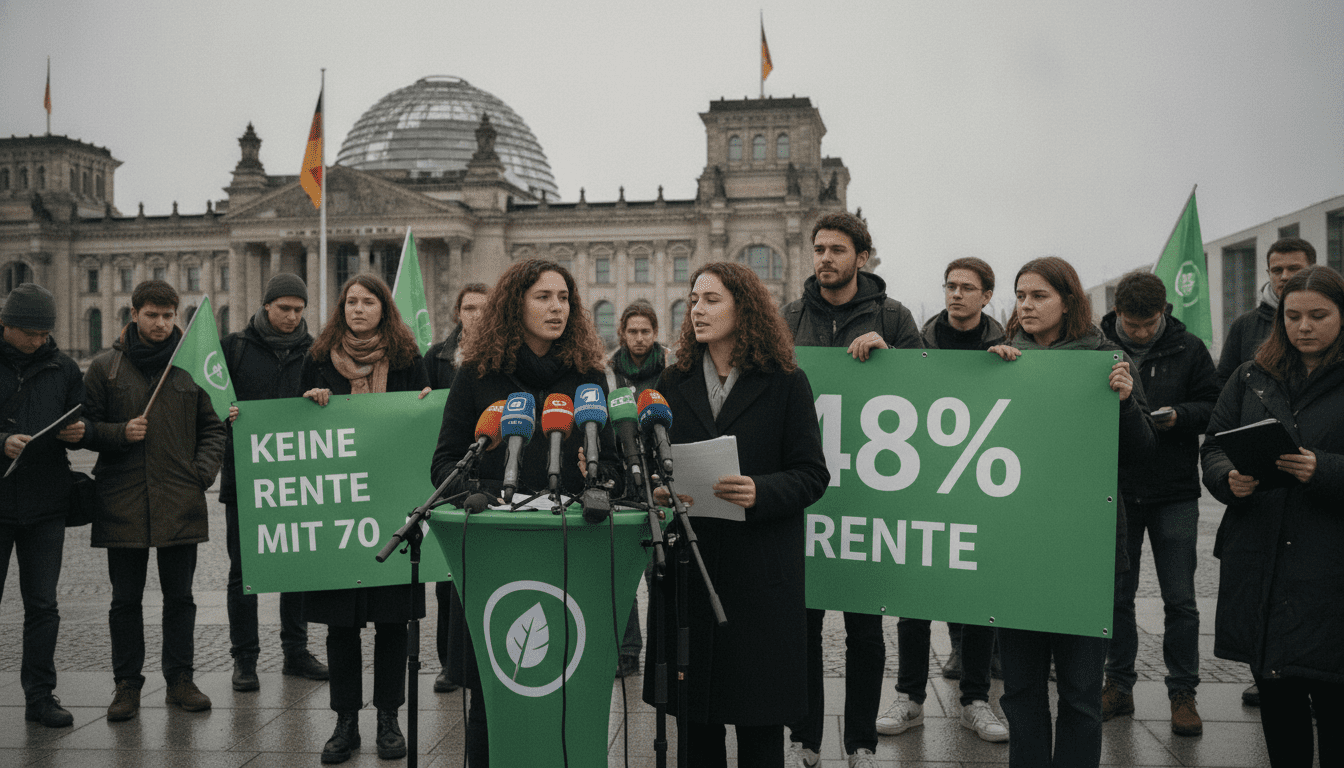
Young Greens reject retirement at 70 and call to strengthen statutory pension protections
Young Green MPs oppose raising the retirement age to 70 and demand a statutory pension at 48% with top-ups for small pensions and higher taxes on the wealthy.
The left flank of the Green Party has published a policy paper opposing proposals to raise the retirement age to 70 and urging stronger protections for the statutory pension. The document, circulated by younger Green Bundestag and European Parliament members, calls for maintaining a pension level of at least 48 percent, targeted top-ups for low pensions and tax measures to shore up financing. The group frames the debate as a question of social justice rather than an intergenerational conflict and positions the statutory pension at the centre of its demands.
Younger Greens mobilize against a higher retirement age
The paper, co-authored by Bundestag member Timon Dzienus and signed by 17 Green MPs alongside a member of the European Parliament and the leaders of the Green Youth, explicitly rejects talk of a retirement age of 70. Dzienus invoked the long-standing declaration that “the pension must be secure” and argued the party needs “pension rescuers” rather than “pension rebels.” The signatories warn that proposals to push back the retirement age would ignore the living realities of many workers and risk increasing old-age poverty.
The group says the statutory pension has been portrayed more negatively than warranted and stresses that stabilizing and strengthening the pay-as-you-go system should be the priority. They point to two decades of a stable federal subsidy and an unchanged contribution rate despite a growing number of pensioners as evidence that the system remains manageable if political choices are made differently. Their message aims to shift the tenor of the intra-party debate ahead of decisions expected from a pension commission.
Proposal to anchor pension level at 48 percent
The authors demand that the pension replacement rate — the measure of how a 45-year career at average wages translates into retirement income — be kept at a minimum of 48 percent. They argue that a concrete target will provide predictability for workers and guard against gradual erosion of benefits. The paper calls not only for preserving the level but for a roadmap that allows the replacement rate to rise noticeably over time.
Maintaining a defined pension level is presented as both an economic and political safeguard, the signatories say, because it links current employment and contributions to a predictable retirement outcome. This explicit target is offered as an alternative to abstract fiscal rules that critics argue incentivize benefit cuts and later retirement.
Top-ups for low pensions and new revenue streams
To reduce the risk of old-age poverty, the proposal includes targeted top-ups for small pensions rather than across-the-board cuts or blunt increases in the retirement age. The authors suggest lifting the lowest pensions by a defined amount to ensure a dignified minimum standard of living for long-term contributors. Those measures are framed as investments in social cohesion and the long-term sustainability of the statutory pension.
Funding proposals in the paper focus on progressive tax reforms and tapping higher incomes and wealthier households to shoulder a larger share of pension financing. Co-author Karoline Otte said people with the greatest means “must not shirk responsibility” and urged reforms that bring stronger incomes and assets into the financing base. The recommendations avoid detailed fiscal modelling in the text, instead setting political priorities for the commission to quantify.
Signatories and intra-party positioning
The initiative comes from the Greens’ left wing, with Dzienus and Otte among the most visible co-authors, and it was endorsed internally by a mix of junior and mid-career MPs as well as youth leaders. That composition signals an effort to set the agenda before final recommendations from the government-appointed pension commission are released. The paper explicitly answers recent contributions from the party’s more centrist figures, who have argued the statutory system faces a crisis of trust among younger voters.
The authors position their demands as a corrective to arguments that younger generations should expect lower benefits or later retirement as a trade-off for fiscal realism. By highlighting solidarity across generations, the left-wing signatories seek to blunt narratives that frame pension reform primarily as a generational burden-sharing exercise.
Response to calls for gradual retirement increases
The paper can be read as an indirect rebuttal to suggestions from the Greens’ realignment wing, which recently proposed gradually increasing the statutory retirement age toward 68 by the 2040s. Those centrist voices warned of a loss of confidence among younger people who fear they “won’t get a pension.” The younger Greens counter that expanding contribution bases and reinforcing benefit floors are preferable to delaying retirement for broad swathes of the workforce.
The debate reflects a wider national conversation about how to reconcile demographic shifts, labour-market changes and fiscal constraints without eroding social insurance. Each side emphasizes different trade-offs: stability and solidarity on one hand, adaptability and fiscal prudence on the other.
Next steps ahead of the pension commission’s findings
The paper aims to influence upcoming political negotiations and public expectations in the run-up to the pension commission’s report. By publishing clear targets and principles — a 48 percent replacement rate, top-ups for low pensions and revenue from higher incomes and wealth — the authors supply negotiators with concrete red lines. Party leaders and coalition partners will now weigh those demands against proposals that prioritise balancing public budgets or incentivising later work.
Observers expect party deliberations to intensify as the commission’s conclusions become public and as social partners and pension experts respond. The younger Greens’ intervention sets the stage for a sustained internal contest over the shape of statutory pension reform and the political trade-offs parties will present to voters.
The Greens’ left-wing paper insists the statutory pension must protect retirees from poverty, keep replacement rates at meaningful levels and secure new, progressive funding streams while rejecting proposals to raise the retirement age to 70.
