
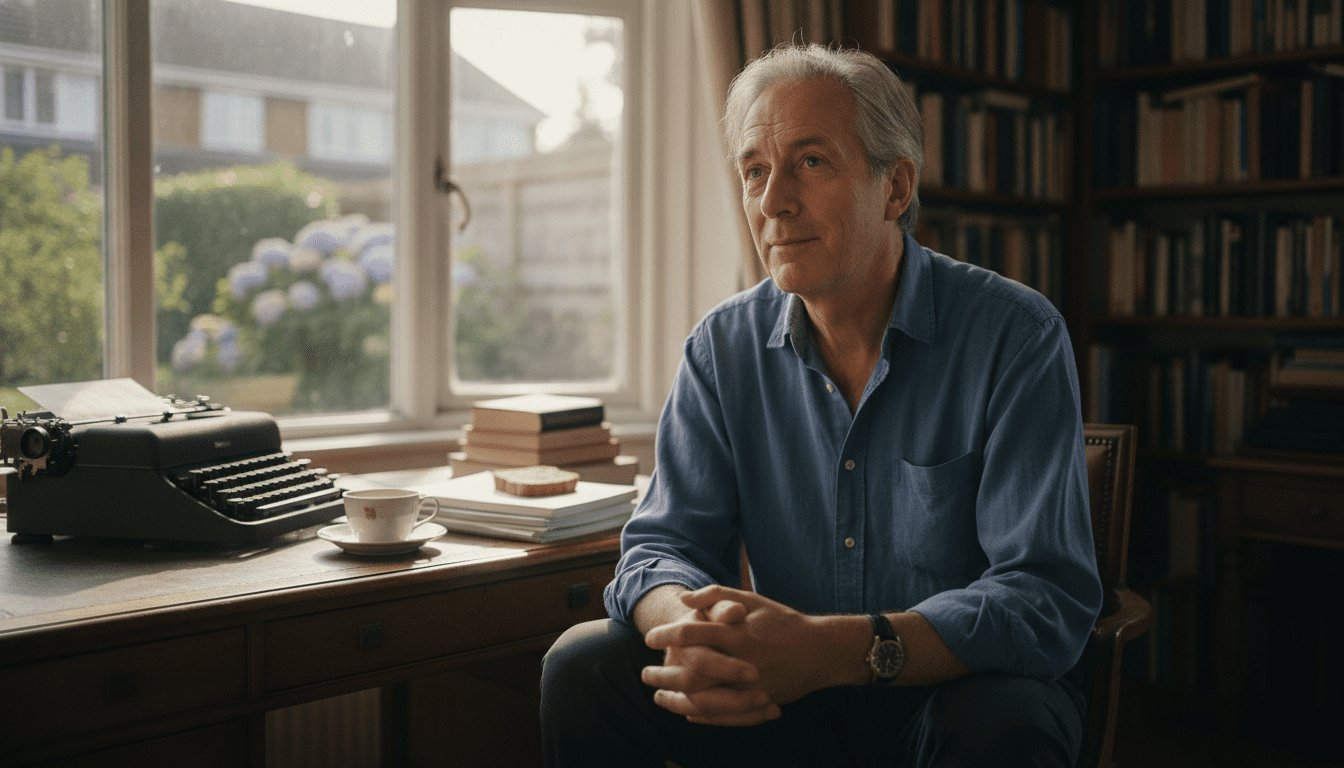
Jonathan Coe remembers the day “quite vividly” and why some moments never fade
Jonathan Coe remembers the day “quite vividly,” saying in a June 21 interview that the hours of the event and the very early morning after have remained with him, and he used the moment to reflect on how memory fixes certain public moments in private life.
Coe’s account of the day and the morning after
Jonathan Coe remembers the sensations of the day itself and the immediate morning that followed with striking clarity, he told an interviewer on June 21. He described the memory as vivid, stressing that the details of where he was and what he felt have stayed with him years later.
Coe framed that persistence as part of a larger pattern: certain events accumulate meaning over time precisely because people continue to recall them in precise detail. His comments underline a commonplace of contemporary memory studies — that the personal recollection of a public event often shapes its cultural weight.
How Coe links memory to significance
In the interview Coe argued that the significance of a moment is, in part, measured by the way it lodges in individual recollection. He suggested that years later we still register an event’s importance by asking where we were, what we were doing, and how we felt when it happened.
That line of thought positions memory as both an archive and a kind of informal memorial; the personal map of feelings and places becomes one of the ways societies keep track of turning points. For Coe, authorial attention to those private maps is less about spectacle and more about understanding consequence.
Connections to his writing and themes
Observers familiar with Coe’s work note that his fiction often returns to the relationship between public events and private lives, making memory a recurring theme. In the interview he echoed that interest, describing how particular days reappear in both his reading and his writing.
He did not frame the recollection as a literary exercise alone, but as a human habit — an instinct to pin down the texture of an event so that it can be carried forward. That instinct, he suggested, offers both material for writers and a means for readers to process what happened around them.
Public reaction and cultural remembrance
The remarks have prompted responses from readers and commentators who see Coe’s reflection as resonant for a wider public still processing shared events. Many contributors noted that the act of remembering together — recounting where one was and what one felt — becomes a form of cultural bookkeeping.
Such exchanges, whether on social media or in private conversation, help transform singular memories into collective memory. Coe’s observation highlights how individual testimonies combine to shape a larger narrative about the past.
Why authors return to moments years later
Coe suggested that authors revisit moments not to relive them but to interrogate their ongoing consequences, and to consider how the personal aftermath interacts with public understanding. Revisiting a day is therefore less an act of nostalgia and more an effort to clarify meaning.
That approach, he indicated, is a discipline: the writer re-examines feelings and facts until a clearer account emerges. It is also a reminder that cultural memory is not static; it is continually revised as people bring new perspective to older events.
Contextualizing the interview and its implications
Published on June 21, the interview presents Coe’s remarks as part of a broader conversation about memory, literature and civic life. His succinct phrase “quite vividly” has been picked up as an entry point for those seeking to discuss how personal memory anchors public events over time.
By focusing on the sensory texture of recollection — the where, the what and the feeling — Coe invited readers to consider their own responses to historical moments. The interview also underlined the capacity of literary figures to frame public reflection without claiming to settle the facts.
Jonathan Coe’s comments on recollection serve as a reminder that memory plays a central role both in private processing and in the creation of shared narratives, and his insistence on the vividness of certain days encourages a closer look at how we each carry history forward.
