
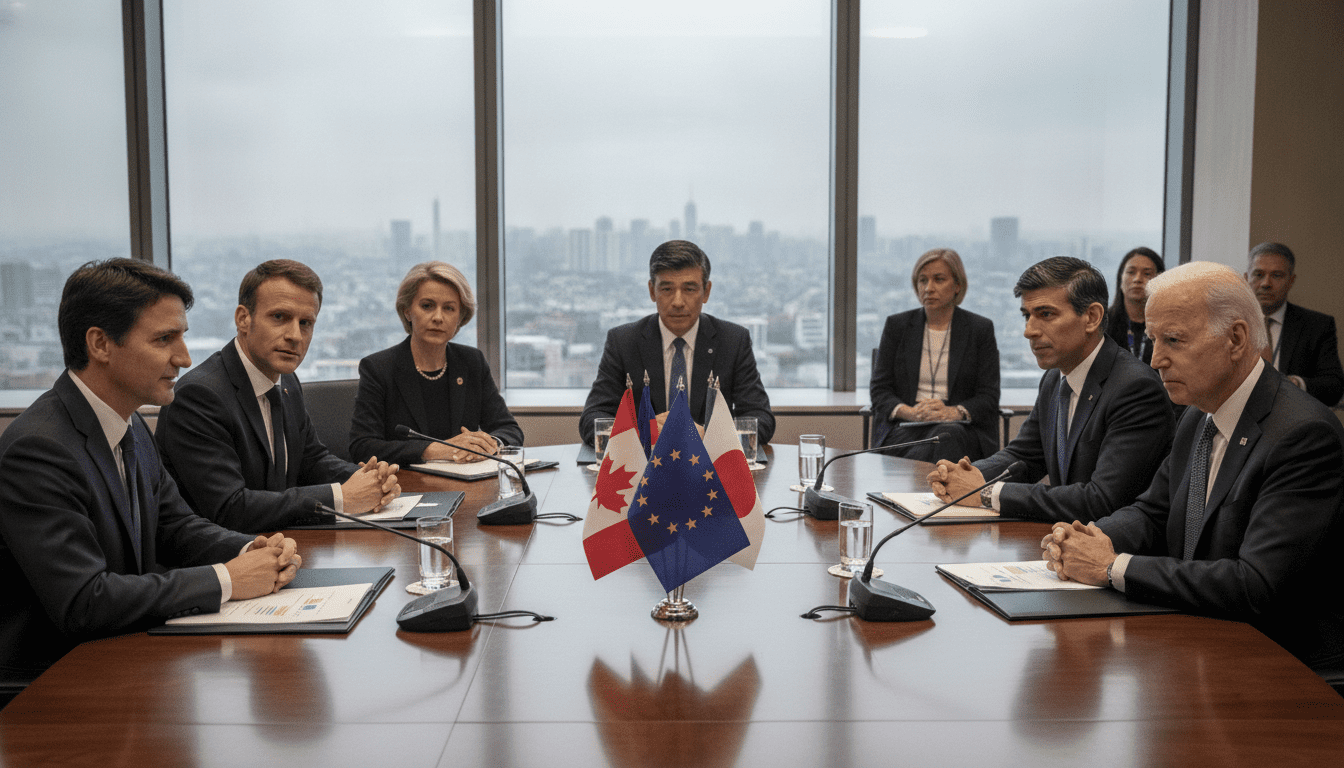
G7 Announces New AI Cooperation Platform to Address Advanced AI Risks
G7 leaders at Évian agree to create an AI cooperation platform to coordinate standards, share risk assessments and reconvene in September to build structure.
France’s president announced on Wednesday that G7 nations have agreed to establish an AI cooperation platform aimed at curbing the risks posed by the most advanced artificial intelligence systems. The move, declared at the close of a two-day summit in Évian, signals a coordinated effort by leading democracies to develop shared standards and exchange practical insights on AI safety. Officials said the framework will be constructed over the coming months, with ministers due to reconvene in September to advance the work. The initiative is intended to complement national and regional regulatory efforts while fostering international technical cooperation.
Agreement Announced in Évian
French President Emmanuel Macron announced the creation of the new AI cooperation platform at the summit’s conclusion, framing it as a mechanism for states to collaborate on the risks associated with powerful AI models. Macron said the platform will enable participating governments to develop common standards and to share lessons about effective responses to emergent harms. He did not identify which countries beyond the G7 would participate, but he pledged to press the agenda within European institutions as well. The announcement capped a two-day meeting that placed technology governance among its leading priorities.
Platform Aims: Standards and Shared Intelligence
According to the brief statement from the summit, the platform’s primary functions will include coordinating technical standards and facilitating the sharing of assessments about AI-related risks. Delegates said the intention is to create interoperable approaches so that safety measures adopted by one state can inform and reinforce those adopted by others. The emphasis on shared intelligence reflects concerns that advanced AI systems can cross borders rapidly, requiring common tools to detect and mitigate emergent threats. Officials framed the effort as an attempt to pair innovation with precautionary controls without imposing a single regulatory model.
Questions Remain Over Membership and Scope
Macron’s announcement left several key questions unanswered, most notably which governments will formally join the platform and whether non-G7 democracies or partner organizations will be invited. The French president’s vow to take the initiative to the European level suggests the bloc may seek a formal role, but summit remarks stopped short of naming additional participants. Observers note that the effectiveness of any such mechanism will depend on broad buy-in from both states and influential private-sector actors who deploy advanced models. How the platform will interact with existing national regulators, multilateral institutions and industry-led safety efforts also remains to be defined.
Timeline and Next Steps Toward Implementation
Summit leaders said the platform’s structures will be constructed over the coming months, with a follow-up meeting scheduled in September to map concrete next steps and governance arrangements. Officials indicated that working groups could be established to tackle technical assessment, standards harmonization and information sharing, but no formal timetable was released. The choice of September as a near-term rendezvous underlines the urgency leaders attach to AI risk management while leaving room to consult with experts. The platform is expected to produce recommendations that individual members can adapt to domestic legal frameworks.
Implications for Industry and International Policy
Analysts and industry officials are likely to view the G7 platform as both an opportunity and a challenge: an opportunity to reduce regulatory fragmentation and share best practices, and a challenge because agreed approaches will require trade-offs between innovation, competitiveness and safety. Tech companies that develop large models may face coordinated expectations on transparency, testing and risk reporting, while research institutions could be asked to meet common assurance standards. Internationally, a successful platform could create pressure for other major economies to align with these norms, though the degree to which participation becomes mandatory or remains voluntary will shape its global impact.
The G7’s pledge to build an AI cooperation platform marks a tangible step toward multilateral management of the risks posed by increasingly capable AI systems, but the initiative now enters a phase in which details will determine its influence. Over the next months, decisions about membership, technical mandates and enforcement mechanisms will shape whether the platform becomes a central forum for AI governance or a coordinating body with limited reach. Stakeholders across government, industry and civil society will be watching the September meeting closely for signs that participating states can convert broad commitments into operational safeguards.
