
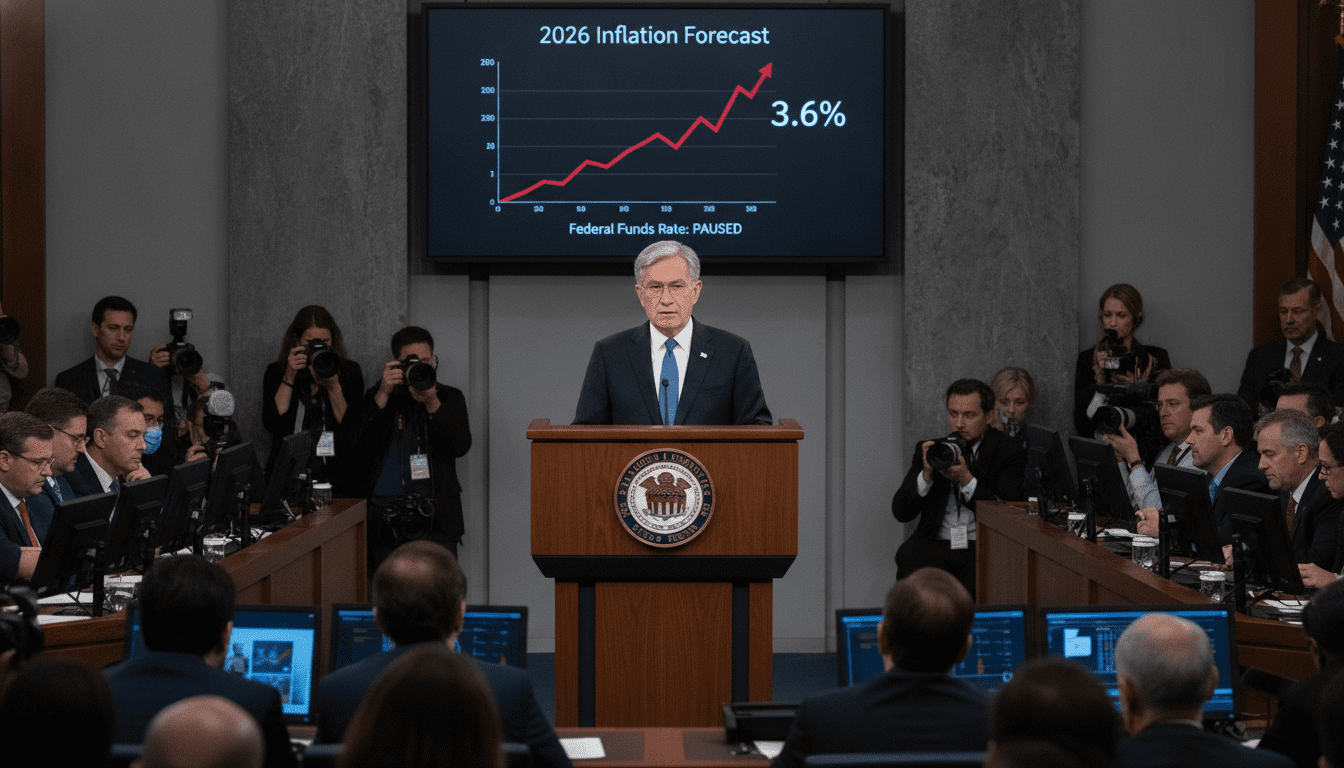
Federal Reserve Keeps Interest Rate at 3.5–3.75% as Chair Kevin Warsh Announces Reforms
Federal Reserve holds policy rate at 3.5–3.75% in a unanimous pause; Chair Kevin Warsh unveils reforms, raises 2026 inflation forecast to 3.6% and trims GDP.
The Federal Reserve on Wednesday voted to keep its target federal funds rate unchanged at 3.50–3.75 percent, marking the fourth pause this year and a unanimous decision among policymakers. Chair Kevin Warsh, who took office at the end of May, framed the outcome as a steadying move while announcing an ambition to reshape how the central bank communicates and collects data. Markets reacted with modest declines in equity indices as investors absorbed both the hold and the Fed’s revised economic outlook.
Decision unanimous for the first time in a year
The Federal Open Market Committee’s vote to maintain the range was unanimous, a departure from split decisions seen over the past year. Officials signalled that, for now, the committee judged monetary policy to be appropriately calibrated to its dual mandate of price stability and maximum employment. The pause follows a sequence of policy moves last year that included three reductions of 25 basis points amid worries about the labor market.
The unanimous vote underscores an early consolidation of authority under Warsh, whose arrival as Fed chair was closely watched by markets and politicians alike. President Donald Trump had pushed for more aggressive rate cuts, but the Fed under Warsh opted to hold steady while warning that monetary policy will continue to aim for price stability.
Warsh outlines five areas for reform
Chair Warsh told reporters he intends to open a “new chapter” at the Fed and announced plans to pursue reforms across five key areas, without detailing every measure. He said working groups would develop proposals and deliver results by the end of the calendar year, signalling an accelerated timetable for institutional change. Among the reforms he mentioned were changes to the Fed’s public communications, revisions to how quarterly economic projections are presented, and a review of the role and format of press conferences.
Warsh also flagged a move toward fewer public forward-looking comments on future rate paths, pointing to a shorter policy statement that will likely reduce explicit guidance. He argued that a more disciplined communications strategy would help the Fed balance transparency with flexibility in a complex economic environment.
Inflation outlook revised higher to 3.6% for 2026
The Fed raised its inflation forecast for 2026 to 3.6 percent, up from an earlier projection of 2.7 percent made in March. Officials cited a range of factors that have lifted near-term price pressures since the previous outlook, including geopolitical developments and supply-side strains. The committee still expects inflation to moderate, projecting a decline to 2.3 percent the following year, a slightly higher path than previously anticipated.
Warsh emphasised the need to remain vigilant on inflation and reiterated the Fed’s core objective of price stability. The upward revision to the inflation projection prompted questions about the longevity of current policy settings and whether future tightening could be required if inflation proves more persistent.
Growth expectations trimmed and markets react
Alongside the inflation revision, the Fed trimmed its growth projection for the current year to 2.2 percent from a prior estimate of 2.4 percent. Growth for the subsequent year was left unchanged at 2.3 percent, reflecting a view that the economy will slow modestly but remain resilient. Those adjustments, combined with the higher inflation forecast, created a mixed signal for investors weighing the outlook for corporate earnings and bond yields.
Equity markets moved lower after the decision, with major indexes posting modest losses as traders digested the combination of a rate pause and firmer inflation expectations. Treasury yields showed limited movement as fixed-income investors recalibrated their expectations for the path of monetary policy over the coming quarters.
Data modernization and private-sector sources
Warsh criticised current government data collection methods as “old-fashioned” and said the Fed would increasingly look to private-sector data sources to inform policy decisions. He argued that newer, higher-frequency datasets could provide a timelier picture of economic activity and labor market conditions. The plan to incorporate alternative data signals a shift toward more real-time tools, though Warsh acknowledged the need to assess the reliability and representativeness of such sources.
Officials made clear that any methodological changes would be tested thoroughly before being used as inputs to policy decisions. Warsh’s emphasis on data modernization dovetails with his broader push to update both the Fed’s analytic toolkit and its public engagement practices.
Kevin Warsh succeeded Jerome Powell at the end of May, stepping into a role that has drawn heightened scrutiny from political leaders and market participants. While Trump had repeatedly pressed for deeper cuts under Powell, Warsh appears to be setting a different course: maintaining current policy settings while restructuring the institution’s approach to communication and data. The Fed’s next steps will be watched closely as working groups report back later in the year and as incoming data on inflation and growth arrive.
