
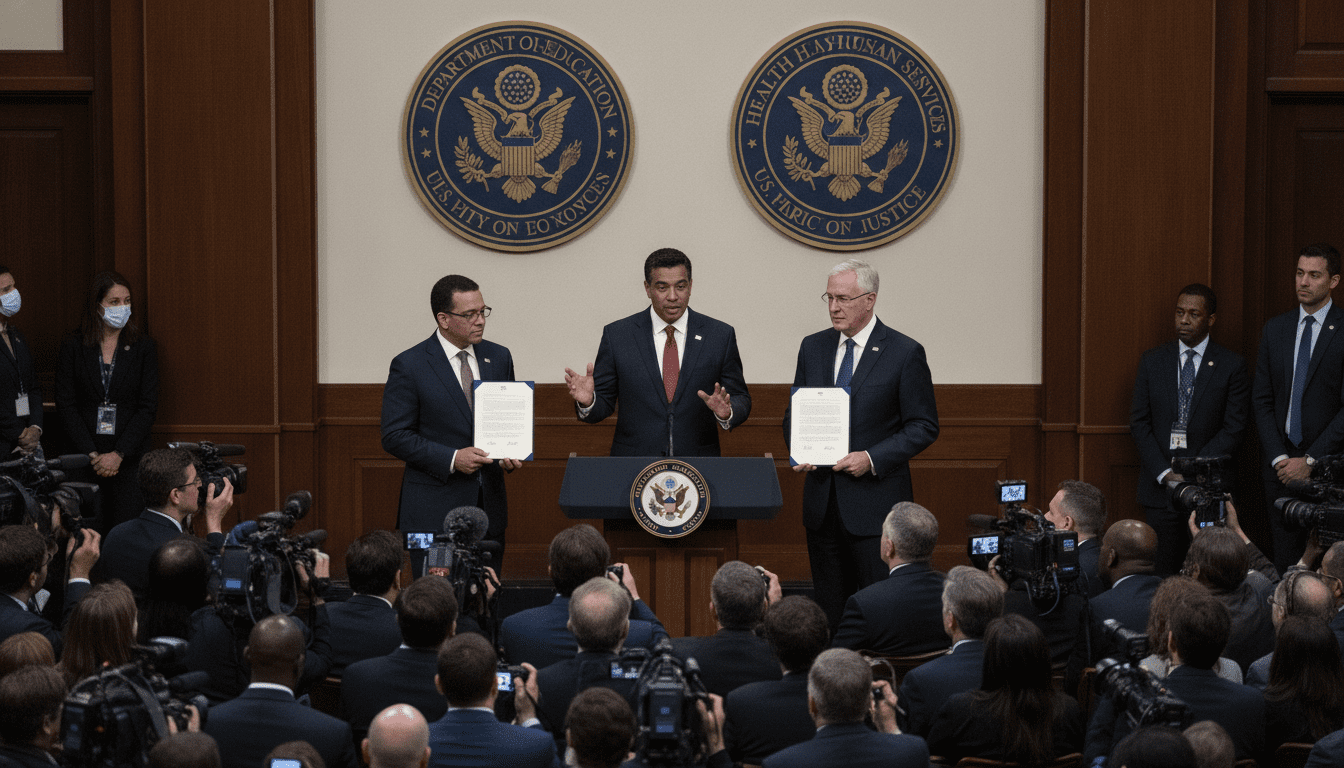
Trump administration transfers special education and civil rights duties from U.S. Department of Education
Trump administration transfers special education and civil rights duties from the U.S. Department of Education to HHS and DOJ, sparking concerns about services and enforcement.
The U.S. Department of Education will relinquish key responsibilities for special education and civil rights enforcement under a new reorganization announced by the Trump administration on June 16, 2026. The Office of Special Education and Rehabilitative Services is to be moved to the Department of Health and Human Services, while the Office for Civil Rights will be transferred to the Department of Justice. Education Secretary Linda McMahon has overseen a series of such shifts, part of a broader plan to decentralize federal education authority.
Education Department to Lose Special Education Oversight
The Office of Special Education and Rehabilitative Services has been charged with ensuring that children and young people with disabilities receive federally guaranteed access to education. Under the planned transfer, those obligations would fall to the Department of Health and Human Services, which traditionally focuses on medical and rehabilitative programs. Advocates and school administrators have expressed concern that moving these functions away from a dedicated education agency could disrupt established processes and expertise that link educational placement with classroom supports.
Replacing a long-standing administrative home for special education will require significant operational changes, including staff reassignment, data sharing agreements, and coordination between education and health systems. State education agencies that work with the federal office on individualized education programs (IEPs) and compliance reviews may face a period of uncertainty. The timing and mechanics of the handover—such as how complaints, monitoring, and funding oversight will be managed—were not detailed in the announcement.
Civil rights complaints to be handled by Justice Department
The administration’s plan also transfers responsibility for investigating discrimination complaints in schools and higher education from the Department of Education’s Office for Civil Rights to the Department of Justice. The OCR has historically conducted administrative investigations, compliance reviews, and negotiated remedies across a wide range of civil-rights claims in K–12 and postsecondary institutions. The Justice Department’s civil rights enforcement typically emphasizes litigation and criminal enforcement where appropriate, raising questions about how routine compliance and resolution practices may change.
Students and institutions rely on the current complaint intake and resolution systems for issues ranging from disability access to sex-based discrimination and race-based disparities. Stakeholders cautioned that shifting civil-rights enforcement to DOJ could alter response times and approaches to remediation, and could require new guidance to ensure continuity for complainants seeking remedies.
Administration continues a decentralization agenda
The move follows campaign pledges by Donald Trump to eliminate the Department of Education and transfer most education policy responsibilities to state governments. While only Congress can abolish a federal department, the current administration has pursued a steady reallocation of duties to other agencies and to states, according to officials involved in the reorganization. Secretary McMahon has overseen previous transfers and said the changes aim to streamline federal roles and reduce overlap among agencies.
Administration officials framed the reassignments as an effort to align specific functions with agencies they consider better suited to deliver services, such as placing rehabilitative services within a health-oriented portfolio. Critics contend that the pattern reflects an ongoing attempt to shrink centralized federal oversight of education, with potential long-term implications for national standards and protections.
Union leaders and staff warn of lost protections
Rachel Gittleman, the union representative for Department of Education employees and chair of the staff union, condemned the decision as harmful to students and families who depend on federal oversight. Gittleman said the transfers risk leaving excluded or marginalized students without necessary services and without protections from discrimination. Department staff have voiced concerns about the speed of change and the potential erosion of institutional knowledge crucial to enforcing education-specific civil rights and special education law.
Union and advocacy groups called for congressional review and oversight hearings to examine the practical effects of the transfers and to seek assurances that services and legal protections will remain intact. Several disability advocacy organizations likewise urged transparent transition plans and guarantees of uninterrupted service for affected students.
Possible consequences for students, schools and enforcement
Observers note several areas where the transfers could have practical impact, including the handling of complaints, the continuity of individualized educational plans, and the federal oversight of school compliance. Moving special-education compliance into a health agency could emphasize medical and rehabilitative perspectives while weakening direct educational accountability mechanisms, according to education administrators. Shifting civil-rights enforcement to the Justice Department could prioritize different enforcement tools and change how cases are resolved without clear statutory amendments.
School districts, higher-education institutions, and advocacy groups will be watching closely for guidance on complaint procedures, investigatory timelines, and funding pathways. Federal monitoring, technical assistance, and dispute-resolution processes are likely to require new interagency memoranda and public-facing instructions to avoid gaps in service or enforcement.
Congressional authority and potential legal review
Although the administration can reorganize functions administratively, only Congress can eliminate a federal department outright or enact major statutory rewrites governing education law. Legal experts and lawmakers have indicated that substantial transfers of statutory responsibilities may invite congressional scrutiny and potential litigation if stakeholders argue that statutory duties cannot be reassigned without legislative approval. Members of both parties have previously conducted oversight when major agency reorganizations were proposed, and similar inquiries are expected in the coming weeks.
The administration has not released a detailed timetable for implementation or an explicit legal rationale for how statutory responsibilities will be carried out after the transfers are complete. That lack of detail has heightened calls from unions, disability advocates, and some lawmakers for a clearer plan to safeguard students’ services and civil-rights protections.
The upcoming weeks are likely to see formal briefings, questions from congressional committees, and appeals from advocacy groups seeking concrete guarantees about service continuity and enforcement mechanisms as the federal government undertakes this significant reshaping of education oversight.
