
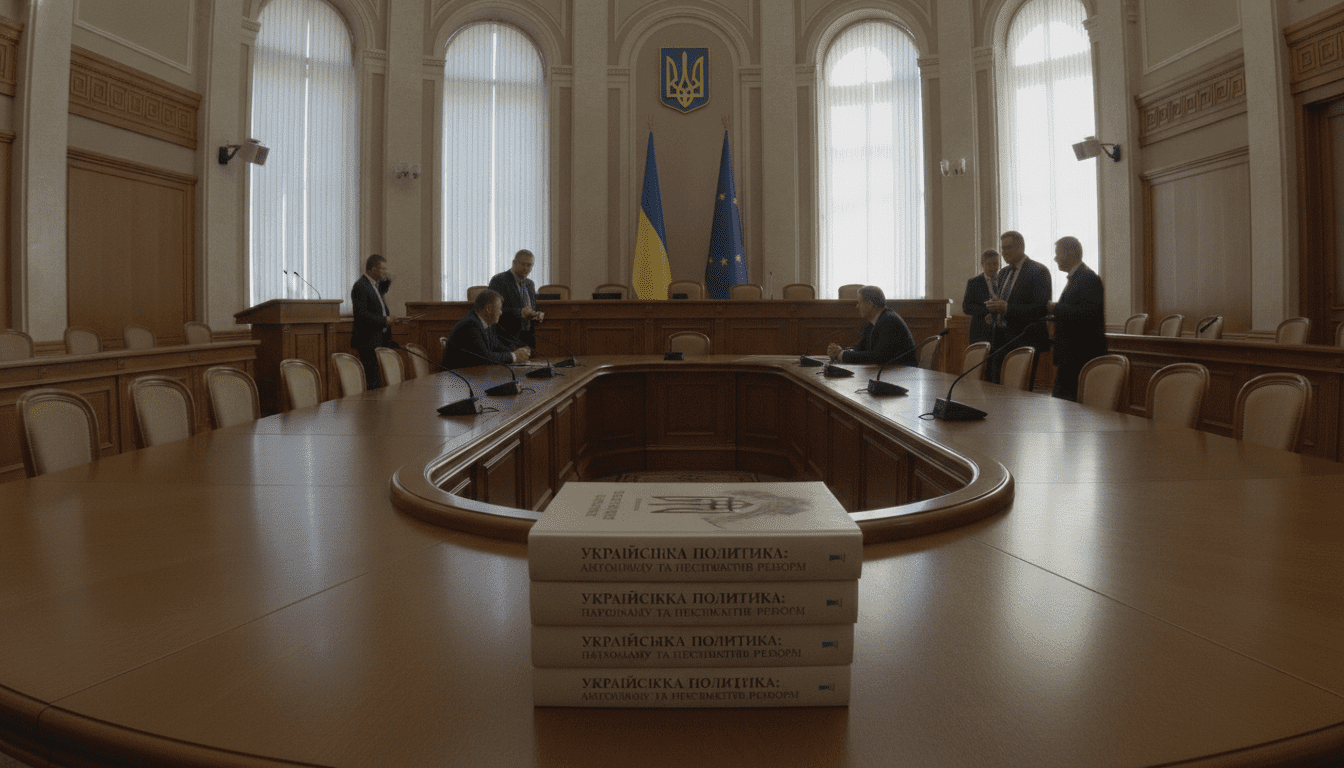
Springer volume maps Ukraine’s political system amid war and EU accession debate
New collected volume dissects Ukraine’s political system: reforms, patronalism, corruption and civic mobilization during war, informing EU accession debates.
Book frames a measured view of Ukraine’s political system
The newly published collected volume Das politische System der Ukraine, edited by Michael Dobbins and released by Springer Fachmedien in 2025, offers a comprehensive examination of Ukraine’s political system. The book brings together fourteen chapters by scholars who map institutions, actors and policy fields against the backdrop of the Russian full-scale invasion. Editors and contributors aim to move public discussion beyond caricatures of either hopeless corruption or idealized democratic exceptionality.
The collection stresses the need for a realistic appraisal as European capitals weigh Kyiv’s future, including possible EU membership. Contributors analyze longstanding continuities in political personnel and practice while also tracking wartime shifts that have altered patronage networks and oligarchic influence.
Editors and contributors detail executive-legislative tensions
Several chapters focus on Ukraine’s semipresidential arrangements and the recurrent tug-of-war between presidents, prime ministers and parliament. Fabian Burkhardt and Olga Mashtaler compare variants of executive governance and argue the post‑2014 move away from a president‑centric model altered formal powers but left space for presidential attempts to dominate institutions. The contributors repeatedly document how political actors have used formal reforms tactically, often to consolidate control rather than to strengthen checks and balances.
The book traces how presidents across recent decades have tried to shape or bypass institutions, sometimes through legal changes and at other times through informal influence. These dynamics are presented as central to understanding both policy outcomes and the recurrent instability of administrative reforms.
Research exposes party weakness and patronal politics
A persistent theme across the essays is the fragility of party structures and the centrality of patronal networks. Jan Matti Dollbaum and others describe parties as historically weak and often vehicles for individual leaders or oligarchic interests, a pattern that has limited programmatic competition and deepened personalization. Political parties are shown as poorly rooted in civil society, which helps explain paradoxes such as low trust in parliament but popular attachment to democratic ideals.
Henry Hale’s concept of patronalism is used to explain how personal ties and pyramidal dependencies prioritize private benefit over public governance. The volume argues that this system of personalized exchange remains a major obstacle to durable institutionalization, even as wartime conditions have weakened some oligarchic levers.
Authors assess corruption — challenges and unexpected openings
Several contributors confront corruption as both a historical legacy and a structural problem tied to weak separation of powers. Michael Martin Richter frames corruption as rooted in informal rules and incomplete institutional reform, but he also highlights recent openings for change. The war has disrupted established patronage chains and increased Ukraine’s dependence on Western aid, creating external pressure and political space for anticorruption measures.
The book suggests that while progress is neither linear nor assured, the current conjuncture presents better prospects for reform than in previous peacetime periods. Still, contributors caution that formal legal changes must be accompanied by shifts in incentives and enforcement to produce lasting results.
Civil society and voluntary mobilization reshape state-society relations
Contributors give significant attention to the surge in volunteer activity since the 2014 Maidan protests and the 2022 invasion. Civic mobilization has taken many forms — fundraising, rebuilding infrastructure, and provisioning equipment for troops — and is analyzed as a partial substitute where state capacity falls short. Authors describe this mobilization as a transformation in social norms and civic identity rather than merely episodic charity.
At the same time, chapters underline ambivalence in citizen‑state relations: Ukrainians expect performance from political leaders and respond with protest when expectations are unmet, yet routine political participation outside crisis moments remains limited. That pattern complicates assumptions that wartime solidarity will automatically translate into sustained, institutionalized civic engagement.
Volume notes editorial limits and areas for deeper study
The collection is not without shortcomings, note some reviewers and the book’s own internal contrasts. The fourteen chapters are coherent in topic but vary in style and methodological clarity, producing a volume that reads more as a set of expert briefs than a single synthetic study. Certain chapters, including a demanding analysis of EU integration that leans heavily on the multiple‑streams framework, are flagged as dense and less accessible to general readers.
Contributors also point to gaps: treatment of the wartime expansion of executive powers and its long-term implications receives repeated mention but limited systematic exploration. Editors leave open important questions about how temporary emergency measures might reconfigure power after hostilities end.
The book’s mix of critical diagnosis and cautious optimism makes it a timely resource for policymakers and observers tasked with assessing Ukraine’s trajectory during war and potential European integration. If that membership debate proceeds, the volume supplies empirical grounding for a careful, evidence-based conversation rather than polemical extremes.
As Ukraine prepares for an eventual post‑war political phase, the assembled research underscores that the next, decisive chapter in the country’s political development remains unwritten and will depend on whether wartime shifts translate into durable institutional reform.
