
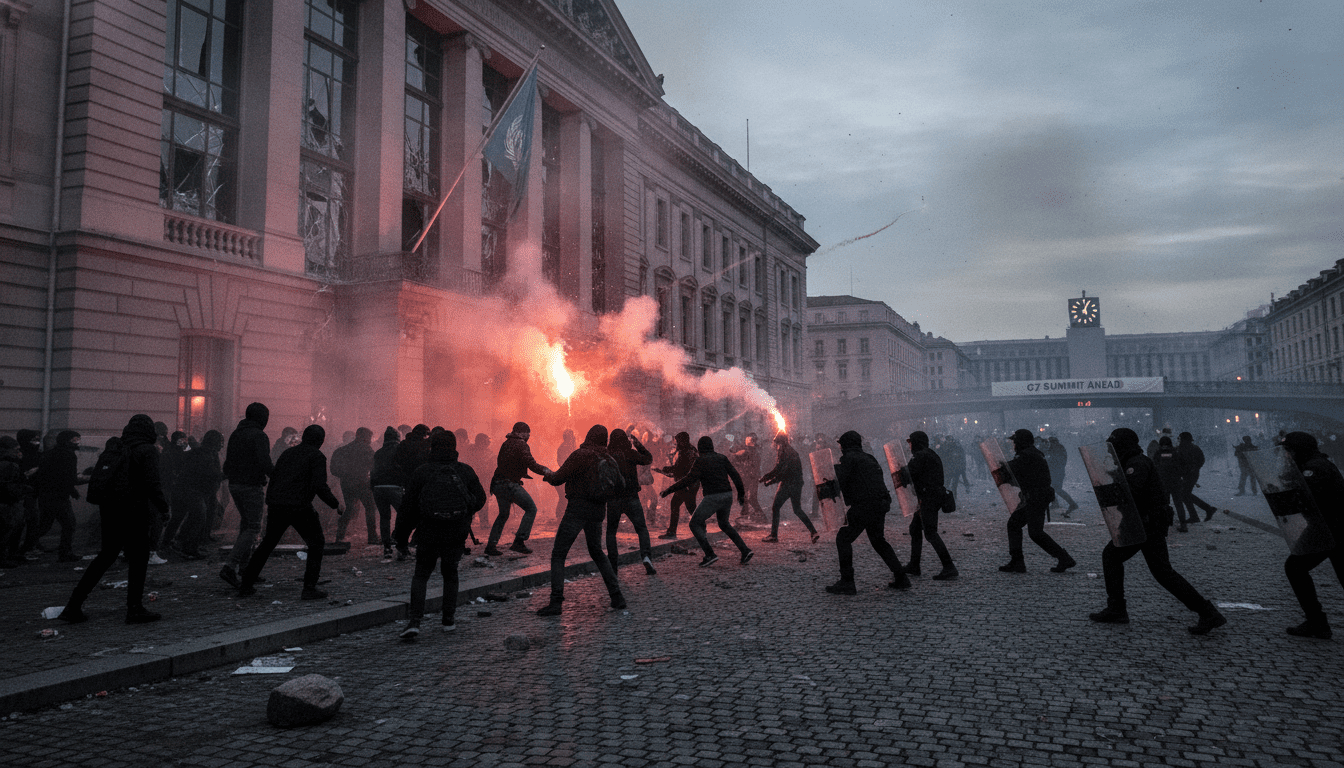
Geneva Violence Escalates as G7 Summit Protests Target UN Building
Geneva clashes erupt during G7 summit protests after an attack on a UN building; Swiss police use tear gas and cross-border forces mobilize for Évian talks.
The G7 summit protests in Geneva turned violent on Sunday when demonstrators attacked a United Nations building with stones and flares, prompting Swiss police to deploy tear gas to disperse crowds. Organizers and authorities provided differing estimates of turnout as leaders prepare to convene in Évian for the G7 summit beginning Monday, June 15, 2026.
UN Building Attacked in Geneva
Witnesses and city officials said a group of demonstrators hurled stones and bright flares at the exterior of a UN facility in central Geneva, smashing windows and causing alarm among staff. The assault occurred amid a larger march that had been authorized in Geneva after France refused permits for protests near the Évian summit site.
Geneva municipal spokespeople described the attack as part of a volatile episode during what organizers framed as an anti-capitalist, anti-globalization demonstration. Swiss authorities later cordoned off the immediate area around the UN compound while emergency crews assessed damage.
Tear Gas and Police Response
Swiss police said they used tear gas to break up confrontations after groups within the march began to clash with officers and damage property. Authorities reported arrests and said they were conducting identity checks on participants; police presence had been visible in certain districts but initially kept to a low profile along the sanctioned route.
The police response followed a long period in which the procession moved without major incident, but tensions rose as some demonstrators removed protective plywood from shopfronts and confrontations intensified near transport hubs. Officials defended the use of crowd-control measures as necessary to restore order and protect civilians.
Scale and Composition of the Demonstration
Organizers described the protest as a coalition of roughly 60 groups, including feminist collectives, antifascist networks, trade unions and a self-described revolutionary bloc, and said tens of thousands took part. Police put the overall figure at about 20,000 participants and estimated that some 6,000 formed a so-called black bloc, a tactic-linked contingent known for confrontational tactics.
City authorities had anticipated up to 50,000 participants and reinforced local forces accordingly, with reinforcements requested from across Switzerland. Demonstrators carried placards criticizing world leaders and targeted messages at high-profile attendees, reflecting the political focus of the march.
Damage to Businesses and Vehicle Fires
Vandalism was reported along parts of the route after some protesters tore off wooden protections from shop windows, leading to broken glass at a bank and a moped retailer. Nearby residents and business owners expressed shock at the speed of escalation after a largely peaceful morning and afternoon of demonstrations.
A vehicle, identified by witnesses as a Tesla, caught fire near the main bus station; firefighting teams on both sides of the border attended several small blazes during the afternoon. Insurance and commercial associations said they would document losses and press for investigations into criminal damage.
Cross-Border Security Deployment
French authorities have assembled a substantial security contingent for the summit in Évian, with roughly 16,000 police and firefighters on duty, according to official counts shared by local sources. Switzerland is contributing about 4,000 soldiers to the joint security posture, and Geneva police reported mobilizing thousands more officers for the demonstration period.
France had declined to authorize protests in proximity to the summit, a decision that organizers said pushed demonstrators into Swiss territory where national laws allowed the march. G7 leaders and invited guests are scheduled to transit through Geneva en route to Évian, complicating security planning on both sides of the border.
Summit Agenda and High-Level Attendance
The G7 leaders, including France’s President Emmanuel Macron as host, are expected to address the wars in Ukraine and the Middle East, the governance of artificial intelligence and efforts to reduce geostrategic imbalances. German Chancellor Friedrich Merz and U.S. President Donald Trump are among those due to attend, with Ukrainian President Volodymyr Zelenskyy slated to join a session on Tuesday in Évian.
In an effort to broaden the discussions, leaders invited the heads of state from Brazil, South Korea, Egypt, India and Kenya to participate in certain sessions, a move intended to counter charges that the G7 operates as an insular or elitist forum. Organizers of the summit say they will press on with the agenda despite security disruptions and protests in Geneva.
The immediate priority for authorities in Geneva and across the border is to contain further violence and ensure the safe arrival of delegations to Évian, while investigating the attack on the UN facility and the incidents of property destruction. As leaders begin summit talks on June 15, officials on both sides of the border warned of continued high security and pledged to pursue arrests and prosecutions where laws were broken.
