
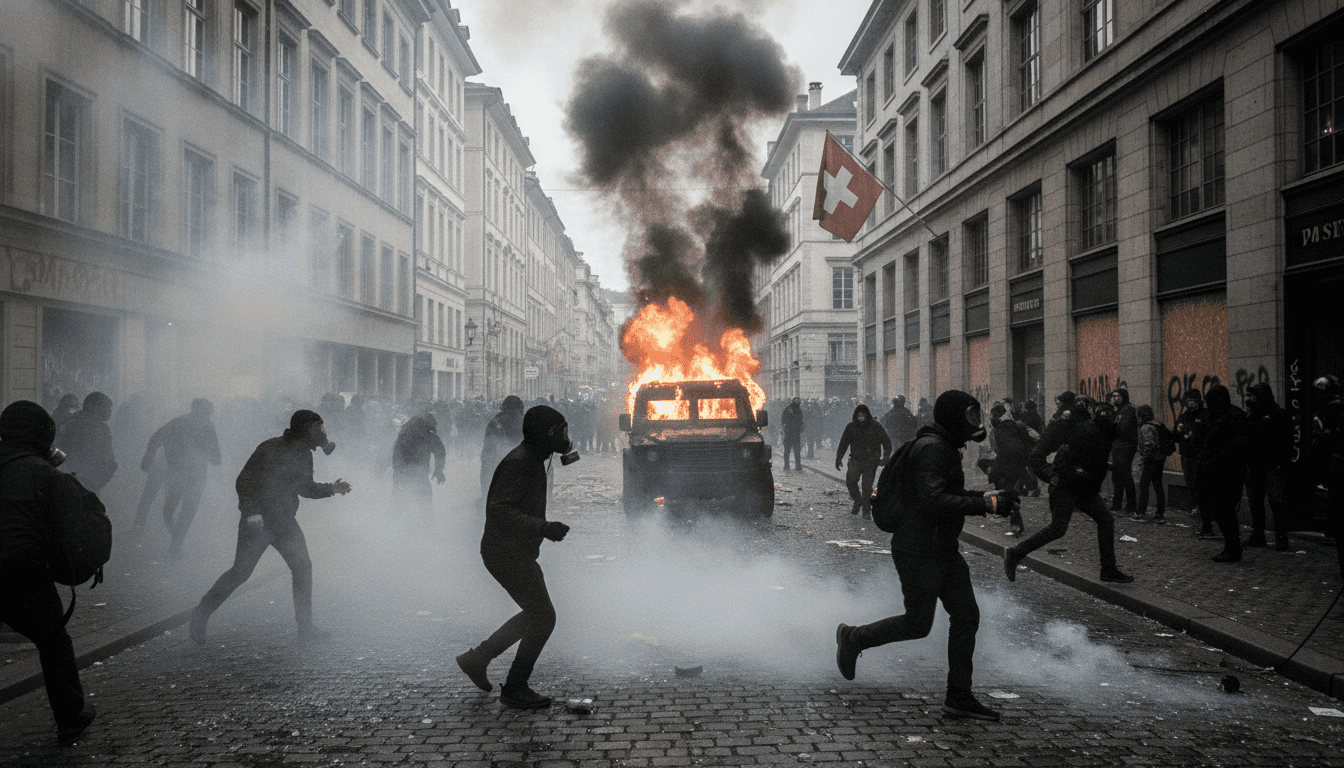
G7 protests in Geneva: Tens of thousands march as clashes, property damage and a vehicle fire unsettle city
G7 protests in Geneva drew tens of thousands against capitalism and global elites, prompting heavy Swiss security deployment, clashes with police, property damage and a car fire near the bus station.
The demonstration in Geneva, organized under the banner “No G7,” drew large crowds to the Swiss shore of Lake Geneva on the eve of the G7 summit in Évian and quickly became the focal point for opposition to the grouping of advanced economies. Organizers and local authorities offered divergent estimates of turnout, and what began as a permitted march along a fixed route ended with episodes of violence, tear gas and arrested items that police said could be used against officers. The protest highlighted both local security concerns and broader transnational grievances aimed at the G7’s political agenda.
Mass turnout and official estimates
Swiss authorities had prepared a large security operation, deploying around 7,000 officers on the expectation that as many as 50,000 people might gather on the lake’s Swiss side. Organizers later reported “tens of thousands” of participants by late afternoon, with crowds concentrated in a park beside the water before marching through designated streets. The numbers and the presence of diverse groups made the demonstration one of the largest public responses surrounding this year’s summit.
Route, slogans and participant coalition
Marchers followed an approved route toward central Geneva, carrying placards and banners that frequently targeted capitalism and, in some cases, specific political figures including the U.S. president. The protest was coordinated by a coalition of roughly 60 groups — from trade unionists and feminist activists to Kurdish organizations and a self-described “revolutionary block” — whose manifesto ranged from demands for higher minimum wages to calls for the removal of gender markers from identity documents. Many demonstrators also displayed Palestinian flags, reflecting the wider geopolitical grievances woven into the protest’s agenda.
Damage to storefronts and a vehicle fire
Despite long stretches of peaceful marching, the demonstration was marred by episodes of vandalism and property damage when some participants tore down plywood protections that local businesses had erected, shattering windows at a bank and a moped shop. Near the bus terminal a vehicle — reported to be a Tesla — was set alight, drawing emergency responders and intensifying tensions on the street. Police confirmed that several items believed to be intended for confrontation were seized during patrols, and local business owners reported losses and ongoing concern over repeat incidents.
Police response and crowd-control measures
Geneva police initially maintained a low profile along the procession but later used tear gas during confrontations after stones were reportedly hurled at officers, according to official statements. Law enforcement described targeted interventions to restore order and protect critical infrastructure, and they said arrests and seizures were carried out where there was evidence of preparations for violence. The canton’s police chief warned that memories of past unrest in Geneva had informed a robust approach to crowd management and public safety.
Historical memory and preventive measures
The city’s heightened alert reflected lingering trauma from violent episodes linked to past anti-globalization protests, notably a destructive summit demonstration in 2003 that resulted in extensive looting and damage. In advance of the current events, hundreds of shopkeepers and hoteliers had boarded up windows and reinforced storefronts, and Swiss authorities reduced the number of open border crossings to limit uncontrolled movement into the enclave. The pre-emptive steps aimed both to shield local commerce and to assist security services in managing flows of people in a city that borders French territory.
Security duties tied to summit logistics
Swiss forces faced a dual mandate: policing the demonstration and ensuring the safety of visiting heads of state who are expected to arrive via Geneva’s airport, the closest international gateway to the summit venue in Évian, some 50 kilometres away. Officials emphasized coordination with French authorities responsible for the summit itself, while Geneva’s heightened internal checks included identity controls and increased patrols in transit hubs. The converging security responsibilities underscored Geneva’s strategic role as the nearest staging point for delegations and the complexity of protecting both civic freedoms and diplomatic movements.
The Geneva demonstration crystallized a wide array of grievances aimed at the G7 and global economic arrangements, combining demands for social reforms with sharp critiques of international military and trade policies. As the summit convenes in Évian, authorities on both sides of the border will monitor whether protests remain contained or further escalate, and business owners and residents brace for additional demonstrations in the coming days.
