
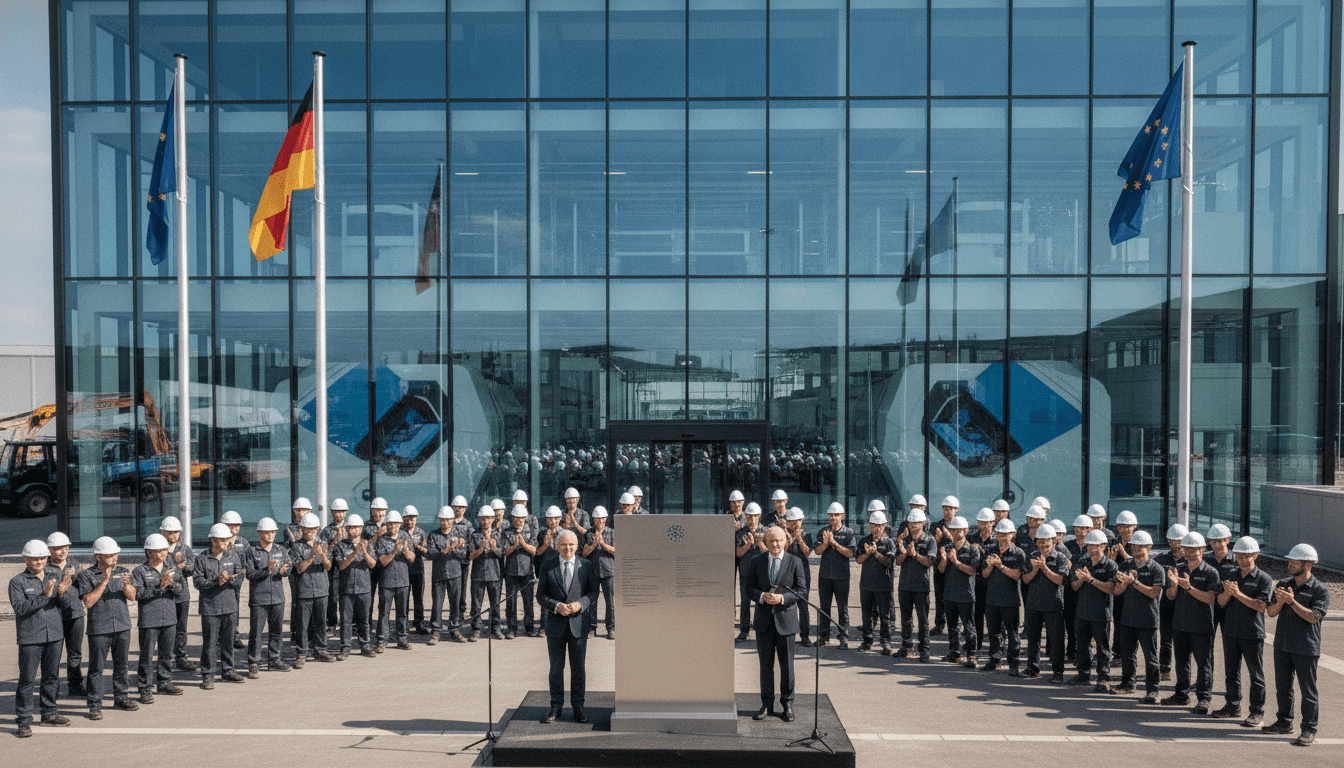
Infineon Dresden chip factory to begin production in early July
Infineon’s Dresden chip factory, the Smart Power Fab, starts production in early July — a €5bn project adding 1,000 jobs and new capacity for AI-era chips.
Infineon’s Dresden chip factory, known as the Smart Power Fab, is scheduled to begin operations in early July, marking the Munich group’s largest single investment to date and a major capacity boost for Europe’s semiconductor supply. The project, a €5 billion investment supported by about €1 billion in state aid, was completed ahead of schedule and will add roughly 1,000 jobs once production is fully ramped. Company officials say the new plant will be integrated with Infineon’s existing Dresden complex and is designed to meet surging demand for power and performance chips used in everything from electric vehicles to AI data centres.
Construction scale and engineering feats
The site was excavated over nearly three years, creating a pit about twenty metres deep across an area comparable to four football fields. Engineers reinforced the excavation with some 1,500 heavy pillars and poured a two-metre-thick concrete base to anchor the facility on solid granite. The scale of the groundwork reflects the precise requirements of semiconductor manufacturing and the need for extreme stability for precision equipment.
Inside the new building, three levels house massive installations for ventilation, water and power management, while two ballroom-sized cleanrooms sit stacked above each other. That unusual vertical arrangement was chosen specifically to save land and resources while enabling the installation of advanced process tools. Over the coming months machines valued at about €3 billion will be installed in those pristine environments where air quality surpasses that of an operating theatre.
Production capacity and market timing
Infineon executives say the Smart Power Fab could reach an annual revenue potential of about €5 billion once fully operational, a figure that would equal roughly one third of the group’s current yearly sales. The new capacity arrives amid an unprecedented global demand for semiconductors, driven in part by the rapid build-out of AI compute infrastructure. Industry estimates cited by the company suggest roughly $4 trillion will be invested globally in AI data centres over the next two and a half years, with as much as $2.8 trillion flowing into semiconductor components.
The Dresden expansion complements Infineon’s modernisation and growth drive over recent years, which has included upgrades and new facilities in Malaysia and Austria. Company management argues the timing is right: expanding power and connectivity chip output now positions Infineon to supply a broader customer base that increasingly includes hyperscale data centres alongside traditional automotive and industrial clients.
Economic impact for Dresden and Germany
Dresden is long established as a leading European semiconductor cluster, and Infineon’s new plant further cements the city’s role in continental chip production. Since 2021 the region has attracted more than €16 billion in investments, and the Smart Power Fab is described internally as a flagship project that demonstrates the feasibility of rapid megaproject delivery in Germany. Local officials and company leaders have highlighted the 1,000 new direct jobs as only part of a wider employment and supplier effect for the region.
Beyond direct employment, the factory is expected to boost the local supply chain for precision engineering, chemicals, and logistics while reinforcing skills development in semiconductor manufacturing. Infineon’s executives have framed the investment as both industrial policy and a commercial response to market realities, arguing that increased domestic capacity supports technological sovereignty and resilience in Europe’s chip ecosystem.
Corporate strategy and investor response
Company leaders have presented the Dresden facility as a strategic lever for faster growth, especially amid surging demand tied to AI and electrification. Infineon board members described the project as a “point landing” that expands capacity at a critical moment, and operational executives say the additional production lines will enable more aggressive expansion than previously planned. Management projects that, at scale, the plant will materially add to group revenues and margins.
Market reaction has been notable: Infineon’s share price more than doubled to around €75 since the start of the year, lifting the group’s market capitalisation toward the €100 billion mark. Analysts remain largely optimistic about the company’s prospects, citing structural demand for power semiconductors and the strategic advantage of having modern European wafer fabs in operation.
Architecture, public profile and planning constraints
The facility’s exterior was shaped as much by urban and landscape planning requirements as by industrial function, with parts of the façade deliberately modelled on the nearby Königstein fortress. Company engineers said the intent was to avoid a purely utilitarian “shoe-box” appearance for the city-facing side of the campus, responding to visibility concerns and the expectations of local planners. The plant occupies an edge-of-city location but remains highly visible from the centre, which shaped design and siting decisions.
Planners and company spokespeople emphasise that the visible, fortress-inspired frontage is intended to integrate the factory into the local identity while preserving the technical interior required for chip production. That public profile underscores a broader point: large-scale industrial investments in Europe increasingly combine technical stringency with attention to civic and environmental context.
The Smart Power Fab’s start of production in early July will mark a transition from construction achievement to the complex, months-long task of equipment qualification and process ramp-up. Infineon says it is prepared for that phase and expects the new lines to contribute meaningfully to supply as global demand for semiconductors continues to climb.
