
FBI Opens 22,000-Square-Foot Kinetic Cyber Range to Train Investigators Against Cyberattacks
The FBI’s 22,000-square-foot Kinetic Cyber Range in Huntsville trains investigators with replica town simulations to combat ransomware and digital crime nationwide.
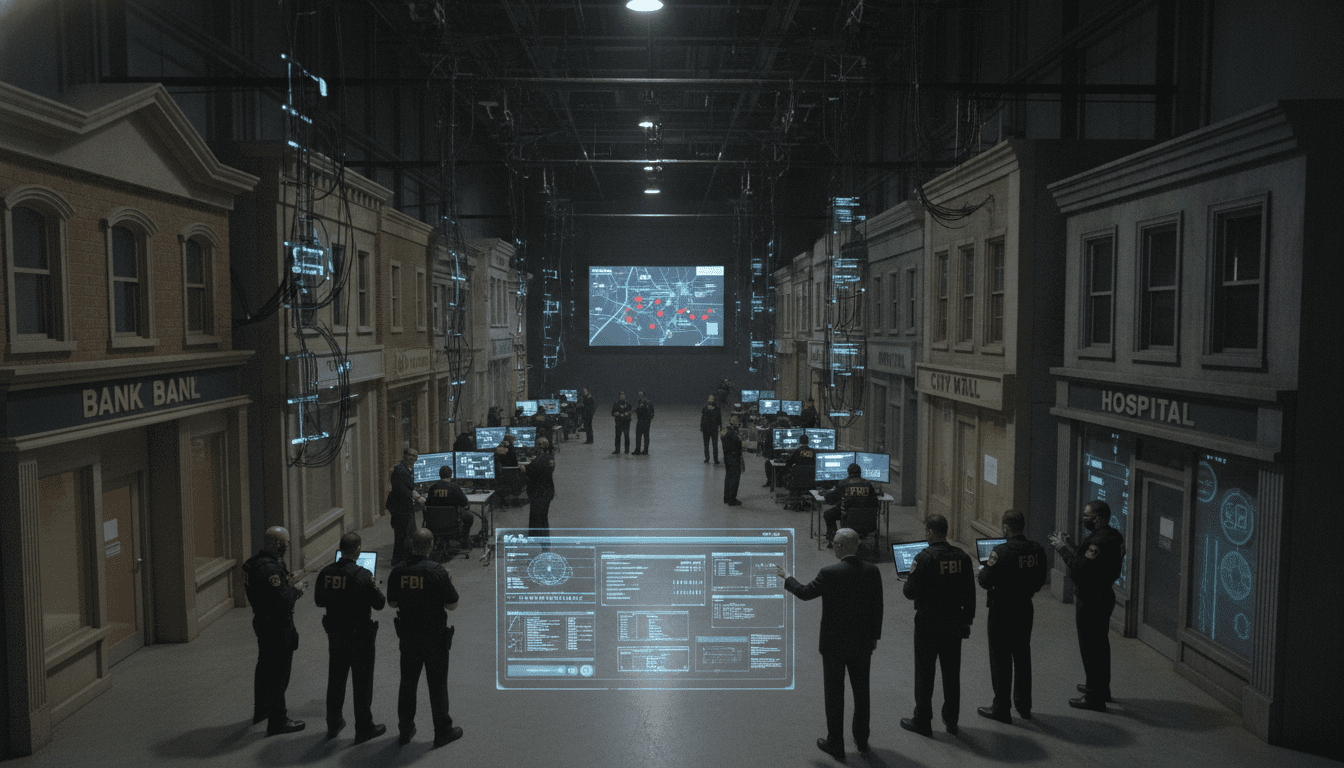
The FBI has revealed a purpose-built training facility, the Kinetic Cyber Range, on its Huntsville, Alabama campus designed to let investigators practice responding to real-world cyberattacks. The range, which opened in February 2025, uses a fully furnished model town to provide hands-on experience with consumer and enterprise technologies commonly targeted by criminals. The facility is intended to bridge classroom theory and field operations by enabling controlled, realistic exercises.
Facility footprint and community layout
The Kinetic Cyber Range occupies roughly 22,000 square feet and is configured to resemble a small American town, complete with roads and traffic control. The site includes homes, a hotel, a gas station, a grocery mart, a courthouse, a hospital and a power company, all wired to behave as they would in a functioning community. This scale allows investigators to observe how attacks cascade across different sectors and how physical and digital systems interact during an incident.
Each building and system in the mock town is fully operational within a contained environment that prevents simulated attacks from reaching external networks. Traffic lights, HVAC systems, point-of-sale terminals and medical devices are integrated to create cross-domain scenarios. The replicated infrastructure is meant to surface practical challenges such as legacy device behavior, network segmentation failures and supply-chain dependencies.
Lab infrastructure and data center realism
At the heart of the range is a data center that houses more than 200 physical servers running both Windows and Linux platforms. The arrangement mirrors the heterogenous corporate and municipal environments investigators encounter in breach responses and lawful searches. Program managers emphasize that the equipment is deliberately austere — cold, cramped and noisy — to simulate the conditions teams will often face on site.
Having physical servers rather than purely virtualized systems gives students opportunities to practice evidence preservation, live response, chain-of-custody procedures and on-premises forensics. The lab also supports exercises that require executing search warrants, imaging storage devices and recovering artifacts from compromised systems. These capabilities are intended to improve investigators’ technical proficiency and procedural compliance.
Simulating ransomware and critical infrastructure impacts
The Kinetic Cyber Range is explicitly set up to model ransomware attacks and their downstream effects, including scenarios in which hospital systems or utilities go offline. Trainers can recreate encrypted networks, disabled services and ransom demands while forcing trainees to weigh operational and ethical trade-offs under time pressure. These realistic simulations are designed to replicate the urgency and ambiguity of live incidents, where decisions can have immediate public-safety consequences.
Exercises also allow teams to practice coordination with incident response partners and third-party vendors, and to test communication protocols between law enforcement and critical infrastructure operators. By exposing students to high-pressure scenarios, the FBI aims to refine investigators’ incident command skills, legal decision-making and technical options when lives or services are at stake.
Digital forensics training and contested tools
The range includes training on advanced digital forensic techniques that law enforcement uses to extract data from encrypted or hardened devices. Those capabilities are taught alongside traditional investigative skills to ensure personnel can handle modern mobile devices, cloud artifacts and specialized forensic tools. The training reflects the complex trade-offs between investigative needs and security protections built into consumer platforms.
Some of the tools and methods used in device exploitation remain controversial because they rely on undisclosed vulnerabilities to bypass vendor security features. The FBI’s program acknowledges that these techniques pose policy and ethical questions while underscoring their continued operational relevance for criminal investigations. Training on such tools is paired with legal and procedural instruction to emphasize oversight and minimization.
Scale of training and interagency participation
Since opening in February 2025, the FBI says the Kinetic Cyber Range has trained more than 1,400 students, including agency personnel and partners from federal and local law enforcement. Sessions are designed for a range of roles, from front-line investigators to incident response coordinators and forensic analysts. The curriculum seeks to standardize response practices and to harmonize technical language across jurisdictions.
The facility also serves as a venue for joint exercises that test coordination between agencies, private-sector operators and critical infrastructure stakeholders. By creating a shared operational baseline, the FBI aims to improve the speed and consistency of investigations and to reduce procedural errors during complex cyber incidents. The interagency focus acknowledges that modern cybercrime frequently traverses organizational boundaries.
The FBI’s new Kinetic Cyber Range aims to turn classroom learning into practiced skill through realistic, repeatable and safe simulations of cyberattacks. By combining a replica community with a physical server farm and scenario-driven exercises, the program seeks to prepare investigators for ransomware, forensics challenges and high-pressure decision-making in the field.
