
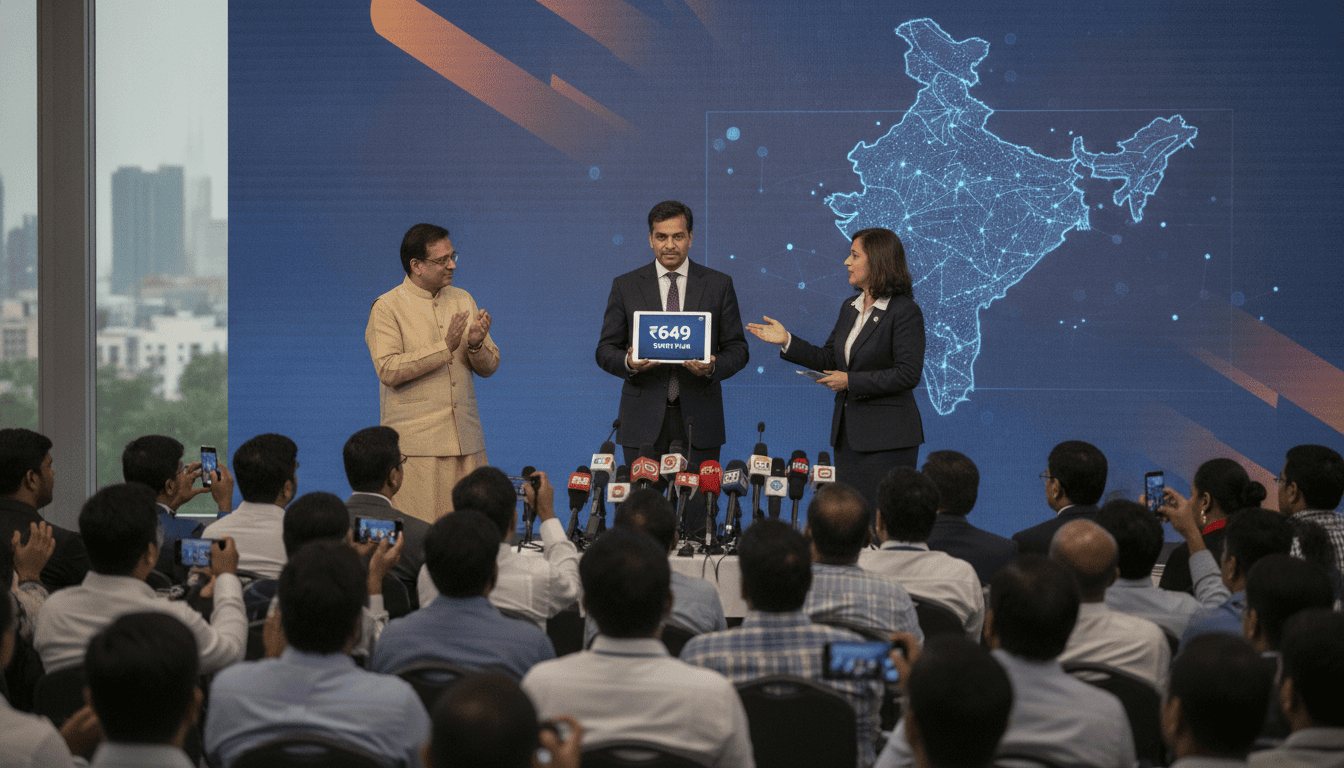
Cursor launches India-only subscription “Cursor Start” at ₹649 to tap developer market
Cursor Start launches in India at ₹649/month, offering Composer 2.5 and Grok 4.5 access with UPI payments to serve a rapidly growing developer base.
Cursor Start, Cursor’s first country-specific subscription, went live in India this week at a price of ₹649 per month, marking the startup’s most significant local push to date. The plan, aimed at individual developers and small teams, includes access to Cursor’s Composer 2.5 and Grok 4.5 models, higher usage limits than the free tier, cloud agents, an iOS app, plugins, and Model Context Protocol support. Cursor said the move is intended to broaden adoption in India’s large and expanding developer ecosystem without cannibalizing its $20-per-month Pro tier.
Subscription details and pricing
Cursor Start is priced in Indian rupees and accepts credit and debit cards as well as India’s Unified Payments Interface (UPI), reflecting the company’s intent to remove friction for local customers. The monthly fee of ₹649 — roughly $7 at current exchange rates — positions the plan well below Cursor’s standard Pro subscription and other international offerings. Cursor said the Start tier is structured to be commercially sustainable by relying primarily on the company’s in-house models to reduce operating costs.
The company emphasized that Cursor Start is not a replacement for Pro but a lower-cost alternative for developers who need more AI-assisted coding capacity than the free tier offers. To preserve the value of its flagship service, Cursor has withheld access to certain frontier third‑party models and advanced features from the Start plan.
Features included and limitations
Subscribers to Cursor Start receive more generous usage caps than free users and gain access to cloud agents, mobile support, plugins, hooks, and skills integrations that accelerate routine coding tasks. The inclusion of Composer 2.5 and Grok 4.5 gives users access to Cursor’s native model stack without the higher costs associated with external frontier models.
Absent from the Start plan are access rights to premium models from providers such as OpenAI and Anthropic, as well as advanced capabilities like Bugbot, Auto Mode, Automations, and the Cursor SDK. Cursor framed these omissions as a deliberate way to create a clear upgrade path to Pro for developers with higher or specialized needs.
Why India matters to Cursor
Cursor has prioritized India because the country is already one of its largest and fastest-growing markets, with a particularly concentrated group of power users. Cursor reported that its user base in India more than tripled over the past year, making the market a natural candidate for localized pricing. The company pointed to India’s deep engineering talent pool as a strategic fit for its product roadmap and commercial ambitions.
The launch arrives against a backdrop of broader industry interest in India’s developer population. Major platforms show India among the world’s top developer hubs, and companies building AI tools have increasingly tailored offers to local purchasing patterns and payment preferences.
Hiring and local expansion plans
To support the subscription roll-out, Cursor is beefing up its presence in India with recruitment and operational investments. The company has hired its first dedicated salesperson in the country and expects an additional commercial leader to join in Delhi. Cursor is also building a government affairs office and has recruited technical customer support staff to serve developers in Bengaluru, Chennai, Hyderabad, and Mumbai.
For now, Cursor’s India customer base is driven primarily by individual developers, startups, and academic users, while enterprise adoption remains in early stages. The company is targeting sectors such as banking and large enterprises as it scales its local sales and support teams.
Risk controls and market integrity
Cursor said it has implemented multiple measures to ensure Cursor Start remains available only to eligible individual users in India, including technical checks designed to deter sign-ups using virtual private networks or other location-masking tools. The company framed the controls as necessary to preserve the plan’s commercial viability and to ensure fairness for local customers.
Cursor also emphasized that the India offer was built with sustainability in mind, asserting that the cost profile of its own models allows the lower price point without relying on loss-leading economics.
Wider strategy and competitive context
Cursor’s India-first pricing move follows a broader pattern of global AI firms localizing subscriptions to capture emerging market volume. Other major providers have introduced lower-cost regional plans in recent years, and Cursor said it could replicate the model in additional markets if the India experiment proves effective. The company signaled openness to expansion but stopped short of committing to specific timelines.
The localized plan arrives as part of Cursor’s wider growth strategy that blends product adjustments, targeted hiring, and commercial experimentation to accelerate adoption in high-potential developer markets.
SpaceX transaction and potential synergies
Cursor’s India push comes while the company is in the process of being acquired by SpaceX in a roughly $60 billion all-stock deal, a transaction the companies expect to close later this year. Cursor has said it will continue to operate independently until the acquisition is finalized. Executives noted that SpaceX’s existing footprint in India through Starlink could lower commercial and operational barriers for Cursor once the deal closes, potentially speeding distribution and enterprise outreach.
Cursor has worked with SpaceX on AI initiatives prior to the acquisition and portrayed the India expansion as a strategic step that was already underway. Company leaders said they foresee opportunities to leverage broader parent company capabilities after integration, particularly in sectors where network and infrastructure partnerships could accelerate deployment.
Cursor Start’s debut reflects a bet that lower localized pricing, combined with tailored payments and on-the-ground support, will convert a growing pool of Indian developers into paying users. The company will be watching adoption, retention, and enterprise interest closely to determine whether the approach can scale beyond India to other developer-rich markets.
