
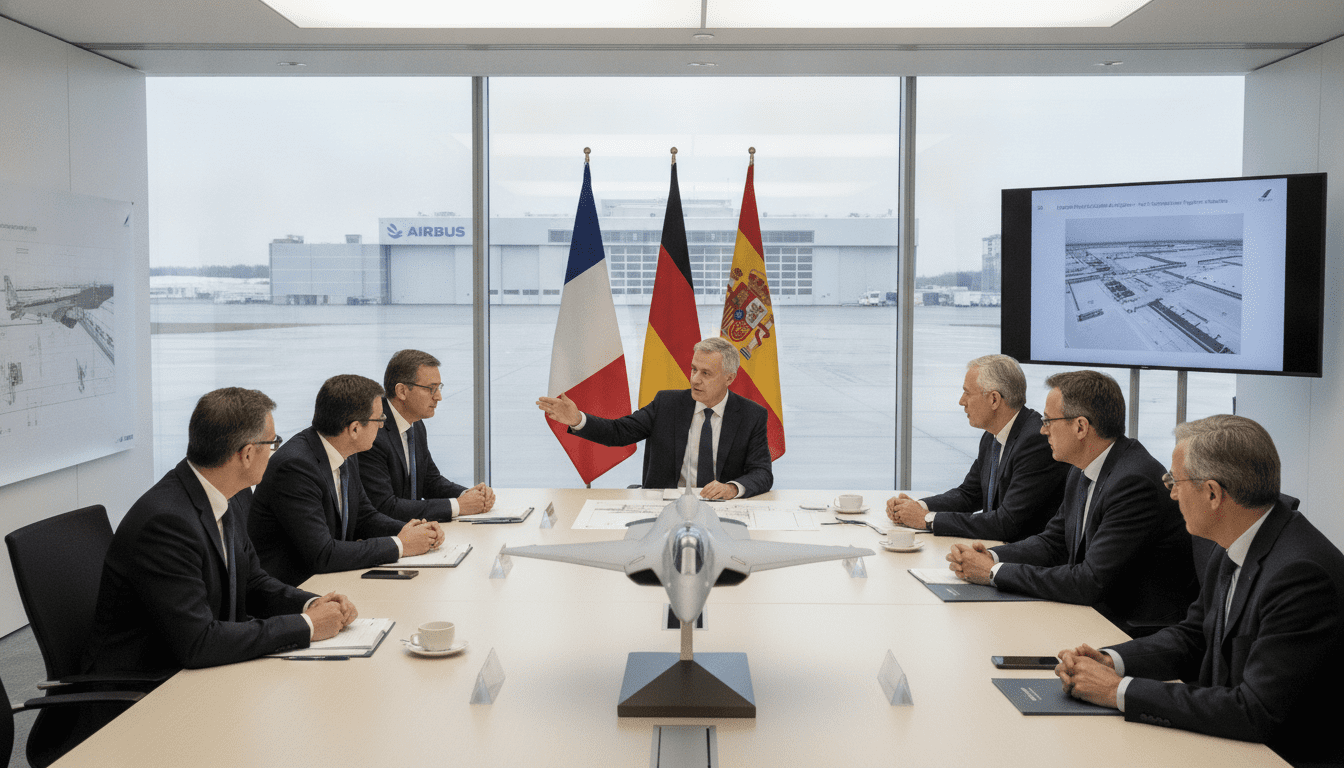
European fighter jet project relaunched as Airbus-led industrial consortium signs at ILA Berlin
Airbus to lead new industrial consortium to revive European fighter jet project after FCAS collapse; partners demand quick German funding decision.
The collapse of the Franco‑German FCAS programme has prompted a fresh push to keep a European fighter jet project alive, with an Airbus‑led industrial consortium signing an agreement at the ILA in Berlin on June 11, 2026. The new grouping brings together major defence suppliers from Germany and beyond and seeks rapid government backing to avoid losing critical know‑how built up during the nine years of FCAS development. Governments in Berlin and Paris have yet to endorse the new industrial set‑up formally, leaving the initiative dependent on political choices this year.
Airbus to lead new industrial consortium
Airbus’s defence and space division will take the lead role in coordinating development of a successor fighter concept, according to the firms involved. The consortium announced on stage at the trade fair includes MBDA and seven German suppliers: Autoflug, Diehl Defence, Hensoldt, Liebherr, MTU Aero Engines and Rohde & Schwarz.
Participants said Airbus would act as the industry prime to assemble a “new, operational industrial set‑up” capable of integrating a future combat aircraft into a wider European combat architecture. The move aims to preserve capabilities that partners say are vital for sovereign defence technology in Europe.
Agreement signed at ILA Berlin on June 11, 2026
The agreement was formalised during the International Aerospace Exhibition (ILA) in Berlin on Thursday, as companies publicly set out their intent to cooperate. French officials announced a separate initiative hours earlier in Paris, underscoring that follow‑on plans to FCAS are taking shape in parallel across Europe.
Company representatives described the ILA signing as a pragmatic response to the end of the joint Franco‑German FCAS effort, which governments announced had been terminated on June 8, 2026. The timing reflects industry pressure to move quickly after nearly a decade of development under FCAS, first announced in 2017.
Spanish firms confirm close collaboration
Spanish defence and aerospace firms also declared they will partner closely with the German‑led group, naming Indra, Airbus Defence and Space (Spain), Grupo Oesia, GMV, ITP and Sener as participants. Indra had been Spain’s lead industrial partner in the earlier FCAS programme and the Spanish consortium said it could not afford further delays.
In a joint statement, the Spanish companies urged rapid decisions to maintain the industrial base and retain engineers and production capacity. They signalled readiness to integrate their workstreams tightly with the German participants to accelerate development timelines.
Partners demand quick German government decision and funding
Industry partners have written to German Defence Minister Boris Pistorius seeking a prompt government decision and explicit financing commitments for the new initiative within the current year. The letter, circulated publicly by consortium members, argues that procurement and contract awards must follow soon to preserve “know‑how and industrial resources” accumulated under FCAS.
Without a timely funding package, participants warned of staff departures and loss of programme momentum that would make a sovereign European fighter project substantially harder and more costly to restart. The consortium says clear political endorsement is required to turn the signed declaration of intent into concrete contracts and work packages.
System of Systems development to continue with France
Bundeskanzler Friedrich Merz has stated he wants to continue collaborative work with France on the FCAS communications backbone, known as the “System of Systems,” even after the fighter‑aircraft element was abandoned. Industry leaders present at the ILA said that preserving and advancing that networking architecture remains a central objective for Europe’s future air combat capability.
Companies argue the System of Systems, which aims to link manned and unmanned platforms and disparate weapons systems, will form the architecture around which any new European fighter must be integrated. Maintaining joint development of those connectivity standards is portrayed as a politically less contentious area where Franco‑German cooperation can continue.
Options on the table for Germany after FCAS end
Defence Minister Pistorius has publicly outlined four possible paths forward following FCAS’s collapse: purchase additional F‑35 aircraft from the United States, join an existing international fighter programme, pursue a new German‑led development, or consider an alternative his office has described only in general terms. The industry consortium’s approach most closely aligns with a new European development under a reconfigured industrial lead.
FCAS had been a central element of long‑term European airpower planning, with France’s Dassault Aviation and Airbus’s defence arm as core industrial partners. High‑level disagreements between those companies contributed to the project’s breakdown, officials have said, creating the opening for the newly announced industrial coalition.
The industry group at ILA framed its proposal as an effort to salvage Europe’s strategic autonomy in advanced combat aviation by combining national strengths and avoiding further dispersal of skills. The success of the initiative now depends on whether Berlin grants the requested approvals and funding this year, and whether Paris and other European capitals will align their defence procurement plans to support a common path forward.
