
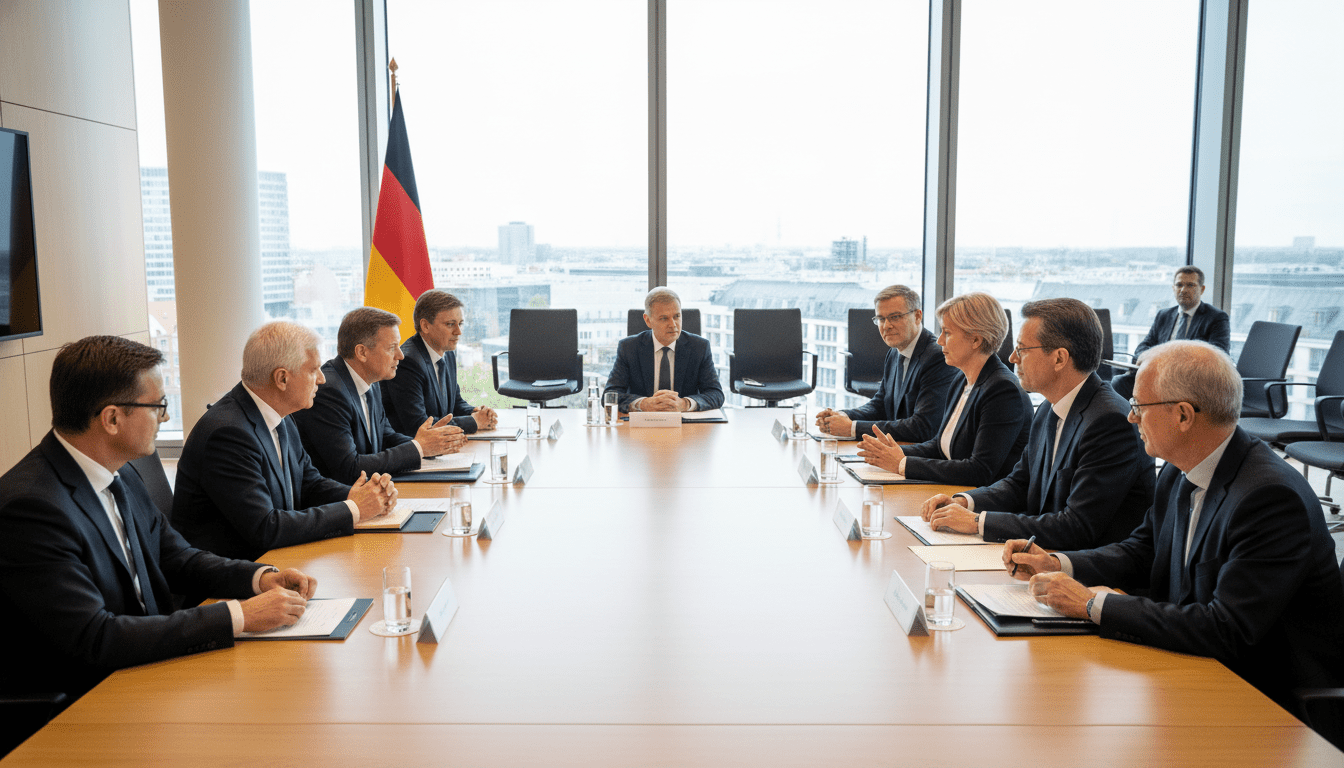
Germany revives “concerted action” as coalition committee invites unions and business groups
German coalition expands Koalitionsausschuss to include unions and employers in a renewed “concerted action” push to address the economic slowdown.
Concerted action returns to the center of coalition strategy
The coalition will widen its Koalitionsausschuss to bring trade unions and business associations directly into talks, reviving a form of “concerted action” intended to align social and economic policy decisions. Supporters within the SPD see the move as necessary to rebuild trust between labour, industry and government, while parts of the CDU prefer framing the initiative as a structured dialogue with social partners. Expectations for immediate breakthroughs are modest, but the expanded format is being presented as a way to reduce public confrontation and manage contentious reforms more discreetly.
Merz rules out an immediate Big Bang of reforms
Friedrich Merz has publicly dampened talk of rapid, sweeping changes, signalling a tactical retreat from the idea of a dramatic “Big Bang” of economic reform. The CDU leader framed the retreat as pragmatic, aimed at preserving coalition unity and calming public anxieties about abrupt policy shifts. Even so, officials and analysts stress that rhetorical de-escalation does not remove the underlying urgency to tackle investment shortfalls and labour-market rigidities.
SPD ministers and unions hold leverage over policy direction
Senior SPD figures and union leaders are widely regarded as decisive actors for any meaningful change, with labour-market and social-policy ministers positioned to shape outcomes. Trade unions will use their new access to press for protections for workers even as employers press for incentives to invest. Observers note that compromise will require concessions from all sides, including from conservative partners and regional leaders who favour more market-friendly measures.
Policy priorities set out by business groups and conservative MPs
Business representatives and market-oriented politicians have outlined a focused set of priorities intended to boost investment and competitiveness, centring on lower social contributions and a reduced tax burden for companies and skilled workers. They argue that these measures would make Germany more attractive to both domestic investors and international talent, reversing a recent trend of capital and labour shifting abroad. In addition, employers and some lawmakers call for more flexible labour rules that would permit varied working-time arrangements and contractual innovation.
Unions resist changes to core labour protections
Union leaders, notably from the main confederations, continue to insist on preserving core labour protections and existing working-time standards, arguing that social stability is a prerequisite for sustainable economic reform. Resistance to altering the statutory eight-hour day or to concessions perceived as increasing precariousness has been strong in union ranks. At the same time, parts of the labour movement acknowledge pressures from members seeking greater flexibility and options for different shift patterns.
Tax proposals and political fallout in the Mittelstand
Proposals circulating among some union circles to adjust the tax mix have alarmed segments of the Mittelstand, where small and medium-sized enterprises fear higher levies or regulatory uncertainty. Business associations warn that aggressive redistributive measures could undermine confidence among the managers and owners who drive investment and employment across Germany. Political strategists from all coalition parties are watching these debates closely, aware that alienating the Mittelstand could have significant economic and electoral consequences.
Low expectations ahead of the coalition meeting
Participants and commentators have downplayed hopes for sweeping policy announcements at the upcoming coalition meeting, instead framing success in pragmatic terms such as improved communication and fewer public disputes. A key objective for negotiators appears to be to create a functioning space for joint consultation that prevents the public theatre of mutual recrimination. If the forum can produce credible short-term steps and a clearer timetable for longer reforms, it will be judged a worthwhile political mechanism even without immediate, large-scale policy shifts.
The broader challenge for Germany is translating the revived “concerted action” approach into concrete policy that meaningfully increases investment and eases labour-market frictions without destabilising social consensus. Achieving that balance will require targeted incentives, disciplined fiscal and social-policy choices, and a willingness among unions, employers and ministers to accept incremental but meaningful compromises. The success of this revived consultation model will ultimately be measured by whether it leads to a clearer path for businesses to invest and for workers to benefit from both security and flexibility.
