
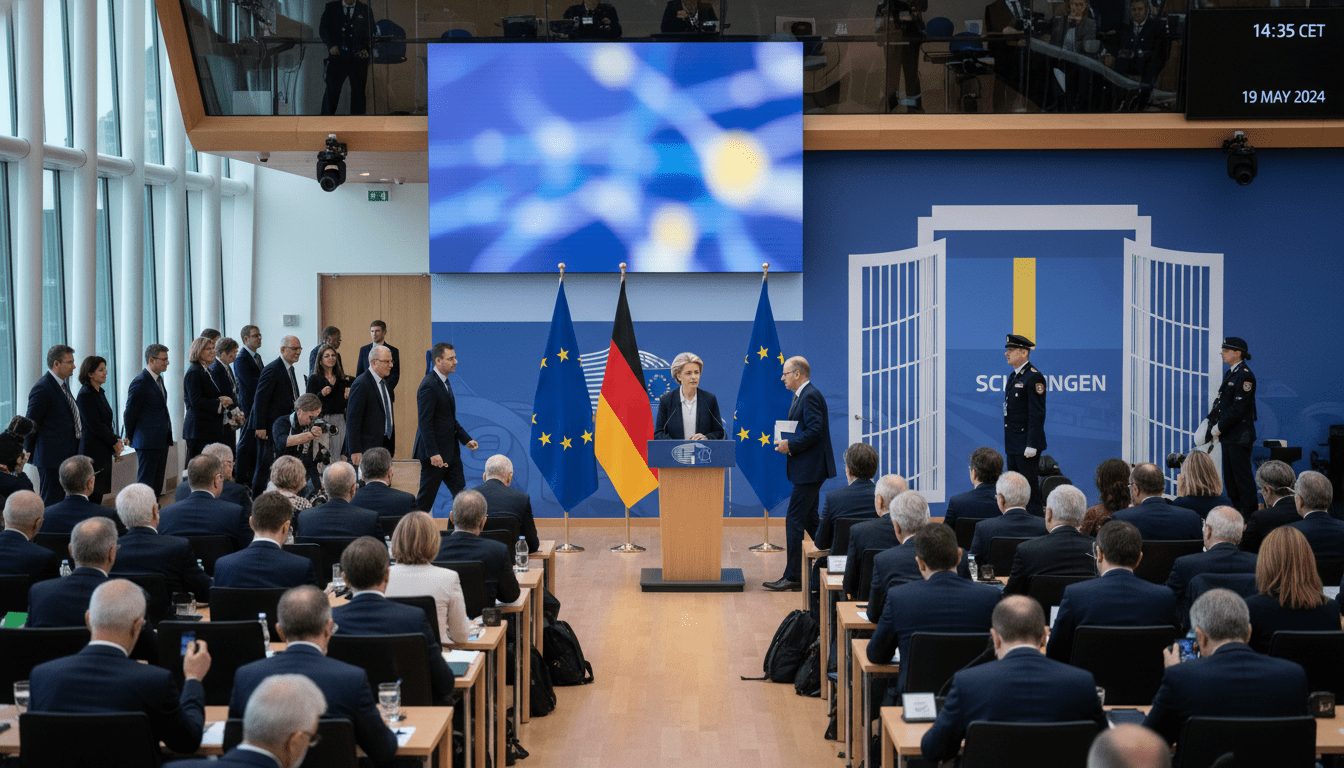
EU Commission urges stepwise rollback of German border controls as new asylum rules near
EU Commission urges stepwise rollback of German border controls as new EU asylum rules near, linking internal easing to tougher, more effective external checks.
The European Commission has recommended a gradual easing of German border controls, urging that checks within the Schengen area be scaled back as new EU asylum rules take effect. German border controls are central to the Commission’s guidance, which ties any internal rollback to strengthened measures at the EU’s external frontiers. Brussels framed its position as pragmatic: acknowledging past failings at external borders while pressing members to restore Schengen freedoms in a calibrated way.
Commission flags legal and operational shortcomings
The Commission’s assessment underlines repeated procedural shortcomings in how several member states notified and justified border measures, not only Germany. It highlighted persistent problems at the EU’s external borders, including high numbers of irregular entries and low return rates. Brussels also noted that the Dublin allocation system has largely failed in recent years and that shortcomings in reception and readmission practices have undermined collective EU responses.
Negotiations shaped by political compromise
Behind the public recommendation lies a political calculus aimed at preserving momentum for a broader asylum reform package. EU institutions and national capitals have reportedly traded firmness on enforcement for cooperation on a revamped Common European Asylum System (GEAS). That compromise appears designed to avoid legal confrontation during a sensitive implementation phase and to encourage member‑state commitment to the new rules.
Berlin conditions any pullback on GEAS delivery
German interior officials have signaled a conditional approach: they are unwilling to remove all federal police presence from borders immediately but indicate readiness to adapt controls if the new asylum framework functions. Federal Interior Minister Alexander Dobrindt has insisted on clearer returns procedures and a demonstrable reduction in irregular arrivals before moving to ease checkpoints. Berlin has also pursued bilateral understandings with frontline states that aim to settle outstanding Dublin claims and align practical cooperation on returns.
Commission monitoring and performance benchmarks
Brussels has tied its recommendations to verifiable progress on returns and procedural guarantees under the new asylum rules, with follow‑up assessments expected in the months after implementation. The Commission has framed the easing of internal checks as contingent on both more effective processing at external entry points and improved readmission cooperation from third countries. For EU authorities, the key metrics will be whether accelerated procedures at the external border produce sustainable increases in removals and lawful disposition of asylum claims.
From fixed checkpoints to mobile, intelligence‑led controls
Officials in Berlin and Brussels envisage a shift away from permanent, predictable border posts toward mobile, risk‑based policing in the border area. The proposed approach emphasizes targeted operations, surprise checks and greater use of automated data such as vehicle registration reads to identify stolen cars or suspect movements. Proponents argue this would make it harder for smuggling networks to plan and would reduce disruption for regular travellers, while critics warn it requires robust legal safeguards and cross‑border coordination.
Public authorities also point to technical enhancements already in use by neighbouring states — including broader camera coverage and data matching systems — as models for smarter controls. Policymakers stress that any system must balance effectiveness with civil‑liberties protections and administrative transparency so that border management remains lawful and accountable.
The Commission’s counsel reflects a compromise between legal caution and political pragmatism: urging member states to restore Schengen freedoms where conditions permit, while demanding measurable gains at the external frontier. How quickly Berlin and other capitals translate those benchmarks into concrete changes will determine whether the EU can reconcile border integrity, asylum reform and free movement.
