
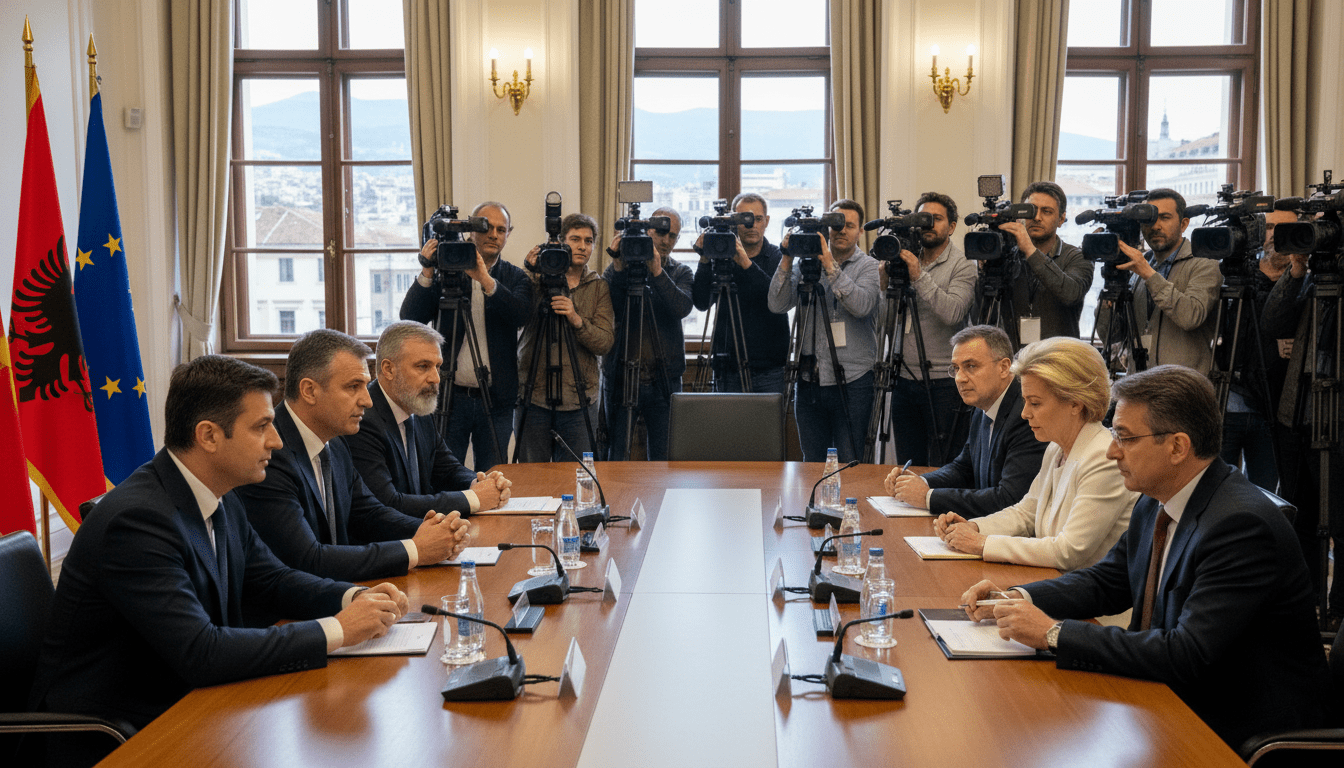
West Balkans EU summit in Montenegro seeks to restart stalled accession talks
West Balkans EU summit in Montenegro seeks to revive stalled accession negotiations amid rising geopolitical competition; Germany reports 50,000 restored citizenships since 2021.
The West Balkans EU summit in Montenegro brought leaders from the six Western Balkan states together with senior European Union representatives to address why EU accession processes have stalled and how to accelerate them. The meeting in Tivat included German Chancellor Friedrich Merz and French President Emmanuel Macron and focused on reform benchmarks, bilateral disputes and mounting geopolitical pressure from external powers. Participants agreed on the urgency of renewed engagement while stopping short of concrete accession timetables.
Leaders gather in Tivat for targeted discussions
Delegations from Albania, Bosnia and Herzegovina, Kosovo, Montenegro, North Macedonia and Serbia attended the summit alongside EU officials to map a way forward on membership talks. The agenda centered on practical measures to unblock negotiations, including judicial reform, anti-corruption initiatives and the resolution of lingering bilateral disagreements.
Organizers emphasized the summit’s diplomatic tone, stressing that the session was designed to restore momentum rather than to deliver immediate membership offers. European leaders signaled an interest in more flexible cooperation formats that could provide tangible benefits while formal accession processes advance.
Causes of the accession slowdown examined
Officials and analysts highlighted a mix of domestic and external factors that have slowed progress toward EU membership for the West Balkan states. Structural deficits such as weak rule-of-law protections, slow public-sector reforms and endemic corruption were cited as primary obstacles to meeting EU criteria.
Bilateral tensions—most notably between Serbia and Kosovo—and differing views among EU member states on enlargement strategy have compounded these internal hurdles. The result is a drawn-out negotiation process that has eroded public confidence in the accession pathway, according to observers.
Geopolitical context drives renewed EU interest
The summit took place against a backdrop of intensified geopolitical competition in the region, with the EU seeking to counter growing influence from Russia, China and other external actors. Several EU officials framed deeper engagement with the Western Balkans as both a strategic priority and a stabilizing measure for Europe’s neighborhood.
Proposals discussed at the meeting included stepped-up investment, infrastructure links and security cooperation as interim incentives that could complement the formal accession process. Delegates argued that delivering measurable benefits quickly could rebuild trust among citizens who have grown skeptical of long accession timelines.
Expert perspective on trust and reform prospects
Vedran Džihić, a political scientist at the Austrian Institute for International Affairs, told delegates that restoring public trust will be essential if accession talks are to regain credibility. He emphasized that technical progress on reforms must be paired with visible improvements in governance and anti-corruption enforcement to change public perceptions.
Džihić also warned that without clearer milestones and faster delivery of EU-linked benefits, nationalist rhetoric and external influence could further complicate reform efforts. His assessment underlined a recurring theme at the summit: political will inside both candidate countries and EU capitals will determine the pace of any revival.
Germany reports wave of restitution naturalizations since 2021
Alongside the summit coverage, German authorities released figures showing more than 50,000 people who had their citizenship revoked or withheld during the Nazi era have been reinstated since 2021. The Federal Ministry of the Interior says affected individuals filed over 100,000 applications after legislation broadened eligibility for restitution naturalizations three years ago.
Ministry officials described the numbers as evidence of ongoing efforts to address historical injustices, while advocacy groups called for continued outreach to ensure remaining eligible persons are aware of the pathway to restored citizenship. The update reflects broader government initiatives tackling legacy issues from the Nazi period.
Next steps and possible timelines after the summit
Summit participants agreed to keep working groups and bilateral channels active in the weeks ahead to translate political commitments into concrete reform steps. EU officials signaled an openness to calibrated packages of incentives tied to specific benchmarks, but they did not commit to fixed accession dates for any country.
Member states will now weigh proposals presented in Tivat and consider how to balance geopolitical urgency with the EU’s established accession criteria. Officials cautioned that any acceleration will depend on measurable, verifiable progress on the rule of law, judicial independence and anti-corruption measures.
The West Balkans EU summit in Montenegro underscored a shared recognition among regional leaders and European partners that reviving the accession process requires a combination of political resolve, technical reform and targeted incentives to rebuild public trust. The coming months will test whether that consensus can be converted into a faster, more credible path toward EU membership for the region.
