
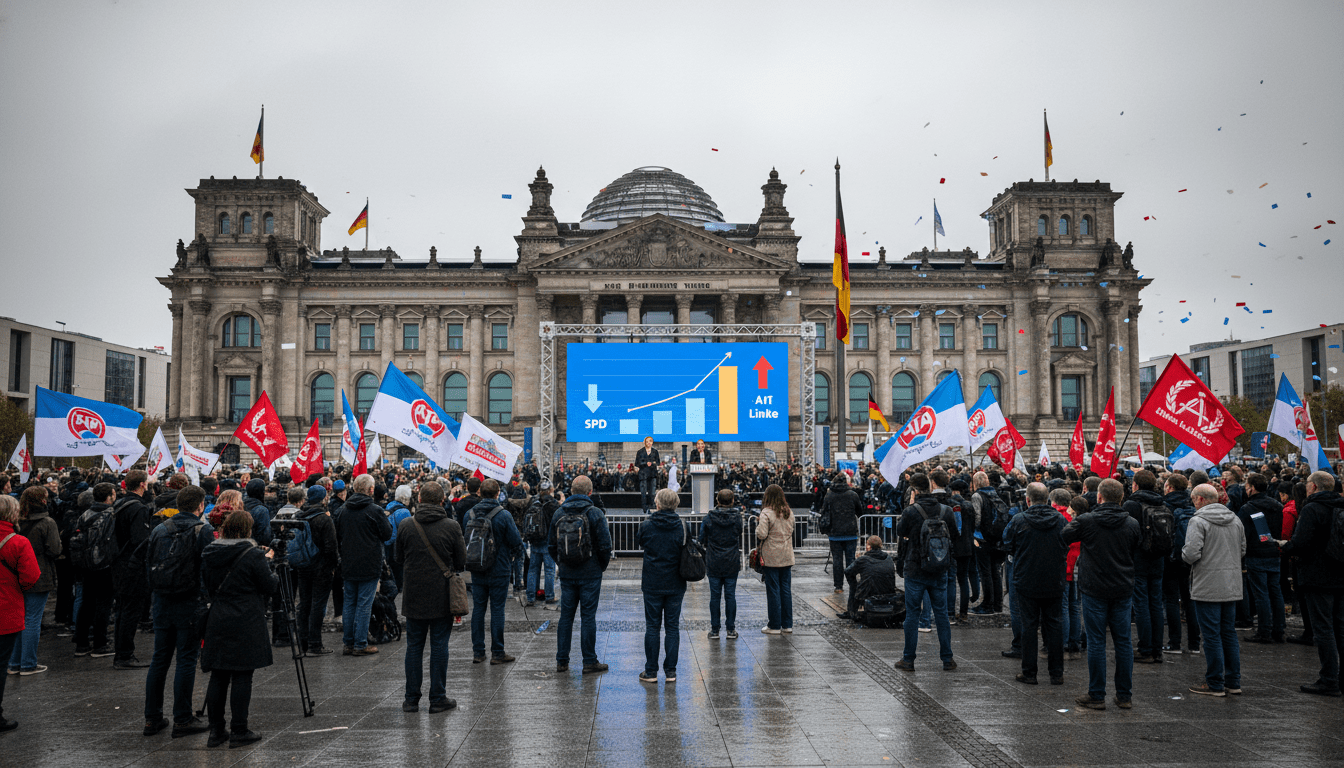
SPD crisis deepens as voters drift and investment shortfalls shape political debate
Germany’s SPD crisis centers on electoral erosion, public investment gaps and a widening disconnect with traditional voters, say analysts and commentators.
The SPD crisis has moved from political analysis into urgent debate as the party confronts sustained losses at the ballot box and growing criticism over policy direction. Longstanding social-democratic functions of representation for those with limited wealth and security are cited as fraying, and observers warn that gaps in public investment and party identity are accelerating voter realignment. Analysts who have studied recent trends argue that the issue is not simple leftward drift but a complex mix of fiscal restraint, policy choices and the party’s changing relationship with its base.
Electoral erosion since 1998
Electoral data and party insiders point to a dramatic decline in the SPD’s vote share since the late 1990s, when the party still commanded more than 40 percent of the vote. By 2025 the SPD’s support had fallen to roughly the mid-teens, reflecting long-term attrition across multiple cohorts of voters.
Political scientists say this loss of binding strength has consequences beyond parliamentary arithmetic. When a traditional integrator of working-class and low-income voters weakens, those constituencies may seek representation elsewhere, reshaping the broader party system.
Shifts in voter allegiance to AfD and Left
Recent polling and electoral results show a notable migration of certain voter groups toward alternative parties, including the AfD and the Left. Analysts stress that the AfD positions itself not merely as an opposition force but as a challenger to core elements of the existing political order.
That dynamic raises strategic concerns for Germany’s democratic balance. If challengers with fundamentally oppositional platforms continue to gain parliamentary foothold, the resulting polarization could complicate coalition-building and policy stability at both federal and state levels.
Public investment shortfall and economic consequences
A recurrent theme in expert commentaries is Germany’s underinvestment in public infrastructure and services over recent decades. Observers link this investment shortfall to structural bottlenecks in transport, digital networks, education and research, which in turn constrain private-sector dynamism.
Fiscal rules and the political acceptance of restrained public spending are frequently cited as institutional factors that hardened this trend. Economists argue that in modern economies robust public investment is often a prerequisite for private investment, particularly where infrastructure and energy costs affect competitiveness.
Debate over the SPD’s ideological trajectory
Commentators have disagreed over whether the SPD’s decline stems from a leftward shift or from a drift toward market-conforming positions. One prominent critique put forward by emeritus economic historian Carl-Ludwig Holtfrerich framed parts of the party’s problems in terms of economic policy, internal shifts and migration handling, sparking a wider debate.
Other analysts counter that landmark reforms since 1998 — including Agenda 2010 and labor-market changes — were broadly market-oriented rather than a leftward realignment. They also point to recent government measures under SPD participation that critics characterize as fiscally cautious or migration-restrictive, complicating the notion that the party has become uniformly more left-leaning.
Perception gap with traditional social base
A recurring explanation for electoral losses centers on a perception gap between the SPD and its traditional supporters. Many voters who are employed, retired, or reliant on social transfers reportedly no longer see the party as an effective advocate for their economic security and social rights.
This estrangement is often linked to policy language and choices that emphasize fiscal discipline or separate “contributors” from “recipients,” framing public services as burdens rather than shared investments. Analysts warn that such framings risk alienating precisely the groups the party historically sought to bind together.
Calls for a renewed social-democratic programme
In response to these trends, some voices within and outside the SPD urge a clearer recommitment to core social-democratic principles: public investment, social protection, and policies that bridge rather than divide economic groups. They argue that revitalizing the party’s appeal requires both policy clarity and visible advocacy for those with precarious incomes.
Proponents of renewal say the goal should not be to adopt conservative fiscal orthodoxies or to pursue symbolic gestures, but to rebuild credibility through tangible programs that improve infrastructure, reduce costs for households, and strengthen labor-market protections.
Political strategists and commentators stress that reversing the SPD crisis will be a multi-year effort requiring organizational, rhetorical and programmatic adjustments. They note that restoring trust among disaffected voters depends on consistent policymaking and on convincing narratives that link economic security to social cohesion.
As the SPD contemplates its next steps, the debate has crystallized around a central choice: whether to reposition toward market-conforming compromises or to reassert a distinct social-democratic alternative built on sustained public investment and broad social representation. The direction the party takes in coming months will shape not only its electoral prospects but also the configuration of German politics for the next electoral cycle.
