
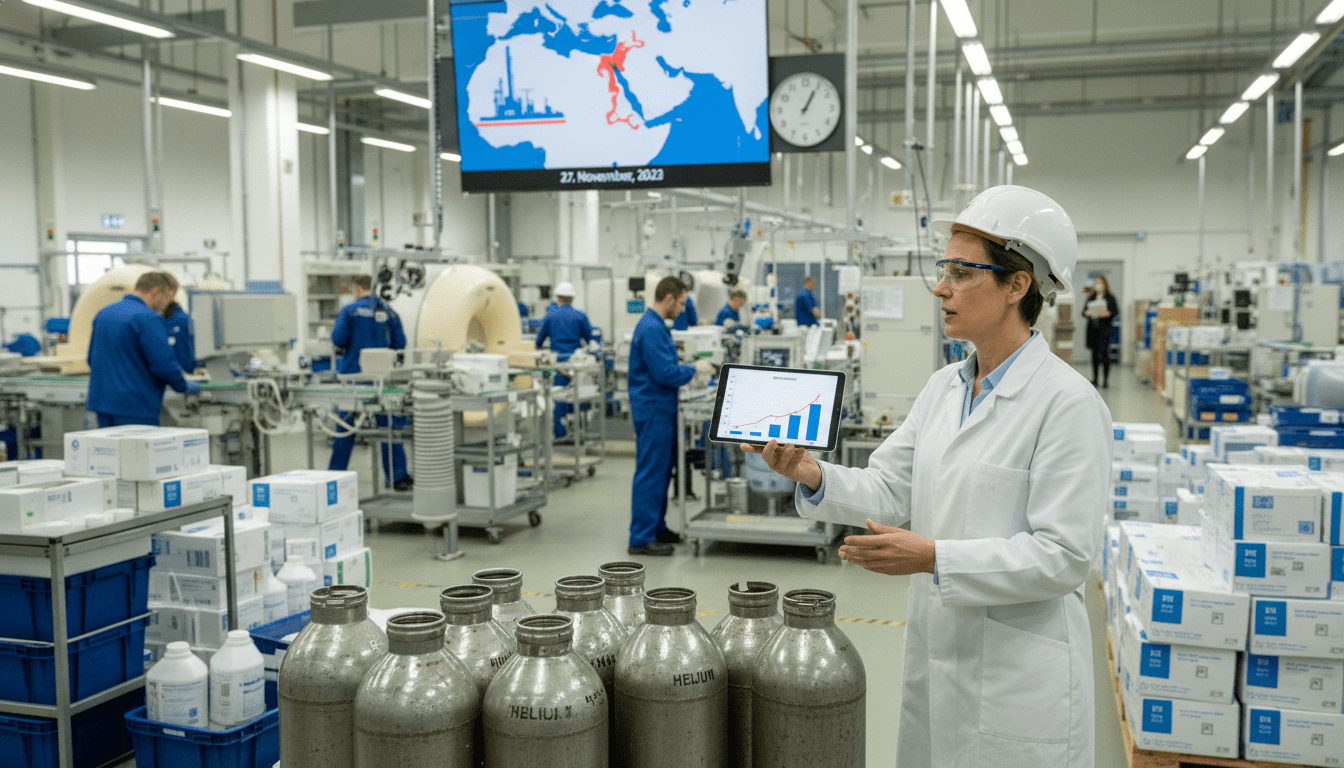
Helium Shortage Deepens as Qatar Facility Attacks Disrupt Global Supply
Global helium shortage escalates after attacks on QatarEnergy sites cut exports by roughly 30–40%, driving price spikes and threatening hospitals, chipmakers and pharma. (cen.acs.org)
The disruption that began with drone and missile strikes on QatarEnergy facilities in Ras Laffan and Mesaieed has pushed a concentrated global helium supply chain to the brink, raising the prospect of rationing and industrial slowdowns. Germany, which relies heavily on imported helium, and other EU countries are confronting immediate allocation decisions for medical and high-tech uses. (lemonde.fr)
Qatar Attacks Take Major Production Offline
In early March, attacks on industrial complexes in northern and southern Qatar forced QatarEnergy to halt liquefied natural gas processing that also extracts helium as an associated product. The company declared force majeure on a range of shipments and paused production at facilities central to the global trade in liquefied helium. (lemonde.fr)
The outages are not confined to a single plant: Ras Laffan and Mesaieed together have accounted for a substantial share of the helium that moves through global markets, creating a gap that cannot be filled quickly by other producers. Shipping through the Strait of Hormuz has also been intermittently constrained, complicating logistics for cryogenic tank transport. (cen.acs.org)
Global Supply Shortfall Estimated at Around 40%
Industry and government analysts say the immediate effect is a sizable shortfall versus normal trade volumes; some national agencies estimate that around 30–40% of globally traded helium is currently unavailable. That degree of disruption is exceptional in a commodity market that was already tightly balanced. (ksta.de)
Helium cannot be manufactured economically and is typically recovered as a byproduct of natural gas processing, which means spare capacity is limited and new production sites would take years to develop. The concentration of supply in a few locations multiplies the risk of systemic shortages. (pubs.usgs.gov)
Spot Prices and Contract Terms Reacted Quickly
Spot markets reacted within days: delivered prices for short-term shipments jumped sharply in March, and industry reports say spot rates have at times more than doubled compared with pre-crisis levels. Buyers with long-term contracts have fared better, but many downstream manufacturers rely on spot or short-notice deliveries. (tradingview.com)
Producers and distributors are reallocating volumes and invoking contractual protections, while some customers report emergency surcharges and delivery delays. Analysts warn that persistent instability in Gulf shipping lanes could keep premiums elevated for months. (thedeepdive.ca)
Hospitals and Pharma Face Immediate Operational Risks
Helium is critical for cooling superconducting magnets in MRI machines and for specialized analytical techniques used in pharmaceutical quality control; the element cannot be readily substituted in many applications. Medical imaging centers and drug testing laboratories therefore sit near the front of the line for scarce supplies. (siemens-healthineers.com)
Manufacturers of high-purity medical gases and diagnostic equipment are urging customers to prioritize critical uses, and some hospitals are already reviewing maintenance schedules for MRI units to conserve helium where possible. Regulators and health systems are tracking inventories to prevent patient-care interruptions. (siemens-healthineers.com)
German and EU Industry Warn of Wide Economic Impact
Germany’s industrial sectors — from semiconductor fabs to pharmaceutical producers — are highly exposed because Europe imports most of its helium and has limited domestic extraction capacity. Companies and trade associations in Germany have flagged the shortage as a supply-chain risk that could force production cuts in sensitive manufacturing processes. (deutsche-rohstoffagentur.de)
The European Union has already classified helium as one of 34 critical raw materials because of its economic importance and high risk of supply interruption, a status that adds urgency to discussions about stockpiling, recycling and diversification. Policymakers in Brussels and national capitals are weighing emergency measures. (consilium.europa.eu)
Policy Options and Short-Term Mitigations Under Consideration
Officials and analysts say short-term responses will focus on reallocation, conservation, and accelerated recycling of helium from industrial and medical systems. Some countries are exploring temporary export controls on nonessential uses and coordination among hospitals and research facilities to maintain critical services. (axios.com)
Longer-term options include diversifying supply sources, investing in helium capture at additional gas-processing plants, and increasing onshore storage capacity; however, those measures require capital and years to implement, meaning the current market could remain tight for an extended period. Economic-modeling groups have also warned that rationing plans may need to be prepared if disruptions persist. (pubs.usgs.gov)
The pace at which Qatar’s facilities can resume normal operations and shipping through the Strait of Hormuz can be secured will determine whether the current squeeze eases or becomes a structural constraint on technology and healthcare production. For now, hospitals, chipmakers and drugmakers are reallocating scarce volumes and urging governments to step in with coordinated contingency plans.
