
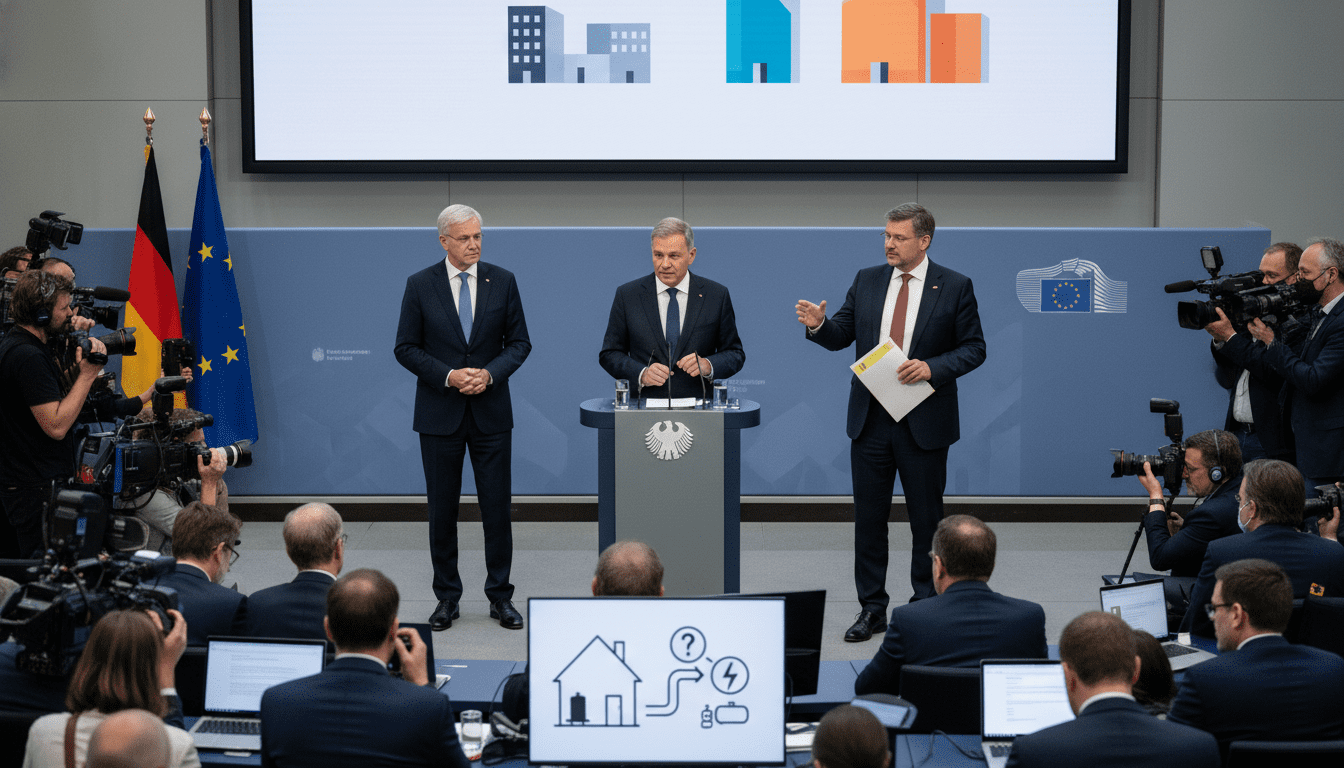
German building modernization law advances after cabinet clears draft allowing oil and gas installations
New draft of the building modernization law would let oil and gas heating be reinstalled, while giving federal states rules-making power and setting fuel-mix targets through 2040.
The federal cabinet last week approved a draft of the building modernization law that would reopen the option to install oil and gas boilers in new and replacement heating systems, a move that shifts regulatory discretion to the Länder and rewrites rules introduced under the previous Habeck-era heating law. The draft, led by Federal Minister for Economics Katherina Reiche (CDU), keeps a phased mandate for cleaner fuels but removes the blanket requirement that new systems run on at least 65 percent renewable energy, the change that has reignited debates over climate targets and local authority. The proposal now moves to the Bundestag for debate and committee work, while state parliaments prepare to press for explicit room to regulate heating transitions locally.
Cabinet decision reopens choice for homeowners
The cabinet’s approved referent draft revises the nation’s approach to heating in buildings by allowing the installation of oil and gas heating systems under the new building modernization law, subject to increasing shares of low-carbon fuels. The change contrasts with the prior regulation, which required a high minimum share of renewables in newly installed systems and effectively pushed households toward heat pumps and district heating. Proponents at the Economics Ministry argue the revision provides practical flexibility for owners and installers facing diverse technical and infrastructure circumstances across Germany.
States gain latitude through Länderöffnungsklausel
A central element of the draft is a Länderöffnungsklausel that explicitly permits federal states to set stricter or alternative rules for heating systems within their jurisdictions. Under the current proposal, individual Länder could retain or adopt tougher requirements similar to the Habeck-era law if they choose, preserving local policy diversity. That feature has become the focal point of negotiations in state parliaments, where regional governments are already calculating the political and regulatory implications for retrofit programs and new construction.
Hamburg Greens demand Senate support for state clause
Green parliamentarians in Hamburg have urged the city’s Senate to back a motion calling for the Länderöffnungsklausel to remain intact during the federal legislative process, citing the clause’s symbolic and practical importance. Nicolas Garz of the Greens’ Hamburg parliamentary group said the clause sends a signal that states must retain the ability to set their own pathways toward climate goals. With a clear rot-green majority in the Hamburg Bürgerschaft, the motion’s passage is widely expected and reflects the city’s legally backed ambition to accelerate its climate program.
Technical shift from the Habeck-era law
Under the Habeck-era heating law, new installations had to run on at least 65 percent renewable energy, a standard that steered investment toward heat pumps, electrification and district heating. The Reiche ministry’s draft drops that blanket requirement and instead allows conventional oil and gas systems while mandating a phased increase in renewable or low-carbon fuel content. The draft envisages starting with a 10 percent minimum share of sustainable fuels for fossil systems from 2029 and rising to 60 percent by 2040, a trajectory designed to blend continuity for owners with gradual decarbonisation of fuel inputs.
Political and legal objections from across the spectrum
The draft has drawn scrutiny from multiple sides of the political spectrum. Hamburg Green energy spokeswoman Melanie Nerlich warned that implying gas remains a viable long-term heating choice risks misleading consumers and undermines planning certainty for climate-aligned investments. Meanwhile, CDU environment politician Thomas Heilmann raised legal concerns, arguing the proposal contains no concrete end date for fossil heating and may conflict with constitutional limits around rolling back environmental protection standards, invoking the so-called Rückschrittsverbot. Lawmakers and legal experts are set to test both the policy coherence and constitutional robustness of the bill as it moves through parliamentary scrutiny.
Legislative timetable and next steps
Parliamentary debate on the referent draft will begin in the Bundestag plenary before the bill is referred to specialist committees for detailed amendment and hearings. According to the government’s planning, consultations in the Bundesrat are expected in October, with the possibility of the law entering into force in early November if the legislative schedule holds. That timeline marks a delay from the original goal of passing the measure before the summer parliamentary recess and opens a window for states and interest groups to press for changes.
Local authorities, industry groups and environmental organisations have signalled that they will use the committee stage and Bundesrat consultations to push for clarifications on obligations, enforcement mechanisms and transitional support for households and building owners. Municipalities particularly emphasise investment certainty and the need for coordinated funding to support low-carbon alternatives where district heating or electrification infrastructure is lacking.
Germany’s national climate target—achieving climate neutrality by 2045—remains the backdrop for the debate, while cities like Hamburg pursue accelerated timetables, aiming for practical neutrality by 2040 and noting that roughly 40 percent of local CO₂ emissions still stem from heat consumption. As the building modernization law advances through the legislative process, the conflict between federal uniformity and state flexibility, and between rapid electrification and a managed transition for fossil fuels, will determine both the legal outcome and the pace of change in the country’s heating sector.
The Bundestag hearings and Bundesrat review will be decisive moments for whether the final law preserves a broad role for the Länder, tightens fuel and efficiency standards, or restores stronger national limits on the installation of fossil fuel heating systems.
