
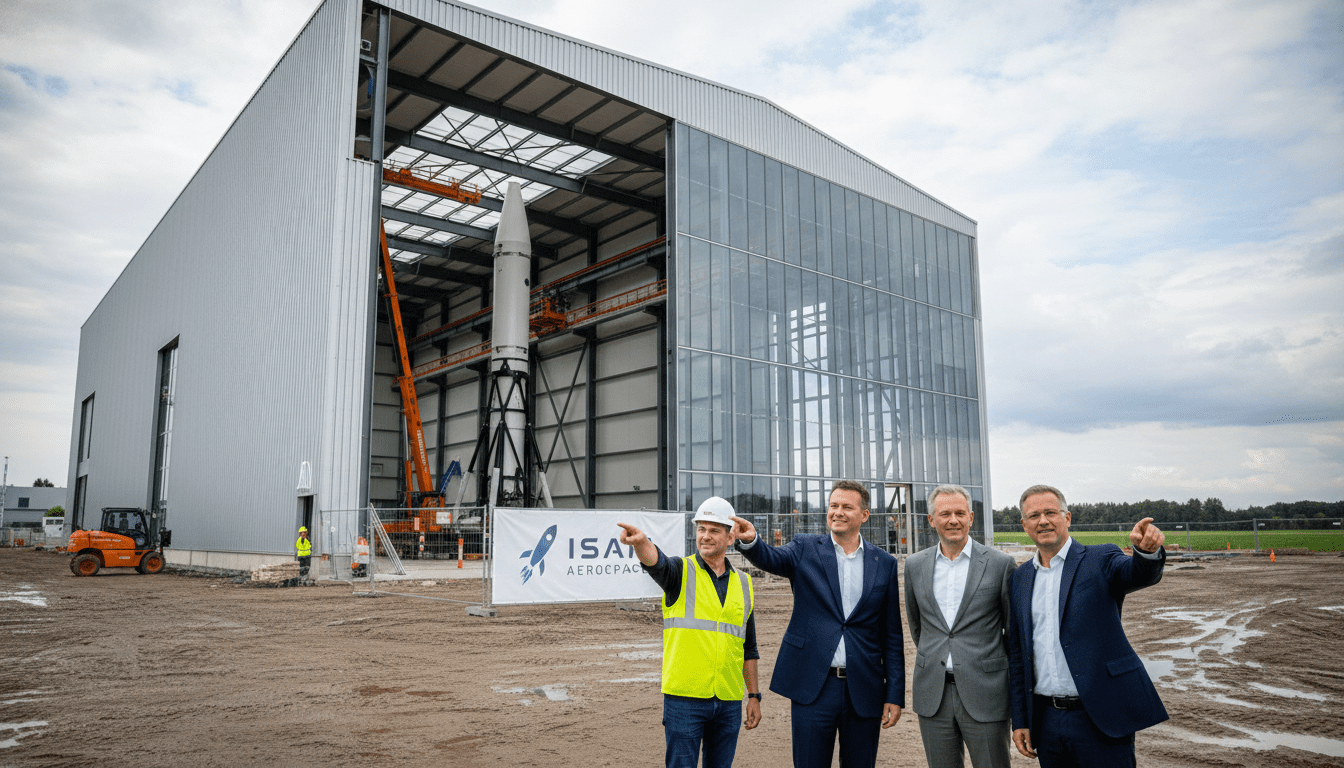
Isar Aerospace Builds 40,000 m² Parsdorf Factory to Produce Up to 40 Rockets Annually
Isar Aerospace is constructing a 40,000 m² factory in Parsdorf near Munich to mass-produce rockets, aiming to manufacture up to 40 vehicles per year and scale European launch capacity.
Isar Aerospace, the German launch startup, has begun construction of a 40,000 square meter production facility in Parsdorf, a northern suburb of Munich, to produce rockets at industrial scale. The company says it intends to reach an output of as many as 40 rockets per year, a production cadence that would mark a significant step for European small- and medium-lift launch capacity. The Parsdorf site is being positioned to move rocket manufacturing from bespoke workshops toward more standardized, repeatable assembly processes.
Parsdorf site and factory footprint
The new facility occupies roughly 40,000 square meters on the outskirts of Munich and is designed for serial production and final assembly of Isar Aerospace launch vehicles. The layout emphasizes linear workflows and higher throughput, with space allocated for propulsion test stands, composite fabrication and integrated assembly lines. By concentrating manufacturing operations on a single campus, Isar Aerospace aims to compress the build-to-launch cycle and tighten quality-control processes.
Ambitious production targets and timeline
Isar Aerospace’s stated goal of producing up to 40 rockets per year represents an aggressive scaling target for a private European launcher. Achieving that cadence will require ramping supply chains, automating repetitive production steps and expanding skilled labor capacity over several years. The company has signaled a phased approach to ramp-up, aligning tooling, parts procurement and certification milestones with expected launch manifest growth.
Assembly-line approach compared with Ariane Group
European incumbent Ariane Group has historically relied on a mix of bespoke and semi-automated production for its larger launchers, and has only partially shifted to continuous flow manufacturing. Isar Aerospace’s Parsdorf design deliberately favors assembly-line methods to lower per-unit costs and speed delivery for smaller rockets serving commercial and government customers. The contrast underscores a broader industry trend: new entrants prioritizing modular, repeatable processes to serve burgeoning satellite markets while traditional players adapt at varying paces.
Supply chain and industrial challenges
Scaling to dozens of rockets annually will test European supply chains for composites, metals, avionics and propulsion components. Isar Aerospace will need to secure multiple vendors, qualify parts to aerospace standards and build redundancy to avoid single-point failures in production. Industrial partners and local suppliers are likely to be integral to the plan, both to shorten lead times and to meet the quality assurance demands of repeated launches.
Workforce development and technical capability
The Parsdorf project will require thousands of skilled hours across technicians, engineers and quality inspectors, along with investments in automation and test infrastructure. Recruiting and training a workforce with rocket-specific experience is a common challenge for scale-ups in the sector, and partnerships with regional vocational programs and universities could accelerate onboarding. The facility’s integrated test and assembly spaces are intended to streamline iterative design improvements and expedite flight-readiness checks.
Market implications for European launch services
If Isar Aerospace succeeds in delivering a high-volume production model, European access to responsive and competitively priced launch options could expand for small- and medium-sized satellites. Greater launch cadence also strengthens mission planning options for commercial constellations and government payloads seeking flexible orbital capacity. At the same time, market entry at this scale will intensify competition and pressure incumbent providers to accelerate their own production modernization efforts.
The Parsdorf plant represents a strategic bet on industrializing rocket manufacturing within Europe and on meeting rapidly growing demand for dedicated launches. Isar Aerospace’s focus on assembly-line production, coupled with targeted supply-chain partnerships and workforce investments, will determine how quickly the company can translate its stated output targets into regular launch windows.
