
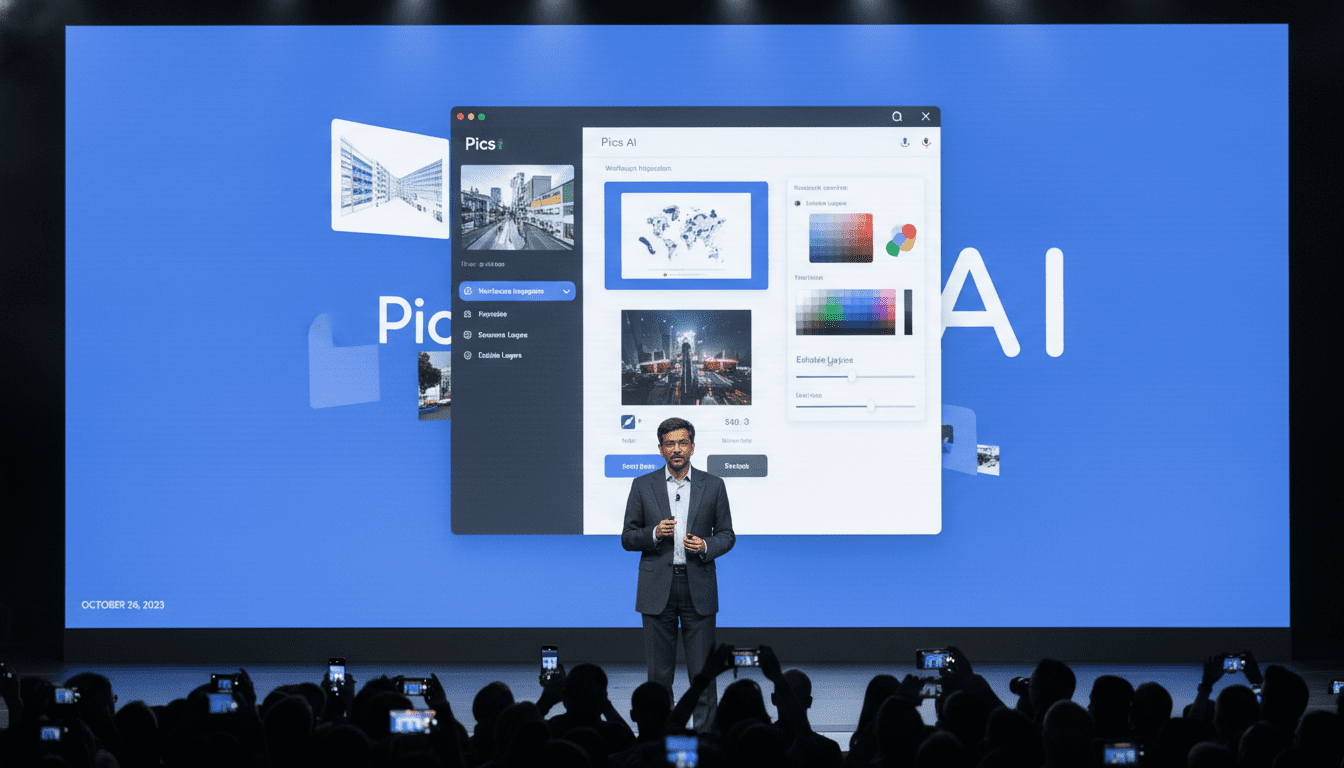
Google Pics debuts in Workspace with editable image generation for all users
Google Pics debuts in Workspace: a new AI image and design tool that generates editable visuals from text prompts, launching to testers with a summer rollout.
Google launches Pics for Google Workspace
Google announced Google Pics at its annual developer conference, introducing an image-generation and design app built into Google Workspace. The company positioned Google Pics as an accessible tool for teachers, small businesses, marketers, and everyday users who need quick, professional-looking visuals. The product is meant to simplify creation of social posts, invitations, marketing assets and mock-ups using only simple text prompts.
Prompt-driven creation with direct manipulation
Users can type a short prompt and receive a finished design ready for refinement, collapsing the gap between idea and deliverable. Rather than forcing a user to craft complex graphical assets from scratch, Google Pics generates layouts, imagery and text that can be adjusted immediately. The app also supports direct edits — you can change copy or adjust an element manually without reissuing a full prompt, preserving other design choices.
Element-level editing powered by Gemini
Google says the editing interface is driven by Gemini, which enables fine-grained control over individual components in a design. Instead of re-running a prompt to alter a small detail, a user can click an element, leave a comment or enter a short instruction to modify only that part. That workflow is intended to mirror collaborative editing models familiar to Workspace customers, reducing revision cycles and keeping designs consistent.
Nano Banana 2 provides image fidelity and text accuracy
Beneath the interface, Google Pics uses the Nano Banana 2 image model, which the company highlights for precise text rendering and realistic detail. The model aims to produce sharper typography and more accurate visual representations than previous generations, addressing a common limitation in image-generation tools. Combined with Gemini’s editing layer, the stack is designed to deliver editable, high-fidelity outputs suited for print and digital distribution.
Workspace integration and collaboration features
Because Pics is built natively into Google Workspace, generated visuals can be shared, co-edited, printed or exported without leaving the suite. Users will be able to circulate drafts for feedback or assign final touches to collaborators before distribution, with sharing controls consistent with other Workspace files. Google positions these features to streamline workflows for teams that already rely on Gmail, Drive and Docs for day-to-day collaboration.
Rollout plan and availability for early users
Google opened Pics to a group of testers at I/O and said the app will become available to Google AI Ultra subscribers this summer. The staged rollout indicates Google intends to refine features and address early user feedback before a wider release. For organizations evaluating the tool, the initial access window offers an opportunity to test Pics in production workflows and assess its fit against existing design solutions.
Competitive context and market implications
Google’s entry formalizes the race among major tech companies to own generative design workflows and compete with specialist platforms. Products such as Canva and newer offerings from AI-first startups have drawn widespread adoption for quick visual creation, and Google Pics targets that same demand with the advantage of Workspace integration. For businesses that depend on frequent visual content, the availability of editable, prompt-driven generation inside familiar productivity tools could alter procurement and production decisions.
Google Pics introduces granular editing and Workspace-native sharing at a moment when automated design tools are moving from novelty to mainstream utility. If the app delivers on fidelity, editability and collaboration, organizations may consolidate more of their visual production inside Workspace. The next months of the testing program and the summer rollout will be a critical period for adoption, user feedback and competitive response.
