
China floods kill at least 10 as historic rains inundate Hubei, Guangxi and Hunan
China floods kill at least 10 as heavy rains inundate Hubei, Guangxi and Hunan; Level‑IV emergency activated and thousands evacuated amid record rainfall.
On 19 May 2026, China floods driven by an unusually large precipitation system left at least 10 people dead across southern and central provinces, authorities said. The China Meteorological Administration warned that the rain system had reached its most destructive stage and issued sustained orange alerts for heavy rain and storms. State agencies reported widespread inundation, landslides and transport disruptions as emergency measures were stepped up.
Fatalities and immediate losses reported
Chinese state media and local officials said the deaths were concentrated in Guangxi, Hubei and Hunan provinces. In Guangxi, six people died after a pick-up truck carrying 15 passengers fell into a swollen river during the downpour, while Hubei reported three fatalities in flash floods in a low-lying village and Hunan recorded at least one death.
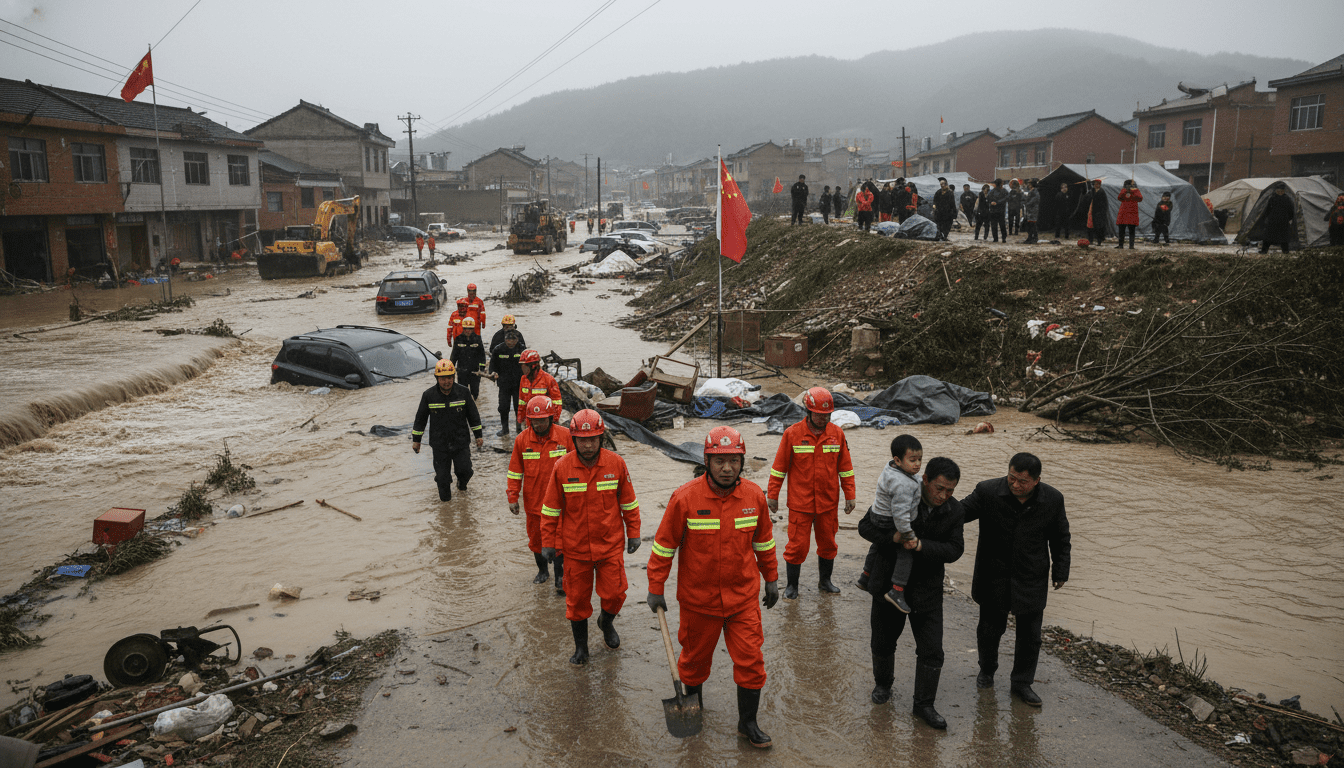
Officials have not released a full national toll of the missing or injured, but imagery and eyewitness accounts show towns and streets submerged, with several vehicles almost entirely underwater. Rescue teams have been dispatched to affected counties and initial assessments are focusing on search-and-rescue and stabilizing slopes prone to landslides.
State emergency response and regional measures
China’s State Flood Control and Drought Relief Headquarters activated a Level‑IV emergency response for Hunan and Guangxi on Tuesday, while maintaining the same tier for Hubei, Chongqing and Guizhou. The Level‑IV designation speeds the mobilisation of provincial and state resources for flood relief and evacuations, officials said.
Local governments ordered schools and some businesses to close, and transport services including passenger ferries and selected road links were suspended in the worst-hit areas. Authorities also reported organised relocations of residents from villages and towns at immediate risk, with temporary shelters being established to accommodate evacuees.
Record rainfall and scope of the system
Meteorological authorities said the affected zone stretches for more than 1,000 kilometres (about 620 miles), making the event broader than many typical heavy-rain episodes. The CMA and state broadcaster CCTV highlighted a string of local rainfall records, particularly in central Hubei, where 337 townships reportedly recorded over 100mm of rain within a 48‑hour window.
The exceptional rainfall totals overwhelmed drainage systems and increased river levels, producing rapid surface runoff and flash floods in low-lying communities. Municipal drainage authorities warned that infrastructure originally designed for shorter, less intense storms was under severe strain across multiple river basins.
How meteorologists explain the heavy rains
Weather scientists attributed the scale and persistence of the China floods to a convergence of moist air from the Bay of Bengal, the South China Sea and the western Pacific Ocean. That combined influx of moisture, coupled with a slow-moving atmospheric circulation, allowed heavy precipitation to cluster over the same regions for extended periods.
The slow translation speed of the weather system meant individual areas received repeated bursts of heavy rain, increasing cumulative totals and the risk of saturated soils and slope failures. Forecasters noted that when multiple moisture streams feed a stalled system, localized extremes become more probable.
Local impact: communities, images and services disrupted
Social media posts from Chinese platforms showed residents wading through knee‑deep water in parts of Jingzhou, Hubei, with some capturing scenes of people catching fish in submerged streets. Local photos and video also documented vehicles stranded in floodwater and riverbanks overtopped by rapidly rising flows.
Authorities said they were prioritising road access to hospitals and the delivery of drinking water and food supplies to isolated communities. Power and telecommunications outages were reported in patches, complicating rescue coordination and prompting additional emergency crews to restore essential services.
Short-term forecast and outlook for the Yangtze corridor
China’s National Meteorological Centre said the severe weather was expected to shift east and south over the next 48 hours, bringing the heaviest rainfall to the middle and lower reaches of the Yangtze River from Wednesday. Forecasts called for continued vigilance as river levels rise and tributaries respond to sustained runoff.
Officials warned downstream communities to prepare for elevated water levels and renewed emergency measures, including further evacuations and temporary flood-control operations. Flood-control agencies also said monitoring would continue for landslide-prone slopes and key reservoir outflows to reduce downstream impacts.
Relief operations are focusing on swift rescues, temporary sheltering and assessments of infrastructure damage, while meteorologists continue to track the moving system and issue updated warnings as conditions evolve.
