
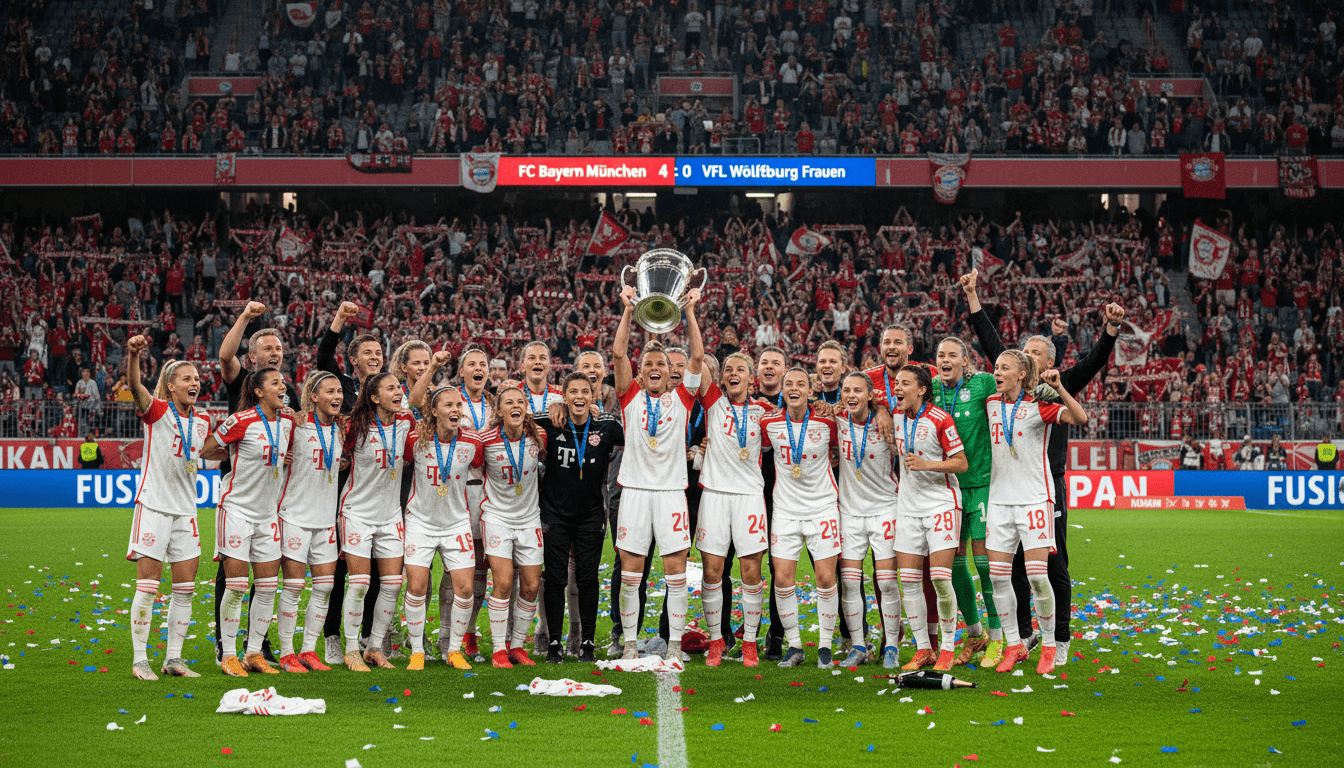
Bayern Women DFB-Pokal final: Bayern Munich rout Wolfsburg 4-0 to complete second straight double
Bayern Munich secured the DFB-Pokal in dominant fashion, beating VfL Wolfsburg 4-0 in a one-sided final that underscored the club’s supremacy in women’s football. The Bayern Women DFB-Pokal final saw goals from Georgia Stanway, Pernille Harder, Momoko Tanikawa and Arianna Caruso as 46,064 spectators watched the Bavarians close a near-perfect domestic season. Captain Glodis Perla Viggosdottir lifted the trophy in a confetti shower, sealing Bayern’s second consecutive domestic double and the club’s third cup triumph.
Decisive moments and the trophy presentation
Bayern’s captain received the eleven-kilogram cup at 18:13 local time, prompting the customary celebrations on the pitch. The victory capped a season in which the Munich side combined clinical finishing with sustained control across competitions. Wolfsburg, who had dominated the cup in previous years, were left to rue a lack of attacking edge against a compact Bayern rearguard. The scoreboard reflected both Bayern’s efficiency and Wolfsburg’s inability to convert possession into clear chances.
How the match turned before halftime
A goalless, chance-sparse first half briefly threatened to produce a stalemate until a VAR intervention changed the course of the game. Video review sent the referee to the monitor after Lineth Beerenstyn fouled Momoko Tanikawa in the box, and Georgia Stanway converted the resulting penalty in stoppage time to make it 1-0. The late first-half breakthrough allowed Bayern to enter the break with momentum and forced Wolfsburg to alter its tactical approach for the second period.
Second-half goals end contest
Bayern extended their lead through a series of decisive moments after the interval, removing any real prospect of a Wolfsburg comeback. Pernille Harder headed home from a Magdalena Eriksson cross to make it 2-0 and relieve pressure on the Munich defence. Momoko Tanikawa and substitute Arianna Caruso added goals in the 77th and 84th minutes, respectively, finishing off a match that had opened only in the final half-hour. The four goals were the product of composed finishing and timely movement in the attacking third.
Wolfsburg’s final chapter and player departures
The defeat marked a disappointing end for Wolfsburg captain Alexandra Popp, who made her return from a calf injury but was unable to influence decisive attacking moments. The final also highlighted an ongoing exodus of talent from the Frauen-Bundesliga, with Wolfsburg set to lose several key players this summer. Fans displayed messages lamenting the club’s trophy drought since 2024, while the squad’s inability to find goal-scoring fluency in the final exposed broader recruitment and retention challenges.
DFB concerns about talent drain to foreign leagues
At the final, DFB vice-president Heike Ullrich voiced alarm over growing transfers of top players abroad, particularly to England, and warned of market forces increasingly mirroring the men’s game. The trend has affected several Bundesliga clubs, with Eintracht Frankfurt among those announcing multi-player departures this week. Ullrich framed the situation as worrying ahead of the 2029 European Championship, noting the potential impact on domestic development if many national-team players pursue careers exclusively overseas.
Bayern’s stability and squad outlook
For Bayern, the win offers reassurance that the club’s core remains intact despite an active transfer market. Georgia Stanway, who converted the match-opening penalty, is expected to remain a key figure as Bayern seek continuity, while Klara Bühl has indicated she will complete her contract in Munich for at least another season. The Bavarians enter the offseason with a roster largely preserved, giving them an advantage in preparing for continental competition and domestic defense of their titles.
Bayern’s triumph in the DFB-Pokal final capped a campaign defined by defensive solidity and attacking precision, and it emphasized the growing gap between the league’s leading club and its challengers. The result will prompt introspection at Wolfsburg and among Bundesliga clubs more broadly about how to retain talent and remain competitive as the women’s game professionalizes across Europe.
