
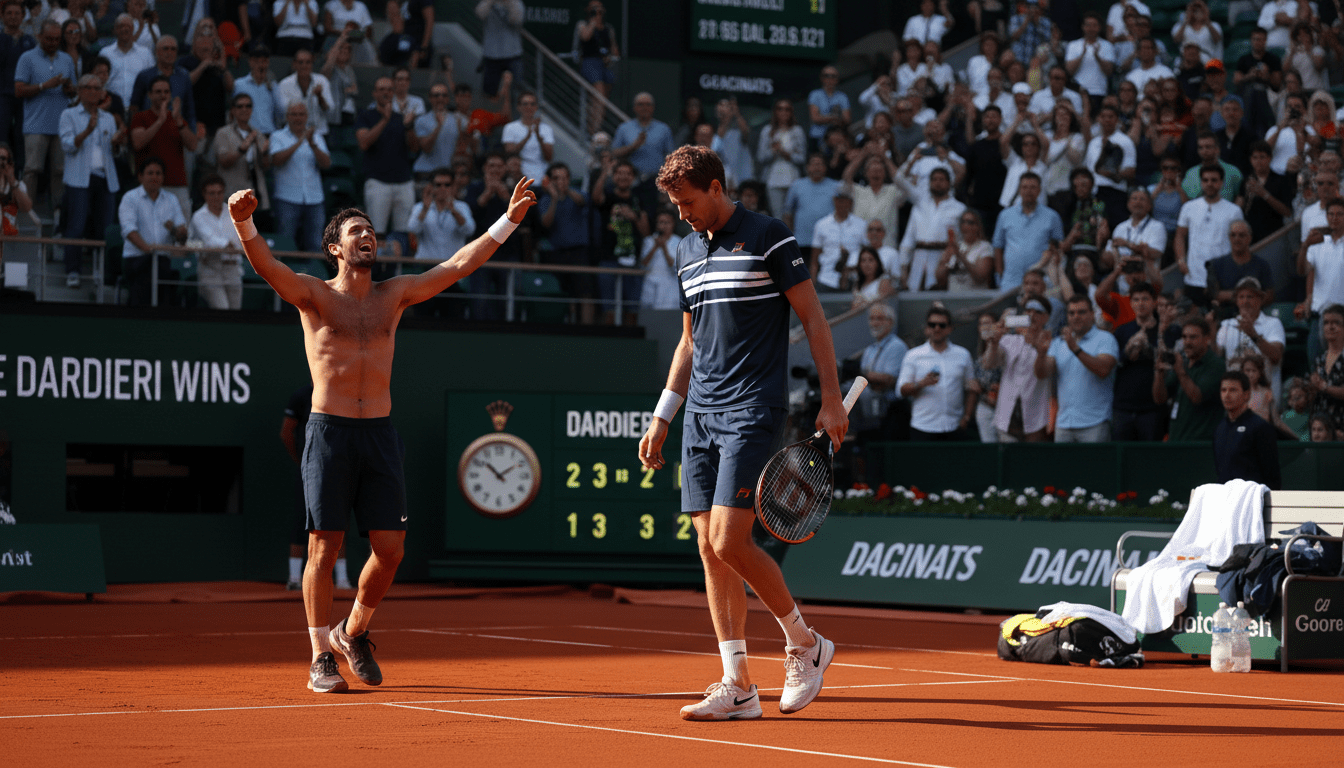
Alexander Zverev stunned in Rome as Luciano Darderi completes comeback; concerns rise ahead of French Open
Alexander Zverev exited Rome after a 6-1, 6-7(10-12), 0-6 defeat to Luciano Darderi, raising fresh doubts about his readiness for Roland Garros this month.
Alexander Zverev suffered a shocking defeat in the ATP Masters in Rome, losing 6-1, 6-7(10-12), 0-6 to Italy’s Luciano Darderi in the round of 16. The loss marks only the second time this year Zverev has bowed out before the semifinals at a tournament, and it interrupts a run of form he had hoped to sharpen ahead of the French Open. The scoreline underscored a dramatic momentum swing: early control gave way to a collapse that left questions about his fitness and preparation.
Early Control, Sudden Reversal
Zverev dictated play from the outset, breaking early and closing out the first set 6-1 with a commanding blend of depth and aggression. For a time the German looked in full control, moving well and hitting a variety of attacking shots that unsettled his much lower-ranked opponent. That control evaporated in the second set as Darderi scrambled back into the contest and the dynamics shifted markedly.
Zverev’s movement and timing, which had been effective in the opening set, appeared to deteriorate as the match progressed. Service games that had been comfortable in set one became vulnerable, and the Italian crowd’s intensity amped up the pressure on the top seed. By the third set Zverev offered little resistance while Darderi seized every opportunity.
Tiebreak Drama and Missed Match Points
The second set produced a tense tiebreak in which Zverev held multiple match points but failed to convert them, allowing Darderi to hang on and force a decider. Those missed opportunities proved decisive; failing to close out the match at that stage swung momentum fully to the Italian. After roughly two and a half hours, Darderi converted his second match point to claim the upset.
Darderi’s resilience was bolstered by the partisan home crowd, whose energy repeatedly lifted his level during critical points. Zverev, by contrast, showed signs of physical and mental fatigue in the closing stages, unable to recover the form that earned him the opening set. The tiebreak sequence will be examined closely as a turning point in Zverev’s Rome campaign.
Court Conditions Draw Strong Criticism from Zverev
After the defeat Zverev voiced sharp criticism of the playing surface on the BNP Paribas Arena, calling it the worst court he has encountered in his career. He suggested the ball’s unpredictable bounce interfered with points at crucial moments and cited a specific incident in which a bounced ball sailed over his head on a match point. The complaint adds an extra layer to his post-match assessment and may prompt questions about venue preparation.
Tournament organizers had assigned Zverev to the second show court rather than the main central court for his match, which the German indicated contributed to the problem. While surface conditions can vary across a tournament, a public rebuke from a top seed intensifies scrutiny on maintenance and scheduling decisions. Such disputes often draw mixed reactions from players and officials alike.
Darderi’s Breakthrough and Upcoming Challenge
For Luciano Darderi the victory represents a career-defining result, as he notched his first win over a top-10 opponent and advanced to the quarterfinals of a Masters event. The 20-year-old carried momentum and confidence throughout the match, turning down-court defense into aggressive, high-percentage offense when it mattered. His composure in the tiebreak and physical push in the decider showcased an ability to thrive under pressure.
Darderi is set to meet Spain’s Rafael Jodar in the quarterfinals, a matchup that will test whether he can sustain this level against another rising talent. The win is likely to boost his ranking points and visibility on the tour, and it will be watched as evidence of Italy producing a deeper crop of competitive players on clay. For Rome and its spectators, the upset will be remembered as one of the tournament’s major surprises.
Implications for Roland Garros Preparation
Zverev’s unexpected exit complicates his lead-up to the French Open, which begins later this month, and raises questions about whether he will opt for additional match play before the Grand Slam. The German had hoped to use Rome as a key tune-up event, but the defeat interrupts his momentum and may force a re-evaluation of his schedule and conditioning. With Roland Garros just weeks away, finding match rhythm on clay will be a priority.
It remains unclear whether Zverev will compete in events in the coming days, including a possible appearance in his hometown tournament in Hamburg, where organizers and fans will be monitoring his recovery. Coaches and support staff will need to balance rest, tactical adjustments and confidence-building sessions if he is to arrive in Paris in optimal form. Any changes to his preparation will be scrutinized by rivals and media alike.
Masters Record and Season Context
The loss also denied Zverev the opportunity to reach what would have been his 40th Masters quarterfinal, a milestone reflecting consistency at the highest level of tour events. This match marked the first time this season Zverev dropped a match after winning the first set, an unusual reversal for a player accustomed to closing out leads. In recent Masters tournaments he repeatedly ran into Jannik Sinner, and while those results had been a recurring theme, the Rome defeat represents a different type of setback.
Across the season Zverev has sought to convert deep runs into titles, but a tournament victory has remained elusive so far this year. The Rome result will be cataloged as a missed opportunity to gain form and ranking momentum ahead of the clay-court pinnacle in Paris. Analysts will weigh the loss alongside his broader results when assessing his prospects for the remainder of the clay swing.
Zverev’s team faces immediate decisions about recovery and calendar choices as the French Open approaches, and the German will have little time to rebuild confidence. For Darderi, the win opens a new chapter and provides a platform for further progress in Rome and beyond. The coming weeks will reveal whether Zverev can translate lessons from this defeat into necessary adjustments for Roland Garros.
