
How the AfD Was Born: From a Frankfurt Café Moment to a National Political Force
Tracing how the AfD began as a eurosceptic initiative and later transformed through leadership struggles into a significant actor in German politics.
Founding Figures and a Frankfurt Café Moment
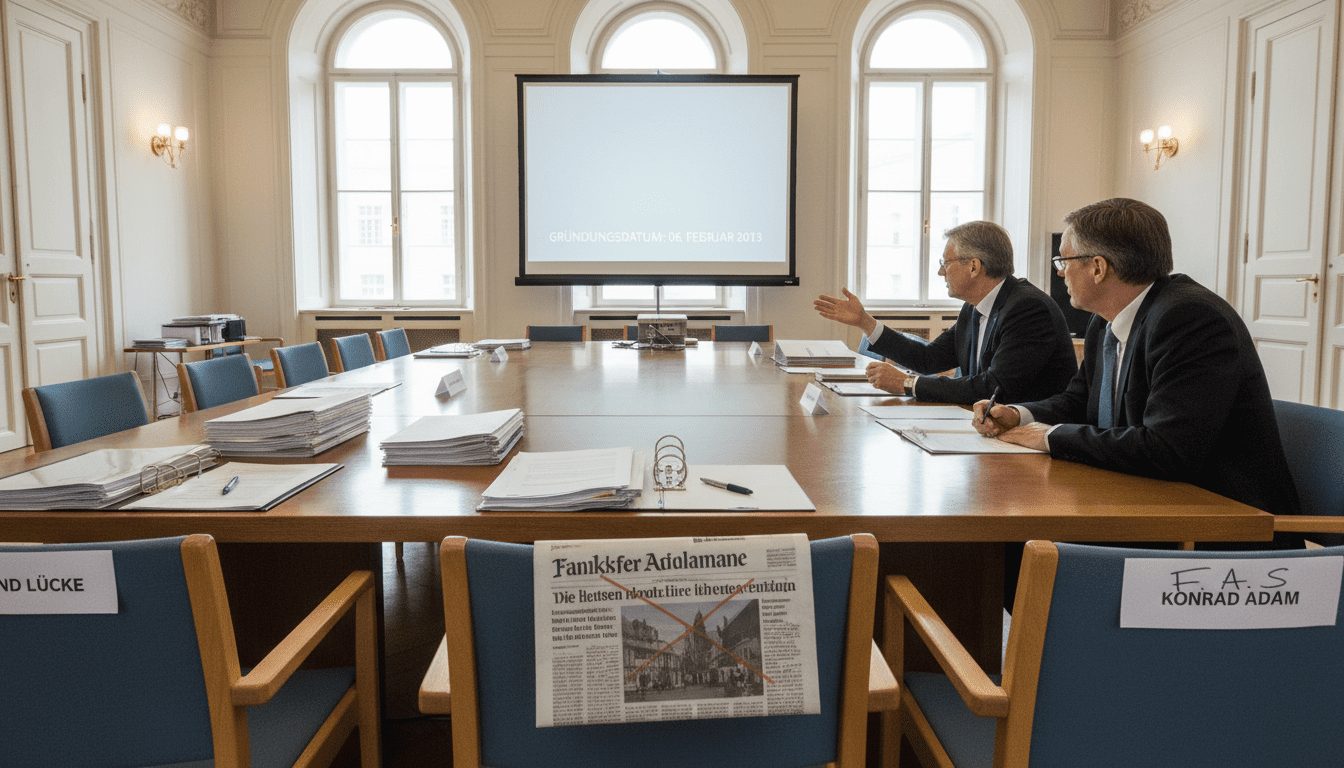
A small group of economists and political activists gathered in 2013 to launch a party that would challenge the euro consensus. Among the founders were Bernd Lucke and Konrad Adam, figures whose names remain linked to the movement that became the AfD. At the time, the initiative was driven by critiques of eurozone policy rather than the broader identity politics that would follow.
A reporter from a national paper later recalled being in a small standing café in Frankfurt during those early days, close to a moment that would prove consequential without realizing it. That anecdote underscores how the AfD’s rapid transformation surprised observers who had seen only the initial eurosceptic contours. The transient, informal encounters of those first months belie the party’s future institutional impact.
Euro Skepticism as the Initial Platform
The AfD launched with a clear focus on opposing bailouts and advocating for a fundamental reassessment of euro governance. Its policy proposals emphasized economic liberalism and a return to national control over monetary matters. This focused agenda attracted academics, entrepreneurs, and voters uneasy with the EU’s fiscal responses to crisis.
Campaign materials and early speeches stressed legal and economic arguments rather than cultural grievance. That framing made it possible for the party to draw support from voters across the political center-right spectrum. Yet the narrowness of the founding platform also left open the question of where the party might move once it had established an organisational foothold.
Rapid Organisation and Media Attention
Within months, the AfD moved from seminars and discussion panels into a formal party structure with regional branches. Media coverage increased as the party began contesting elections at state and European levels. Early electoral results were modest but sufficient to signal that the party had tapped into a constituency unhappy with mainstream options.
Founders used a mix of scholarly argumentation and populist shorthand to reach different audiences. The presence of public intellectuals lent credibility, while sharper rhetoric broadened appeal. This dual strategy accelerated growth but also sowed the seeds of internal tension about identity and strategy.
Leadership Battles and an Ideological Shift
Internal disagreement over strategy and messaging intensified as the AfD expanded. A leadership contest exposed divisions between the original economists and a rising faction that emphasized immigration and identity issues. When the new leadership consolidated around a more national-conservative line, some founding members parted ways with the party.
Those departures changed the party’s profile and public perception. What began as a technical critique of the euro increasingly incorporated cultural and security themes that resonated with a different segment of voters. The shift hardened the party’s image and shaped both its policy priorities and its relations with other political actors.
Electoral Gains and National Impact
As the party recalibrated, it registered substantial gains in regional and federal elections, breaking through into state parliaments and eventually the Bundestag. Its success forced established parties to reckon with an altered political map. Coalition arithmetic, campaign strategies, and parliamentary debates all adjusted in response to the AfD’s presence.
The party’s rise also sparked intense public debate about political norms and the boundaries of acceptable discourse. Critics argued that the ideological shift brought extremist rhetoric into mainstream institutions, while supporters said the AfD gave voice to legitimate concerns that had been ignored. That polarization has become a defining feature of Germany’s recent political life.
Institutional Consequences and Ongoing Questions
Beyond votes and seats, the AfD’s emergence reshaped party competition, media coverage, and civic discussion in Germany. Its ability to mobilize discontent exposed vulnerabilities in traditional political offers and highlighted gaps in communication between elites and parts of the electorate. At the same time, legal and parliamentary challenges have tested how institutions respond to parties that push new boundaries.
Looking ahead, questions remain about the party’s durability and adaptability. Internal factions continue to influence policy direction, and external pressures — from court rulings to voter realignments — will shape its trajectory. Observers note that the AfD’s future depends as much on broader social trends as on its internal discipline.
The story of the AfD’s formation, from a focused eurosceptic project to a major political actor, is a reminder that parties can evolve rapidly once they acquire organizational momentum. Early meetings and casual encounters in places like a Frankfurt café were small moments with outsized consequences, and the political landscape that followed reflects both deliberate strategy and unintended amplification.
