
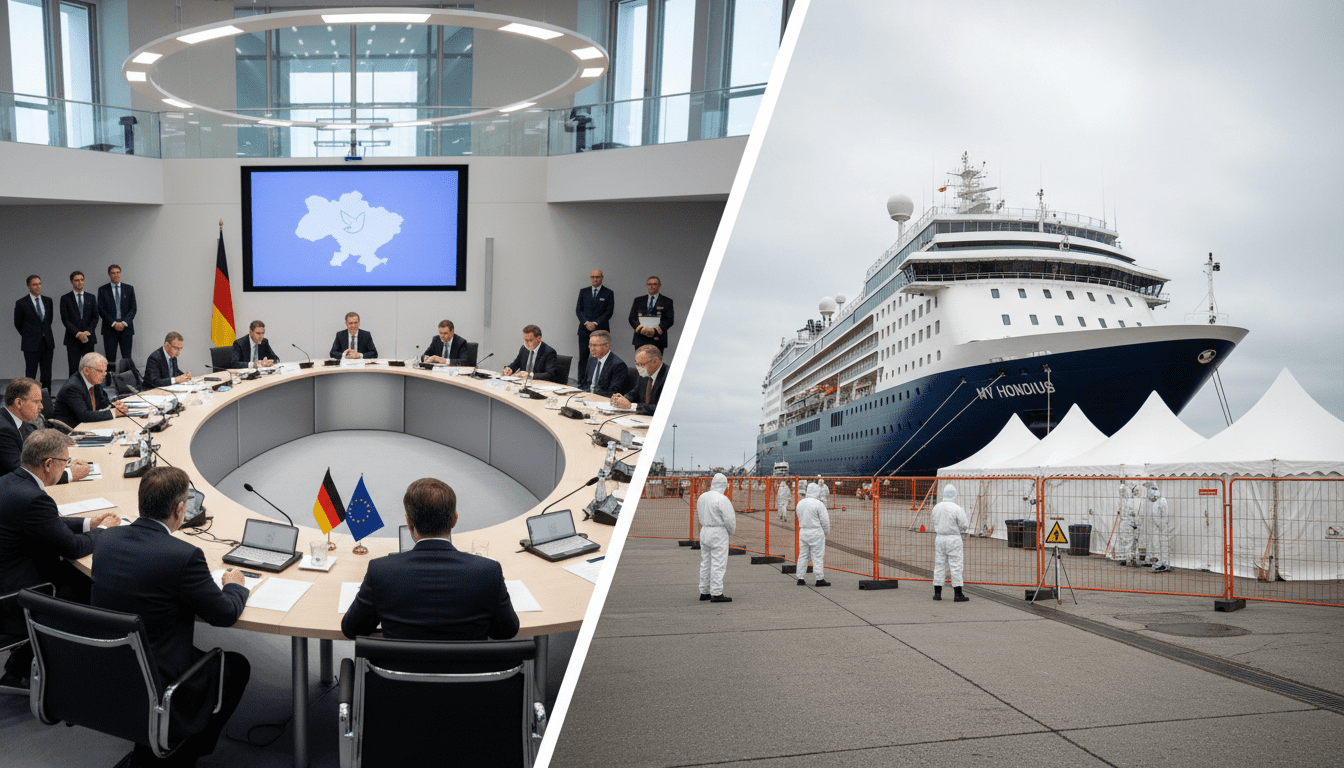
Berlin Speculates on Mediators for the Ukraine War as Australia Quarantines MV Hondius and Maintal Residents Halt Data Center
Berlin debates potential mediators for the Ukraine war as Australia orders weeks-long quarantine for MV Hondius passengers, while Maintal citizens stop a planned data center.
Russia’s war in Ukraine has reignited diplomatic discussion in Berlin about possible mediators for the Ukraine war, even as two unrelated crises — a maritime quarantine in Australia and a local protest in Maintal — underscore how global and local events can collide on a single news day. German officials, diplomatic sources and analysts are said to be considering a range of actors who might facilitate talks, reflecting growing concern about escalation and the search for channels of communication. Meanwhile, Australian authorities have imposed a prolonged quarantine on passengers of the MV Hondius and local residents in Maintal have succeeded in pausing construction of a data center, showing the varied pressures facing governments and companies.
Berlin deliberates possible mediators
German diplomats and foreign-policy analysts in Berlin are exploring who might serve as credible mediators for the Ukraine war, with the search focused on actors perceived as neutral enough to be accepted by Kyiv and Moscow. Discussions reportedly consider regional powers, international organizations and trusted individuals who could open lines of communication without prejudicing Ukraine’s sovereignty or security demands. The deliberations come amid unease in European capitals over the durability of diplomatic mechanisms and the need for fresh initiatives that could reduce violence or facilitate prisoner exchanges and humanitarian corridors.
Sources in diplomatic circles say the consideration of mediators is pragmatic rather than signaling imminent negotiations, and that any third-party role would require clear mandates and safeguards. Analysts caution that proposals must reckon with deep mistrust on the ground and the political risks for potential mediators, who could face domestic or international backlash if perceived as biased.
Australia orders weeks-long quarantine for MV Hondius passengers
Australian health and border authorities placed passengers aboard the MV Hondius under a weeks-long quarantine order, citing public-health and border control responsibilities that typically govern seaborne arrivals. The decision has drawn attention from shipping companies and consular officials who are monitoring the welfare and legal status of those affected. Local authorities have outlined arrangements for basic needs and monitoring but have emphasized that quarantine measures will remain in place until health assessments and regulatory checks are completed.
Maritime industry representatives warned that prolonged quarantines can complicate crew rotations and commercial schedules and urged clearer guidance to mitigate disruption. The case highlights the continuing complexity of managing international sea traffic when health or security concerns intersect with port protocols and passenger rights.
Maintal residents stop construction of planned data center
In Maintal, a town in Hesse, citizens mobilized to halt work on a planned data center, citing environmental concerns, traffic impacts and questions about planning transparency. Local protests and legal challenges prompted municipal authorities to suspend construction pending further review, signaling a victory for community organizers who had argued that the project lacked adequate local consultation. Developers said they would engage with authorities and stakeholders to address outstanding issues and explore options to proceed within regulatory frameworks.
The pause in Maintal reflects a broader pattern of local resistance to large-scale digital infrastructure projects in Germany and across Europe, where residents and advocacy groups increasingly seek stronger environmental assessments and community benefits. Municipal leaders now face pressure to balance economic and technological advancement with preservation of local quality of life.
Official reactions and industry responses
German government spokespeople framed the mediation discussions as part of routine diplomatic assessment, stressing that any step toward negotiation would require close coordination with Ukraine and European partners. In Australia, officials defended the quarantine as necessary to protect public health and ensure compliance with border laws, while offering consular assistance to those onboard. In Maintal, municipal authorities and the developer committed to further dialogue, though both sides acknowledged legal and political hurdles remain.
Industry groups responded to the three developments with calls for clarity and predictability. Shipping and logistics associations urged more consistent protocols for maritime health incidents, while the technology sector emphasized the importance of stable planning processes for critical infrastructure. Observers noted that uncertainty in any of these domains — diplomacy, public health, and local planning — can ripple outward, affecting supply chains, investment decisions and public trust.
Broader implications for diplomacy, public health and local governance
The convergence of these stories underlines how diplomatic maneuvering, health measures and grassroots civic action are interconnected in today’s geopolitical landscape. Debates over mediators for the Ukraine war illustrate the persistent search for avenues to reduce conflict even as battlefield realities change. At the same time, the MV Hondius quarantine reinforces the logistical and humanitarian challenges that national authorities face when international travel and public health collide.
Locally, the Maintal episode serves as a reminder that infrastructure projects, however strategic, must negotiate social license as much as regulatory approval. Municipalities and developers seeking to build critical facilities will likely encounter heightened scrutiny, requiring more robust community engagement and environmental assessment to proceed smoothly.
The three developments — Berlin’s exploration of mediators for the Ukraine war, Australia’s quarantine of MV Hondius passengers, and the citizen-led halt to a Maintal data center — collectively reflect a moment in which diplomatic, health and civic pressures demand coordinated and transparent responses from governments and the private sector.
