
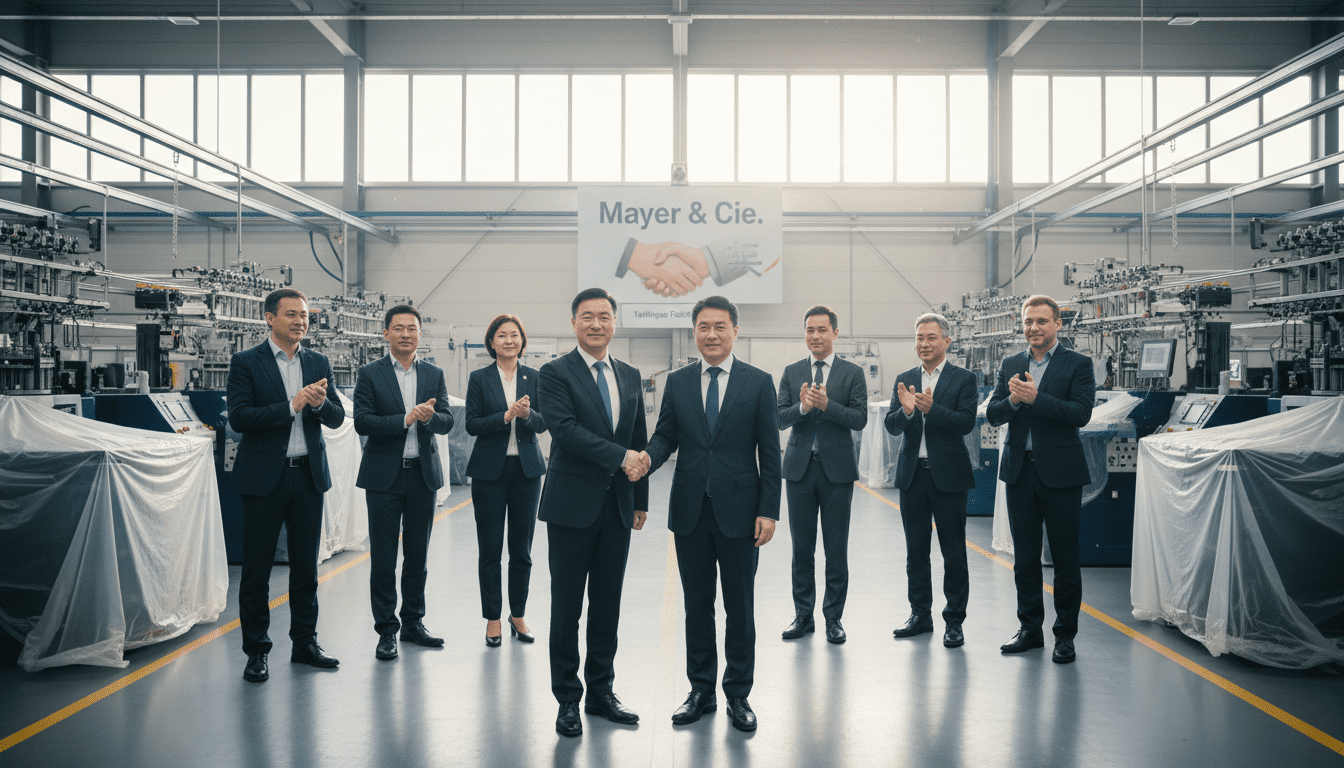
Mayer & Cie takeover: Chinese entrepreneur Xu Hongjie completes purchase to save historic Swabian machine maker
Chinese investor buys Mayer & Cie in Tailfingen, pledging to keep production and development on the Schwäbische Alb while restarting operations and rehiring staff.
Xu Hongjie, a 32-year-old machine-builder from Shishi, China, has completed the Mayer & Cie takeover, acquiring the assets of the 120-year-old knitting-machine manufacturer based in Tailfingen. The purchase, agreed in February and finalized in mid‑April after regulatory approvals, comes after the company filed for insolvency last autumn and faced imminent closure. Xu has said he will keep production and development in Tailfingen and plans to restart manufacturing in May with a reduced workforce.
Investor from Shishi steps in
Xu Hongjie is the sole owner of Huixing Machine Co., Ltd., the family business that operates textile‑machine production in Shishi and employs more than 1,000 people, according to company statements. He arrived in Tailfingen in December after hearing that Mayer & Cie. had run out of options and immediately began assessing the factory and its workforce. His family travelled from China to inspect the plant, and initial talks culminated in a commitment to pursue a takeover.
Xu has framed the Mayer & Cie takeover as both a rescue and a strategic move to add a high‑end product line to his group’s portfolio. He told local officials and staff that production and research and development would remain on the Schwäbische Alb, and that he intends to integrate Mayer & Cie.’s premium machines with his group’s lower‑cost offerings.
Last‑minute rescue and sale timeline
Company representatives and insolvency counsel say negotiations accelerated in early 2026. A purchase agreement for Mayer & Cie.’s assets was signed on February 10, and the transaction was completed in mid‑April after the required approvals were granted by German and Chinese authorities. The takeover followed an aborted deal from a Swiss investor and a period in which Mayer & Cie. had already issued termination notices to about 300 employees at the Tailfingen site.
Local managers describe the factory as orderly and well maintained despite the insolvency, a factor that convinced Xu to proceed. Longstanding production staff and managers held out hope through a tense winter while the investor due diligence and regulatory clearances were completed.
Workforce, contracts and working conditions
Xu plans to resume production with roughly 130 employees, significantly fewer than the pre‑insolvency headcount but more than the alternative of a complete shutdown. The company has said it will rehire staff at their previous gross pay levels, but under different conditions: the new Mayer & Cie. Global will not follow the IG Metall collective agreement and will institute a 40‑hour workweek instead of the former 35‑hour tariff week, with no separate holiday or Christmas bonuses.
Management and municipal officials emphasize that rehiring former employees already in new jobs will be part of the restart, noting some workers have returned out of loyalty to the brand. The reduced staff size and altered terms reflect both short‑term cost containment and the investor’s stated aim to reshape cost structures for long‑term viability.
Local government and community reaction
Albstadt’s mayor, Roland Tralmer, initially met the new owner with caution and said public skepticism lingered about the Mayer & Cie takeover. Residents and local leaders asked whether the acquisition would lead to technology transfer and plant closure or whether it would truly secure jobs at the Tailfingen site. After meetings and visits, the mayor says trust is gradually forming, though he remains watchful about the investor’s long‑term intentions.
Town officials have underscored the importance of preserving local employment and know‑how. The municipal administration has engaged with company management to monitor commitments on production, staffing and investment in the facility’s future.
Competitive pressures that triggered insolvency
Former owners and industry representatives attribute Mayer & Cie.’s decline to intense price competition from subsidized Chinese manufacturers and structural shifts in the fashion industry, including the rapid rise of ultra‑fast fashion that favors low‑cost equipment. Mayer & Cie.’s reported annual sales fell sharply from about €110 million in 2022 to roughly €50 million in the insolvency year, reflecting steep revenue erosion.
German industry observers, including representatives at the VDMA machinery association, note that some Chinese competitors have been able to grow by offering machines that are “good enough” at a much lower price point. Those dynamics forced legacy producers to reconsider product complexity, cost structures and customer segmentation.
Turnaround strategy and remaining challenges
Xu has signalled a two‑track approach: preserve Mayer & Cie.’s high‑end brand and engineering capacity in Tailfingen while leveraging his group’s lower‑cost production capabilities from China to address different market segments. He has urged faster decision making and operational discipline at the German plant and cited the need to reduce “overengineering” that may have priced the company out of critical markets.
Nevertheless, the path to recovery is narrow. The firm must restore customer trust, adapt to pricing pressures, and demonstrate that the Mayer & Cie takeover will protect local jobs over the medium term. Rebuilding order books for high‑precision, premium knitting machines will require focused sales efforts and credible delivery schedules.
Local managers and employees have expressed cautious optimism, while industry experts stress that German manufacturers must balance quality with cost competitiveness. Xu’s willingness to live in Tailfingen and bring his family to the region underscores his stated commitment, but the ultimate test will be whether the revived Mayer & Cie. can regain market share without sacrificing the skilled workforce and engineering reputation built over more than a century.
The coming months will show whether the Mayer & Cie takeover secures a sustainable future for the Tailfingen plant and whether a Chinese owner can reconcile competitive realities with the social and industrial expectations of a historic Swabian manufacturer.
