
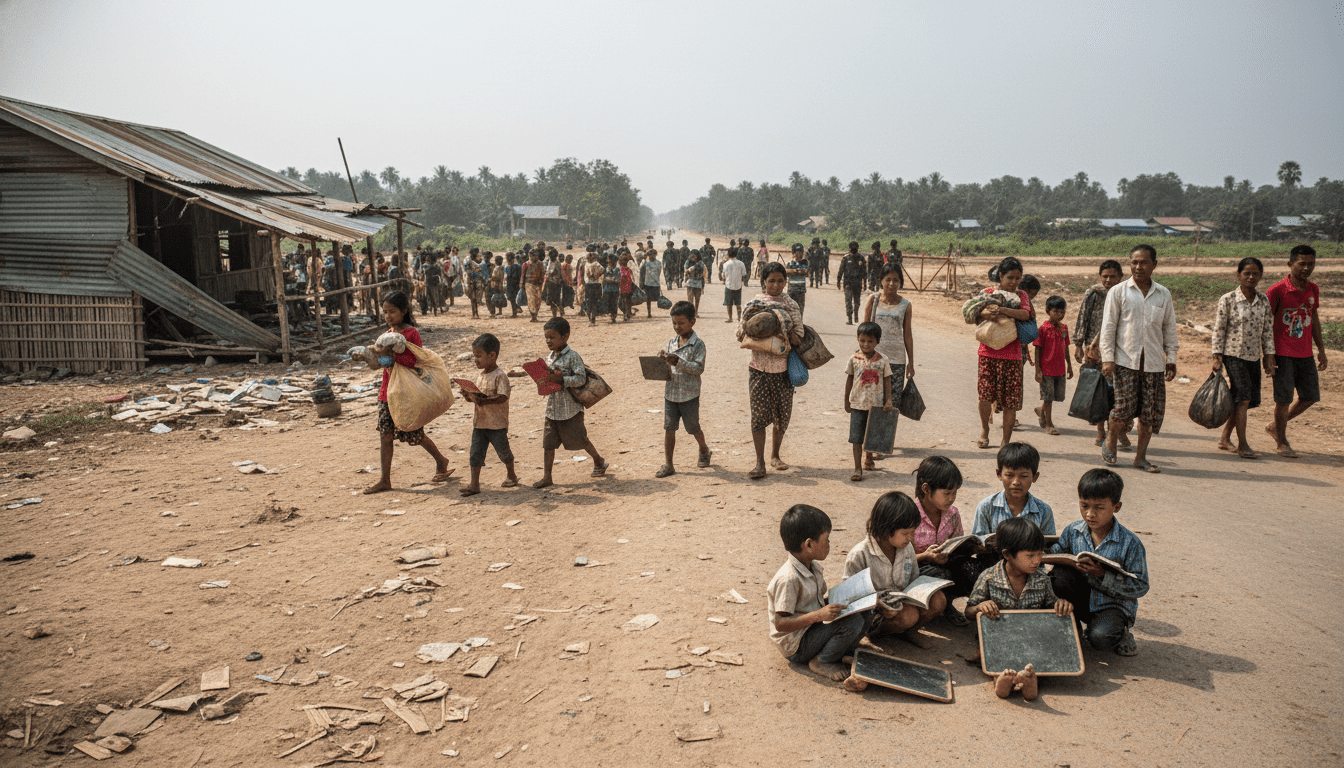
Cambodia displacement camps leave more than 34,000 people living in limbo after Thailand border fighting
Thousands remain in Cambodia displacement camps as families face unstable shelter, disrupted schooling, and restricted access to frontline homes after cross-border clashes.
The conflict between Thai and Cambodian forces has left more than 34,440 people sheltering in Cambodia displacement camps as of May 2026, the Ministry of Interior reports, with 11,355 of them children. Many families live in emergency tents on pagoda grounds or in government-built stilt houses, but uncertainty over security, access and services continues to shape daily life.
More than 34,000 remain displaced in camps
Official tallies show at least 34,440 people displaced inside Cambodia as of May 2026, including more than 11,300 children, according to the country’s Ministry of Interior. These figures reflect civilians who fled frontline villages during two rounds of cross-border clashes in July and December 2025.
Displacement is clustered in provinces along the Thai border, including Preah Vihear, Siem Reap and Banteay Meanchey, where camps have been set up at Buddhist pagodas and other communal sites. Government counts and local aid agencies say the numbers have fallen only gradually as limited resettlement and ongoing security concerns slow returns.
Camp life: daily routines and precarious shelters
At displacement sites such as Wat Bak Kam and Wat Chroy Neang Ngourn, families live under blue tarps or in tents reportedly supplied by foreign aid, while some have transitioned into wooden stilt houses built by Cambodian authorities. Daily life is shaped by basic chores and the strain of crowded, temporary conditions, with children often taking on responsibilities to help their families.
Residents describe a mixture of emergency assistance and shortfalls: food and blankets are available through donations, but sanitation, privacy and livelihoods remain fragile. Older residents who try to tend fields or retrieve personal belongings face access restrictions and the risk of encountering military patrols near the frontier.
Education disrupted for thousands of children
School attendance among displaced children is fragmented, humanitarian workers and parents say, with primary pupils sometimes able to join local classes but older students forced to travel long distances. High schoolers in some camps must make daily journeys of roughly 15 kilometres to provincial centres, a trip rendered more difficult by rising fuel costs.
WorldVision technical lead Kinmai Phum warned that dropout rates and absenteeism are climbing as displacement, inadequate learning spaces and trauma combine to push children out of school. Parents report children returning home preoccupied with rumours of renewed fighting, undermining concentration and attendance.
Movement restrictions and new frontline barriers
Villages near the border have been transformed by military measures, with Thai forces reportedly installing shipping containers and barbed wire to block access to areas once inhabited by Cambodian families. Those physical barriers, residents say, have hardened a de facto frontier and limited the ability of displaced people to return and harvest crops.
Cambodian authorities have also maintained restrictions on returning to highly militarised frontline zones, citing security concerns. Farmers such as 67-year-old Sun Reth say they are prevented from sleeping in their homes or collecting cashew nuts, eliminating a small but vital source of income.
Aid response, resettlement and gaps in support
Humanitarian organisations and the Cambodian government have provided a mix of emergency aid and construction of temporary stilt houses, yet agencies acknowledge significant gaps in education, mental health services and livelihoods support. Aid workers say donations keep many families afloat, but sustainable solutions are limited while security remains uncertain.
Rising operational costs and regional tensions complicate assistance. Fuel price increases tied to broader geopolitical instability have reduced mobility for students and aid distributions, and local authorities warn that prolonged displacement could entrench poverty and reduce the likelihood that children return to formal schooling.
Voices from the border reflect exhaustion and fear
Displaced residents express profound fatigue with repeated cycles of conflict and displacement, often referencing decades of violence in Cambodia’s modern history. Deputy village chief Soeum Sokhem described returning occasionally to his front-line home to check crops and neighbours, but admitted he now moves with fear, hearing gunfire that had previously been rare.
Parents recount nights of anxiety when relatives served on the front line, and say their children often wait by the phone for calls from fathers and brothers. For many displaced families, the psychological toll and the loss of routine have become as pressing as material needs.
Tensions remain high months after the December 27, 2025 ceasefire, and Cambodian officials warn that a lasting recovery will depend on durable security arrangements, expanded education and livelihood programs, and the gradual, safe reopening of access to frontline villages. The combination of physical barriers, military deployments and economic strain means that for tens of thousands living in Cambodia displacement camps, returning to normal life will require more than tents and temporary houses.
