
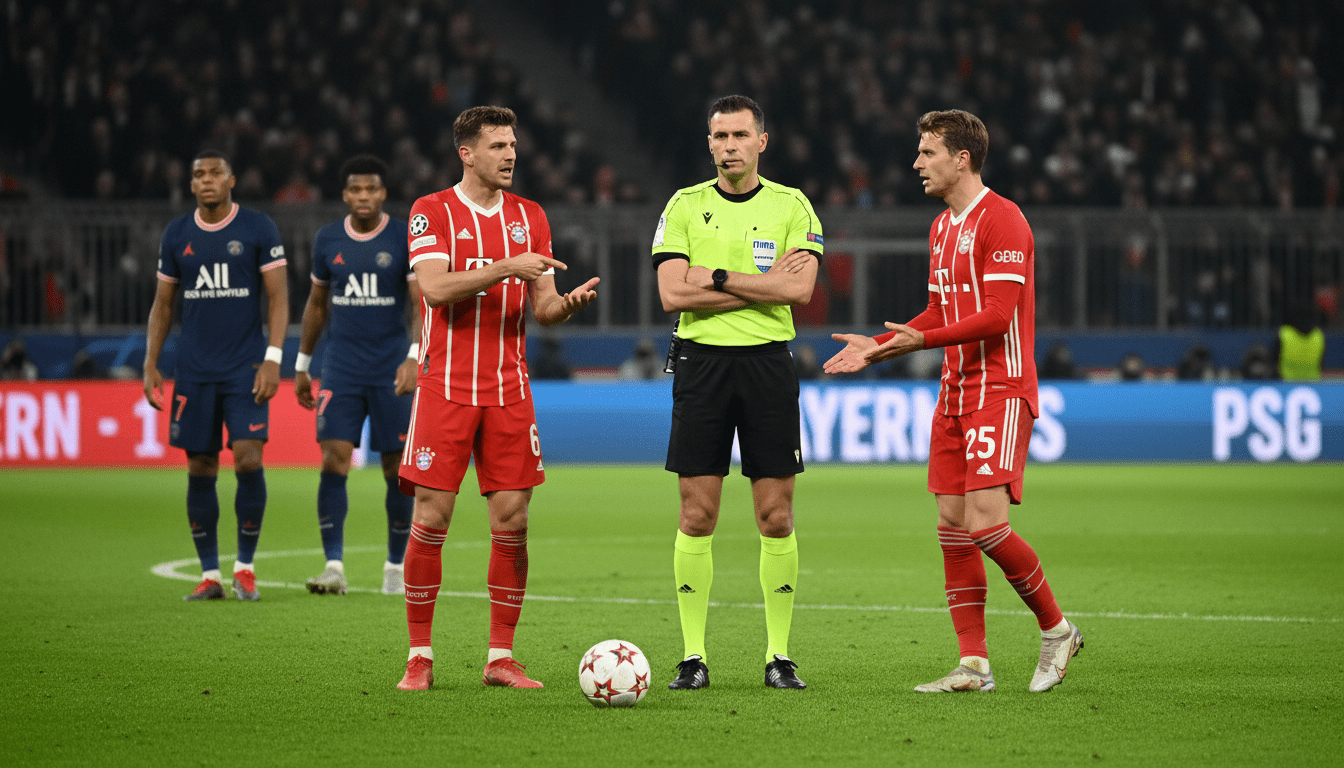
João Pinheiro decisions in Bayern 1-1 draw with PSG spark controversy
João Pinheiro decisions in Bayern’s 1-1 Champions League semi-final with PSG sparked debate after two handball incidents that did not result in penalties.
The Portuguese referee João Pinheiro drew intense scrutiny after Bayern Munich’s 1-1 Champions League semi-final second-leg draw with Paris Saint-Germain, when two handball incidents in quick succession were handled without spot-kicks. The first sequence involved a challenge with Konrad Laimer and a later handball by Nuno Mendes in the 29th minute, while two minutes later Vitinha’s effort deflected onto teammate João Neves’ arm inside PSG’s penalty area. Both calls — and the lack of a penalty award — set off immediate discussion among players, observers and pundits.
Sequence of events in the 29th minute
In the 29th minute a contested play saw Bayern’s Konrad Laimer entangled with PSG defenders, prompting referee João Pinheiro to flag a handball by Laimer. That decision appeared to influence the immediate follow-up, when PSG full-back Nuno Mendes clearly contacted the ball with his hand moments later. Match footage showed the two incidents occurring in rapid succession, leaving little separation between the initial whistle and the subsequent handball by Mendes.
The Vitinha shot and the hand on João Neves
Two minutes after the Laimer-Mendes episode, PSG midfielder Vitinha fired a ball into the penalty area that struck the extended arm of teammate João Neves. From several viewing angles, the contact with Neves’ arm looked significant and within the defined penalty area, prompting Bayern players to appeal vigorously for a penalty. Referee João Pinheiro did not point to the spot, and the play continued with no intervention that altered the match score.
Immediate reactions from players and benches
Bayern players and staff voiced visible frustration on the touchline after the incidents, while PSG personnel appeared to support the referee’s on-field assessment. The on-pitch response from both teams was audible and animated, with Bayern players gesturing and seeking clarification from officials. Coaches and substitutes clustered at the side as the match resumed, underscoring how pivotal those minutes felt amid a tightly contested semi-final.
Broadcast replays and public debate
Television replays circulated quickly on social media and in sports programming, feeding a broader public debate about the decisions. Analysts parsed frame-by-frame footage to assess whether the ball-to-arm contacts met the criteria for handball under the Laws of the Game. The sequence generated commentary about consistency in refereeing interpretations, particularly in high-stakes Champions League fixtures where margins are slim and every call carries weight.
Broader implications for refereeing standards
The incidents have reignited longstanding questions about how handball is adjudicated at elite level matches, and whether current guidelines yield uniform outcomes in comparable situations. Refereeing panels and governing bodies have emphasized case-by-case judgment, but contentious moments such as these often prompt calls for clearer protocols or additional review mechanisms. For clubs and supporters, the episode underscored the enduring tension between human refereeing discretion and expectations for procedural consistency.
The controversy surrounding João Pinheiro decisions in this semi-final leg is likely to be a talking point as UEFA and refereeing stakeholders review the match. Officials may analyze both the initial Laimer call and the subsequent contacts to determine whether the correct application of the rules occurred. For Bayern and PSG, the immediate competitive consequences are fixed in the result; for the wider game, the episode adds fuel to ongoing debates about interpretation and technology.
Observers will be watching subsequent UEFA communications and post-match reports for any clarifications or explanations about the incidents. Parties involved typically release statements through clubs or officiating bodies when disputed decisions attract significant attention. Whatever follow-up occurs, the sequence of events in those key minutes will remain a focal point in assessments of refereeing performance in this Champions League semi-final.
Public discussion and media analysis are expected to continue in the days following the match as replays and expert breakdowns circulate. Supporters, commentators and former players will likely revisit the footage in search of consensus, while referees’ unions and governing bodies weigh how such episodes affect perceptions of fairness. The debate also serves as a reminder of how single decisions can shape narratives in major European ties.
The Bayern-PSG semi-final produced a tightly contested 1-1 draw that will be remembered as much for the on-field drama as for the questions it raised about officiating. Many viewers and stakeholders will now await formal statements or match reports that clarify the rationale behind the calls that defined those crucial minutes.
