
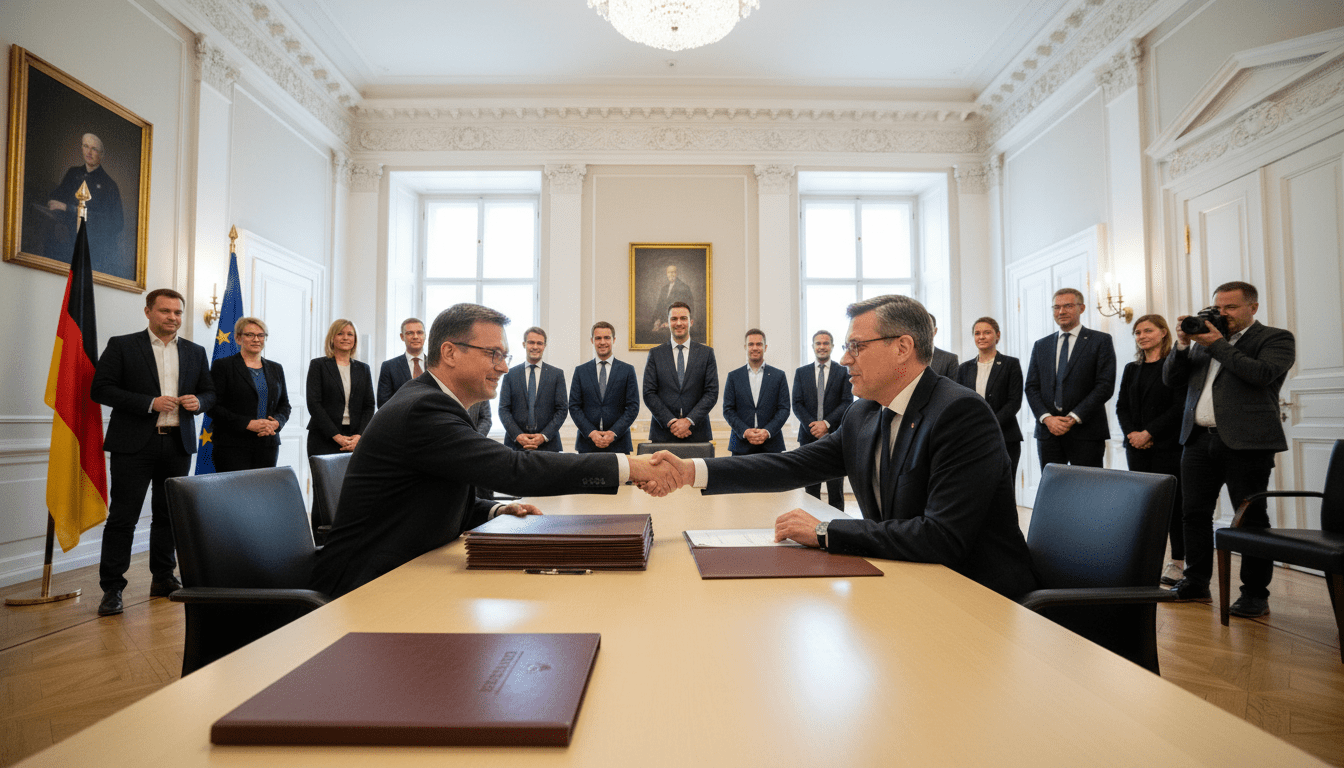
CDU-SPD coalition agreement ratified as parties secure comfortable two‑thirds majority
CDU-SPD coalition agreement ratified after talks; partners hold a two‑thirds majority. SPD pledges a systematic review of its election defeat while CDU’s imprint is visible across the pact.
The CDU-SPD coalition agreement was ratified on Monday after what party officials described as constructive negotiations, giving the partners a comfortable two‑thirds majority to elect the new minister-president. Schnieder hailed the outcome as a joyful milestone and framed the agreement as the start of an active governing partnership that will face “all that lies ahead.” Negotiations were limited to CDU and SPD because other parliamentary combinations were mathematically impossible, and both parties have ruled out any cooperation with the AfD.
Schnieder frames the coalition as a fresh start
Schnieder told delegates he was “incredibly happy and glad,” portraying the coalition deal as both a personal and political milestone after lengthy talks. He said that, after 35 years in politics in various roles, building mutual trust had been essential and that the agreement now reflects a readiness to govern together. The tone from CDU leadership emphasized confidence that the pact provides a clear direction for the next legislative term. Party spokespeople noted they expect swift movement from agreement to implementation in policy areas outlined in the text.
Coalition agreement carries a CDU imprint
Officials acknowledged the negotiated contract bears a distinct CDU signature in key sections, reflecting the party’s leverage as the largest force emerging from the March 22 election. CDU negotiators insisted on provisions they argued were necessary to address fiscal and administrative priorities, and those elements are prominent in the document. SPD representatives accepted the CDU’s imprint while highlighting retained policy areas where they secured influence. Together, the partners presented the pact as a compromise that balances differing programmatic priorities.
SPD leaders vow systematic review of election loss
SPD chair Sabine Bätzing‑Lichtenthäler and party leader Schweitzer urged members simultaneously to endorse the coalition and to confront the party’s poor electoral showing. Both promised a methodical review of the defeat, with Bätzing‑Lichtenthäler saying the party must “rub the wound” open to ensure it heals properly. Schweitzer described the result as “far too weak” for a party that still shares governing responsibility, and he fought back emotion as he acknowledged the damage to the SPD brand nationally. The leadership indicated the review will examine national party strategy alongside regional campaign execution.
Finance ministry remains contested but retained by SPD
One of the more sensitive elements in the negotiations was control of the finance ministry, a portfolio the SPD will keep under the terms of the agreement. SPD spokesmen framed the retention as an assurance that the party will remain an indispensable partner in fiscal policy and legislative bargaining. Schweitzer stressed that the SPD will not be sidelined by its larger partner and vowed the party would act as a “strong, self-confident and shaping partner” within the coalition. CDU negotiators, for their part, signaled they expect cooperation on budgetary restraint and administrative reform.
Electoral shift: CDU strongest for first time in 35 years
The March 22 election produced an historic shift when the CDU emerged as the strongest party in the state parliament for the first time in 35 years, a reality that set the parameters for the coalition talks. That result left few arithmetic options in the new Landtag and focused bargaining on a single feasible partnership between CDU and SPD. Party officials from both camps acknowledged the unusual political moment and framed the coalition as a pragmatic response to voters’ signals. Observers say the new balance will test how two traditionally rival parties manage the transition from opposition dynamics to shared governance.
Parties explicitly exclude AfD and prepare for minister-president vote
Both CDU and SPD reiterated a categorical rejection of any alliance with the AfD, casting the CDU‑SPD coalition as the only legitimate governing option compatible with their stated democratic principles. The two parties now hold a solid majority—well over two‑thirds—positioning them to elect their chosen candidate as minister-president without relying on external support. With ratification complete, preparatory steps for the minister-president vote are expected to move quickly, and both sides described a shared interest in providing governmental stability. Negotiators emphasized that the coalition will pursue a policy agenda intended to be visible to voters and designed to yield tangible results.
The newly ratified CDU‑SPD coalition agreement signals a period of cooperative government marked by pragmatic compromise and a commitment from both partners to govern decisively while the SPD undertakes a candid assessment of its electoral performance.
