
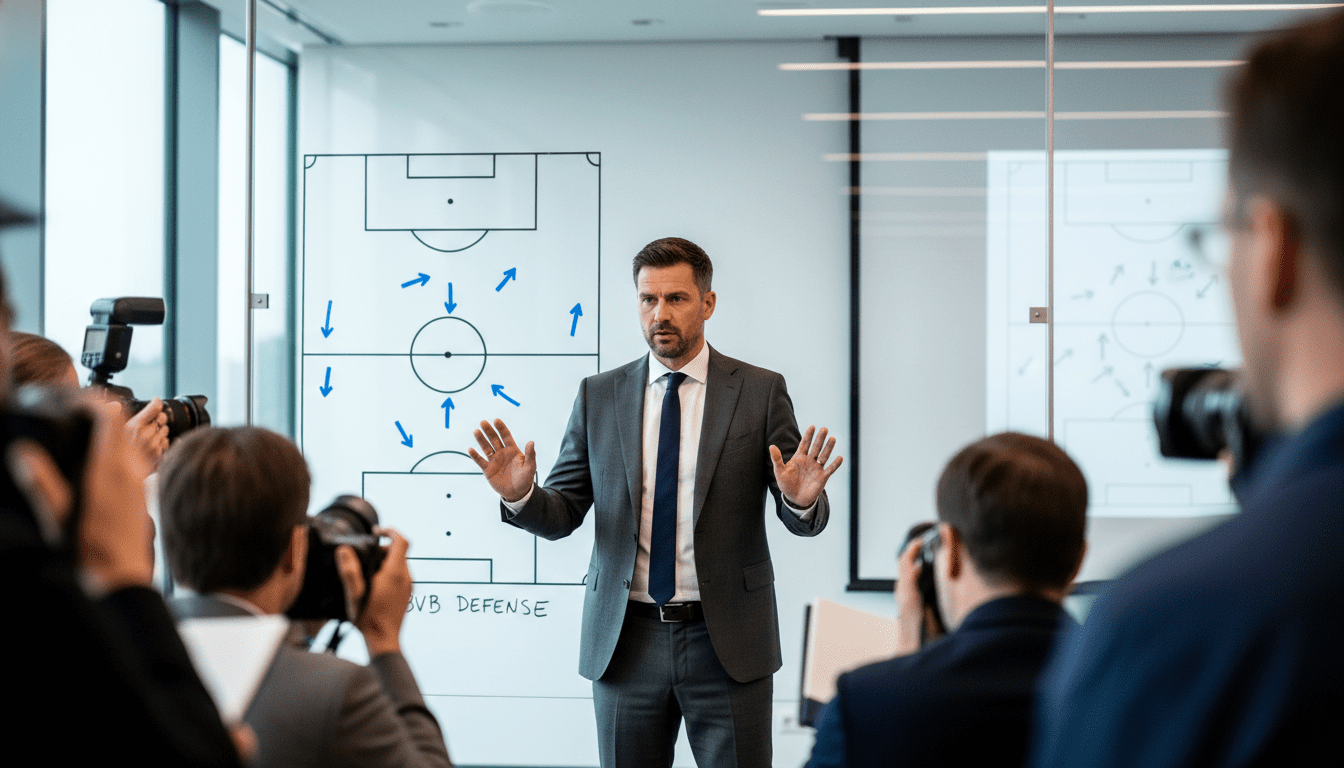
Niko Kovač Emphasizes Defensive Stability and Collective Responsibility at BVB
Niko Kovač tells how he is reshaping Borussia Dortmund’s approach, stressing defensive stability, player accountability and high physical standards to close the gap with Bayern.
Borussia Dortmund coach Niko Kovač laid out key principles of his work on May 2, 2026, describing a clear emphasis on defensive organisation and the need to connect with every player in the squad. He argued that consistent running and physical effort are measurable indicators of a team’s value and competitiveness. Kovač also suggested practical tactical adjustments that, he believes, could enable Dortmund to contest Bayern Munich more effectively in the title race.
Kovač on reaching every player
In the interview Kovač said successful coaching requires communication tailored to individual players rather than a single method for all. He warned that some professionals adopt a narrow mindset and that part of a coach’s job is to broaden their perspectives and responsibilities. Kovač described concrete steps he uses to ensure messages land across the dressing room, from one-on-one conversations to role-specific drills.
He stressed that psychological connection matters as much as tactical instruction because buy-in determines whether principles are implemented on match day. The coach indicated that fostering shared responsibility reduces individual lapses and creates the collective discipline he wants to see on the pitch. Those leadership practices underpin the defensive profile he is building at the club.
Defensive stability as a central principle
Kovač framed defensive stability not as an aesthetic choice but as a foundation for attacking freedom and consistency. He argued that when a team is compact and disciplined at the back, creative players gain the security to take offensive risks without exposing the side to counterattacks. According to Kovač, this balance aligns with long-term club objectives and can be adapted to Dortmund’s traditional emphasis on proactive football.
He acknowledged questions about style compatibility but countered that principles and identity can coexist when applied with clarity and coherence. Tactical training, set-piece organisation and clear defensive triggers are being prioritised to reduce the kinds of mistakes that cost points in tight matches. This, he said, is essential if Dortmund are to maintain pressure in a season-ending sprint.
Measuring effort: running and team value
Kovač made a direct link between physical output and the economic and sporting value of a squad, asserting that running statistics reflect commitment and tactical discipline. He pointed to internal metrics used by coaches and analysts that track distance covered, high-intensity sprints and positional work as objective indicators of collective effort. For Kovač, those numbers are not the whole story, but they provide a reliable baseline for evaluating whether principles are being turned into action.
The coach suggested that teams with higher physical benchmarks tend to perform more consistently because they sustain pressing structures and recover quickly after turnovers. He also stressed that physical preparation must be intelligent; conditioning supports tactical plans rather than substituting for technical or cognitive shortcomings. The emphasis on measurable output has led to specific workloads and recovery programmes tailored to the squad.
Tactical adjustments for a title challenge against Bayern
Kovač outlined pragmatic tactical ideas Dortmund could deploy to contest Bayern Munich, focusing on minimising individual errors and exploiting transitional moments. He recommended sharpening collective defensive movements to prevent Bayern’s attacking stars from finding space between the lines. The coach argued that compactness in midfield and precise pressing triggers would increase Dortmund’s chances in head-to-head fixtures.
He also discussed set pieces and quick counter transitions as areas where Dortmund can gain marginal advantages, saying that targeted preparation for Bayern’s tendencies can pay dividends in high-stakes games. Kovač emphasized flexibility: game plans must be adaptable to opponent and circumstance while adhering to the team’s core principles. He believes that attention to detail and consistent application of defensive standards can tilt tight title contests.
Player responsibility within the system
Kovač repeated that individual accountability is central to his coaching philosophy and that players are expected to internalise their roles within the system. He highlighted leadership responsibilities across the squad, encouraging veterans to model behaviours and younger players to embrace positional discipline. According to Kovač, a shared code of conduct in training and matches reduces confusion and improves decision-making under pressure.
The coach described regular reviews of performance data with players to make expectations transparent and to identify areas for improvement. He also noted that responsibility extends beyond match days to recovery, preparation and diet, which together sustain the fitness levels he demands. Collective standards, Kovač said, become self-reinforcing when everyone understands how their contribution affects team outcomes.
Looking ahead, Kovač presented a picture of incremental progress rather than overnight transformation, emphasising that consistency will decide Dortmund’s ability to challenge for honours. He underlined that defensive solidity, clear communication and physical commitment are the building blocks of the project he is advancing at the club. If those elements cohere, Kovač believes Dortmund can both uphold their identity and close the gap on domestic rivals.
